Review
. 2016 Dec;21(12):1336-1353.
doi: 10.1007/s10495-016-1292-8.

Peripheral blood mononuclear cell secretome for tissue repair

Affiliations
Review

Peripheral blood mononuclear cell secretome for tissue repair

Lucian Beer et al. Apoptosis. 2016 Dec.

Abstract

For almost two decades, cell-based therapies have been tested in modern regenerative medicine to either replace or regenerate human cells, tissues, or organs and restore normal function. Secreted paracrine factors are increasingly accepted to exert beneficial biological effects that promote tissue regeneration. These factors are called the cell secretome and include a variety of proteins, lipids, microRNAs, and extracellular vesicles, such as exosomes and microparticles. The stem cell secretome has most commonly been investigated in pre-clinical settings. However, a growing body of evidence indicates that other cell types, such as peripheral blood mononuclear cells (PBMCs), are capable of releasing significant amounts of biologically active paracrine factors that exert beneficial regenerative effects. The apoptotic PBMC secretome has been successfully used pre-clinically for the treatment of acute myocardial infarction, chronic heart failure, spinal cord injury, stroke, and wound healing. In this review we describe the benefits of choosing PBMCs instead of stem cells in regenerative medicine and characterize the factors released from apoptotic PBMCs. We also discuss pre-clinical studies with apoptotic cell-based therapies and regulatory issues that have to be considered when conducting clinical trials using cell secretome-based products. This should allow the reader to envision PBMC secretome-based therapies as alternatives to all other forms of cell-based therapies.

Keywords: PBMC; Paracrine; Regenerative medicine; Secretome; Tissue regeneration.


Conflict of interest statement

The Medical University of Vienna has claimed financial interest. Aposcience AG holds patents related to this work (EP20080450198 and EP20080450199). HJA is a shareholder of Aposcience AG. All other authors declare no potential conflicts of interest.

Figures
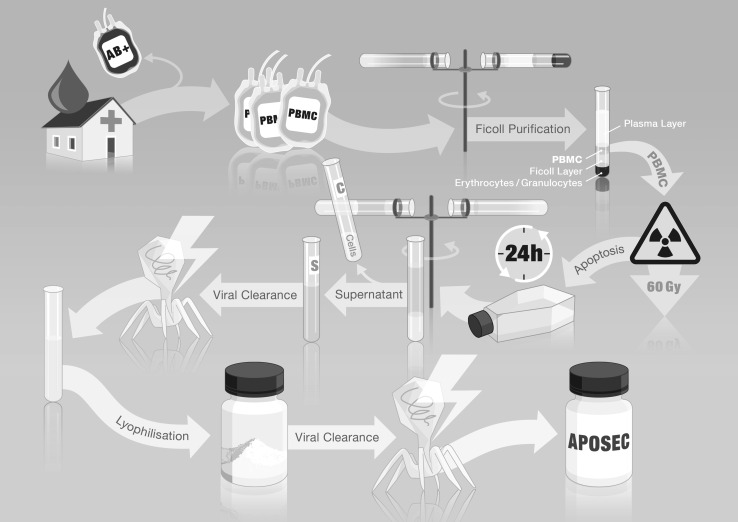
Fig. 1
Fig. 1
Schematic workflow of the preparation of apoptotic PBMC secretome. PBMC-enriched blood bags are obtained by blood banks and used for the generation of paracrine factors. The PBMCs are further purified using Ficoll-paque centrifugation. Apoptosis is induced by 60 Gy gamma-irradiation. The PBMCs are then cultivated at 37 °C in 5 % CO/5 % CO2 for 24 h. The cells are removed by centrifugation and ultrafiltration. The remaining cell culture supernatant containing the paracrine factors is subjected to methylene blue viral clearance. The viral cleared supernatant is then lyophilized to remove all soluble factors. The remaining solid compartments are subjected to a second viral clearance step and irradiated with 30k Gy, eventually yielding the final product produced in accordance with GMP
Fig. 2
Fig. 2
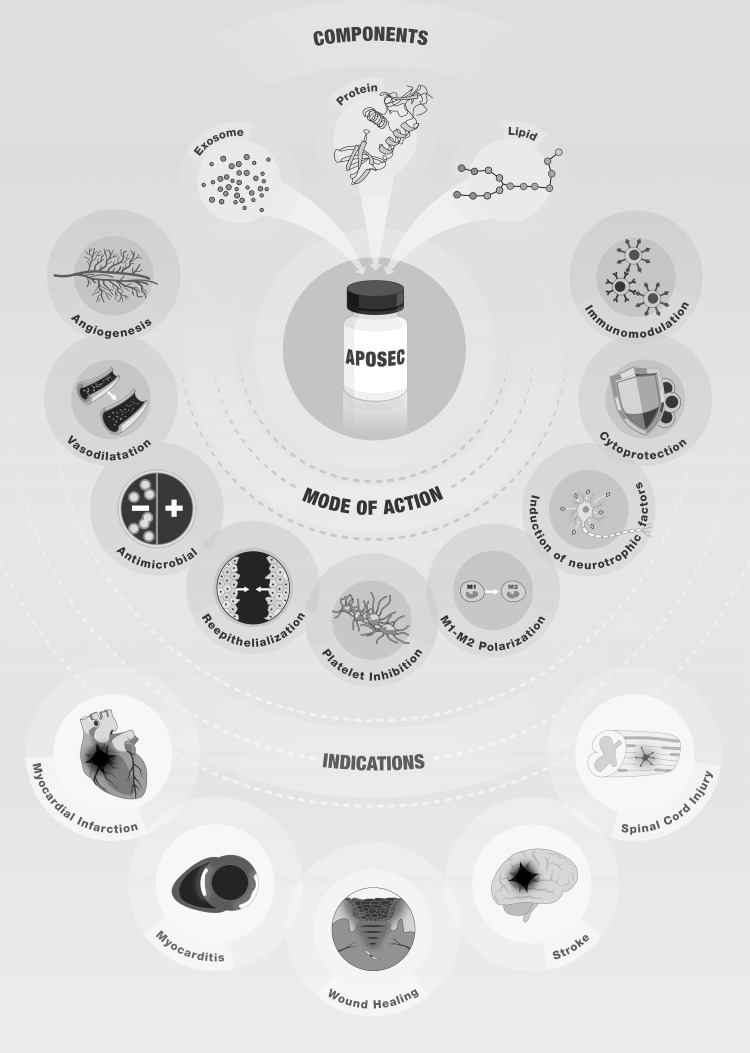
Components, mode of action, and indication of paracrine factor-based therapies. The cell secretome consists of multiple paracrine factors that can be categorized into different biological classes. The best investigated components are proteins, lipids, and exosomes, which have been shown to exhibit in vitro and in vivo biological activity. Due to the complexity of paracrine factors present in the cell secretome, it is likely that other factors exert biological activity. Paracrine factors derived from apoptotic PBMCs have been shown to induce angiogenesis and vasodilation, exert antimicrobial activity, enhance re-epithelialization, inhibit platelet coagulation, induce M1–M2 polarization, augment the release of neurotropic factors, exhibit cytoprotective capacities due to the up-regulation of anti-apoptotic proteins, and act in an immunomodulatory manner. Based on these biological effects, the PBMC secretome has been successfully tested in animal models to treat acute myocardial infarction, chronic heart failure, myocarditis, skin ulcer, stroke, and spinal cord injury
Fig. 3
Fig. 3
Regulatory issues for cell-free therapies. To enable regulatory approval for testing paracrine factor-based therapy, several regulatory issues have to be fulfilled. First, cell-free therapies have to be discriminated from cell-based medicinal products (ATMP). ATMPs deal with living cells, whereas paracrine factor-based therapies, such as APOSEC™, contain only factors produced by living cells. In cell therapies, the mode of action is thought to be mediated by the cells or their paracrine factors, whereas in cell-free therapies multiple paracrine factors are thought to exert the biological activity. The starting material in both therapies are cells of human origin, either autologous or allogeneic. An important difference between these two types of therapies is that viral clearance is not possible in ATMPs, but viral clearance steps can be applied in cell-free therapies such as APOSEC™. In the right side of the figure, the different regulatory steps that have to be performed during the development of a cell-free therapy are depicted, starting from pre-clinical studies and leading to Phase I/Phase II studies
Fig. 4
Fig. 4
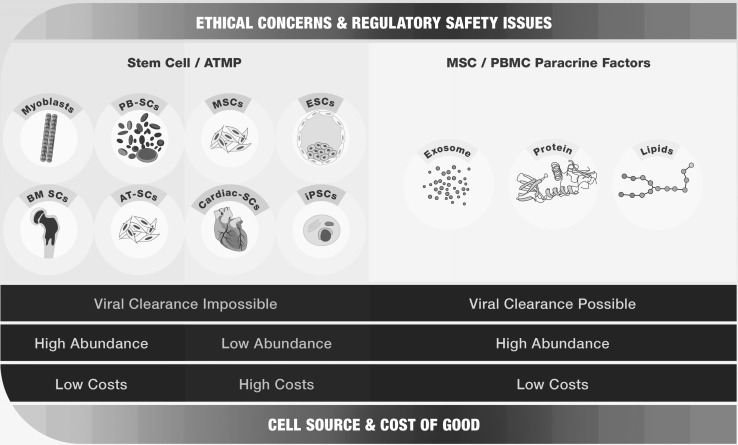
Ethical, economic, and safety considerations of stem cell-based and paracrine factor-based therapies. In contrast to stem cell-based therapies, paracrine factor-based therapies can be seen as an economic, ethical, and fully acceptable therapeutic strategy lacking significant safety issues and restrictions in production capacity. Viral clearance methods are not possible in stem cell-based therapies containing myoblasts, bone marrow stem cells (BM-SCs), peripheral blood stem cells (PB-SCs), adipose tissue-derived stem cells (AT-SCs), mesenchymal stem cells (MSCs), cardiac stem cells (Cardiac-SCs), embryonic stem cells (ESCs), and induced pluripotent stem cells (iPSCs). In addition, ESC- and iPSC-based therapies are associated with high costs for cell manufacturing and low cell numbers. Stem cell-based therapies with ESCs, and especially iPSCs, also have ethical and safety concerns because these cells have on embryonic source or bear a risk of malignant transformation. In contrast, paracrine factors derived from PBMCs or MSCs, including exosomes, proteins, and lipids, can be subjected to viral clearance methods, guaranteeing a viral-free medical drug. In addition, paracrine factors, especially from peripheral blood mononuclear cells (PBMCs), can be produced and stored in high amounts with low costs

References

    1. Niehans P. 20 Jahre Zellular-Therapie. Berlin: Urban & Schwarzenberg; 1952. - PubMed
    1. Rietschel H. Gefahren der Frischzellentherapie. Dtsch Med Wochenschr. 1954;79:1671–1673. doi: 10.1055/s-0028-1119943. - DOI - PubMed
    1. Rietschel H. Frischzellentherapie und ihre Gefharen. Wiener Med Wochenschr. 1955;46:949–957. - PubMed
    1. Maximow AA (1909) Der lymphozyt als gemeinsame stammzelle der verschiedenen blutelement in der embryonalen entwicklung und im postfetalen leben der säugetiere. Folia Haematologica 8
    1. Metchnikoff II. The prolongation of life: optimistic studies. New York: Springer; 2004.

Publication types