


Effect of Geriatric-Specific Trauma Triage Criteria on Outcomes in Injured Older Adults: A Statewide Retrospective Cohort Study
- PMID: 27696350
- PMCID: PMC5117430
- DOI: 10.1111/jgs.14376
Effect of Geriatric-Specific Trauma Triage Criteria on Outcomes in Injured Older Adults: A Statewide Retrospective Cohort Study
Abstract
Objectives: To evaluate the effect on outcomes of the Ohio Department of Public Safety statewide geriatric triage criteria, established in 2009 for emergency medical services (EMS) to use for injured individuals aged 70 and older.
Design: Retrospective cohort study of the Ohio Trauma Registry.
Setting: All hospitals in Ohio.
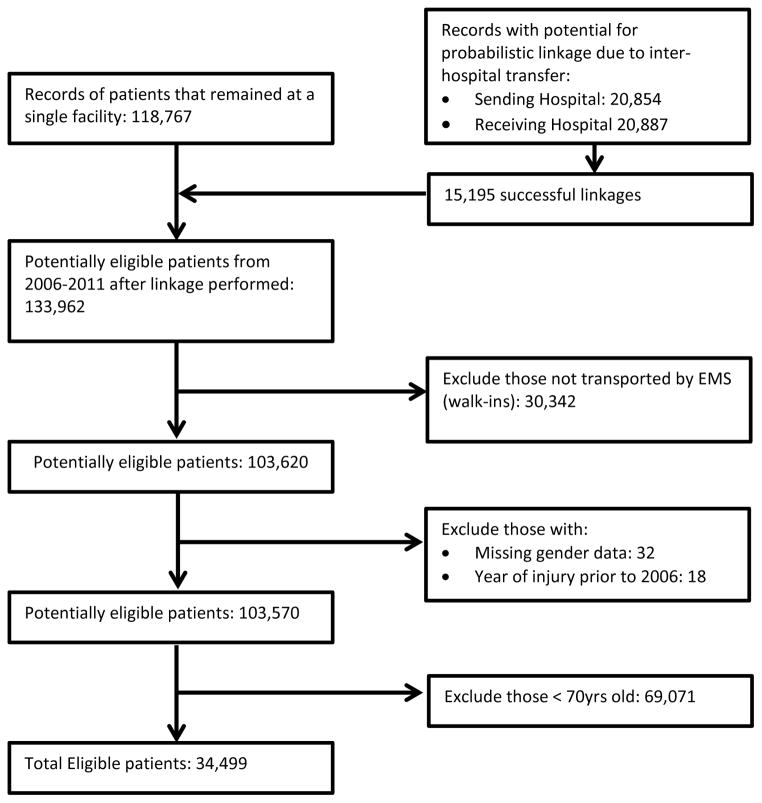
Participants: Individuals aged 70 and older in the Ohio Trauma Registry from January 2006 through December 2011, 3 years before and 3 years after criteria adoption (N = 34,499).
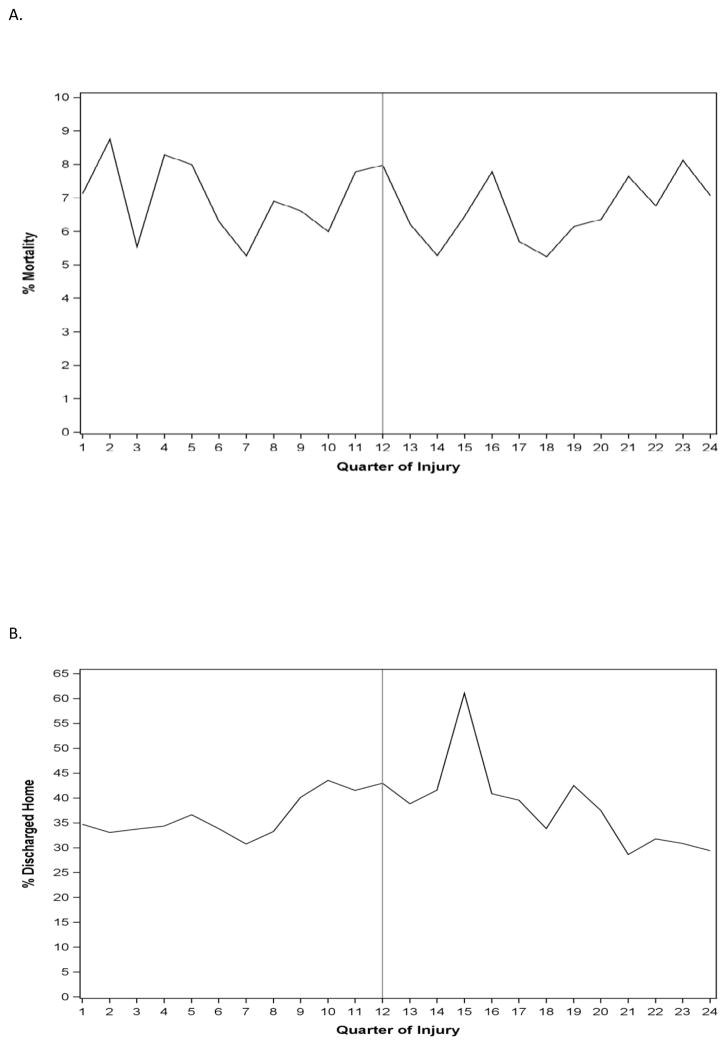
Measurements: Primary outcomes were in-hospital mortality and discharge to home. Criteria effects were assessed using chi-square tests, multivariable logistic regression, interrupted time series plots, and multivariable segmented regression models.
Results: After geriatric criteria were adopted, the proportion of older adults qualifying for trauma center transport increased from 44% to 58%, but EMS transport rates did not change (44% vs 45%). There was no difference in unadjusted mortality (7.1% vs 6.6%) (P = .10). In adjusted analyses, subjects with an injury severity score (ISS) less than 10 had lower mortality after adoption (3.0% vs 2.5%) (odds ratio (OR) = 0.81, 95% confidence interval (CI) = 0.70-0.95, P = .01). Discharge to home increased after adoption in the adjusted analysis (OR = 1.06, 95% CI = 1.01-1.11, P = .02). There were no time-dependent changes for either outcome.
Conclusion: Although the proportion of older adults meeting criteria for trauma center transport substantially increased with geriatric triage criteria, there were no increases in trauma center transports. Adoption of statewide geriatric triage guidelines did not decrease mortality in more severely injured older adults but was associated with slightly lower mortality in individuals with mild injuries (ISS <10) and with more individuals discharged to home. Improving outcomes in injured older adults will require further attention to implementation and use of geriatric-specific criteria.
Keywords: geriatric; trauma; triage.
© 2016, Copyright the Authors Journal compilation © 2016, The American Geriatrics Society.
Figures
Comment in
-
Prehospital Triage of Injured Older Adults: Thinking Slow Inside the Golden Hour.J Am Geriatr Soc. 2016 Oct;64(10):1941-1943. doi: 10.1111/jgs.14405. Epub 2016 Aug 24. J Am Geriatr Soc. 2016. PMID: 27556573 No abstract available.
References
-
- Keller JM, Sciadini MF, Sinclair E, et al. Geriatric trauma: demographics, injuries, and mortality. Journal of orthopaedic trauma. 2012;26:e161–5. - PubMed
-
- Bonne S, Schuerer DJ. Trauma in the older adult: epidemiology and evolving geriatric trauma principles. Clinics in geriatric medicine. 2013;29:137–50. - PubMed
-
- MacKenzie EJ, Morris JA, Jr, Smith GS, et al. Acute hospital costs of trauma in the United States: implications for regionalized systems of care. The Journal of trauma. 1990;30:1096–101. discussion 101–3. - PubMed
-
- Administration on Aging (AoA) [Accessed 04/21/2015];Projected Future Growth of the Older Population. at http://www.aoa.acl.gov/Aging_Statistics/future_growth/future_growth.aspx.
-
- Campbell JW, Degolia PA, Fallon WF, et al. In harm’s way: Moving the older trauma patient toward a better outcome. Geriatrics. 2009;64:8–13. - PubMed
Publication types
MeSH terms
Grants and funding
LinkOut - more resources
Full Text Sources
Other Literature Sources
Medical
