


Severity of experimental traumatic brain injury modulates changes in concentrations of cerebral free amino acids
- PMID: 27696676
- PMCID: PMC5323875
- DOI: 10.1111/jcmm.12998
Severity of experimental traumatic brain injury modulates changes in concentrations of cerebral free amino acids
Abstract
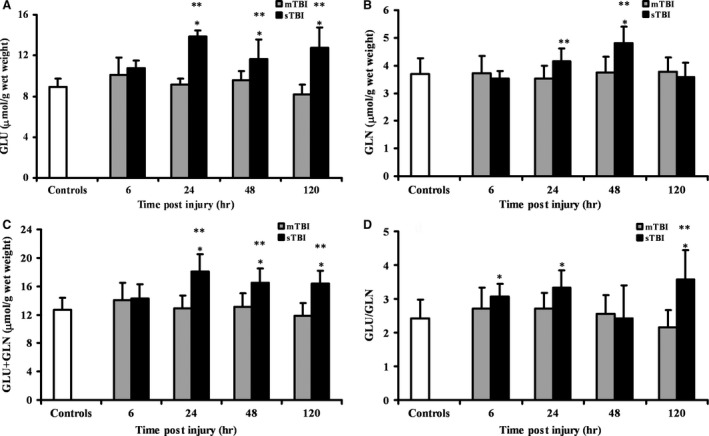
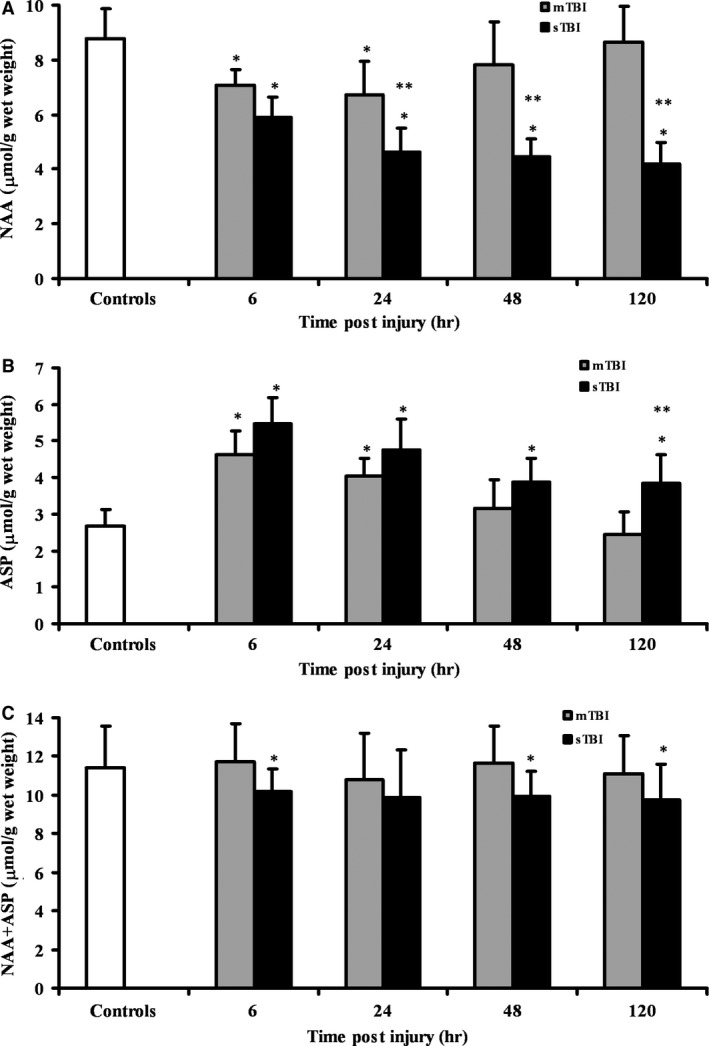
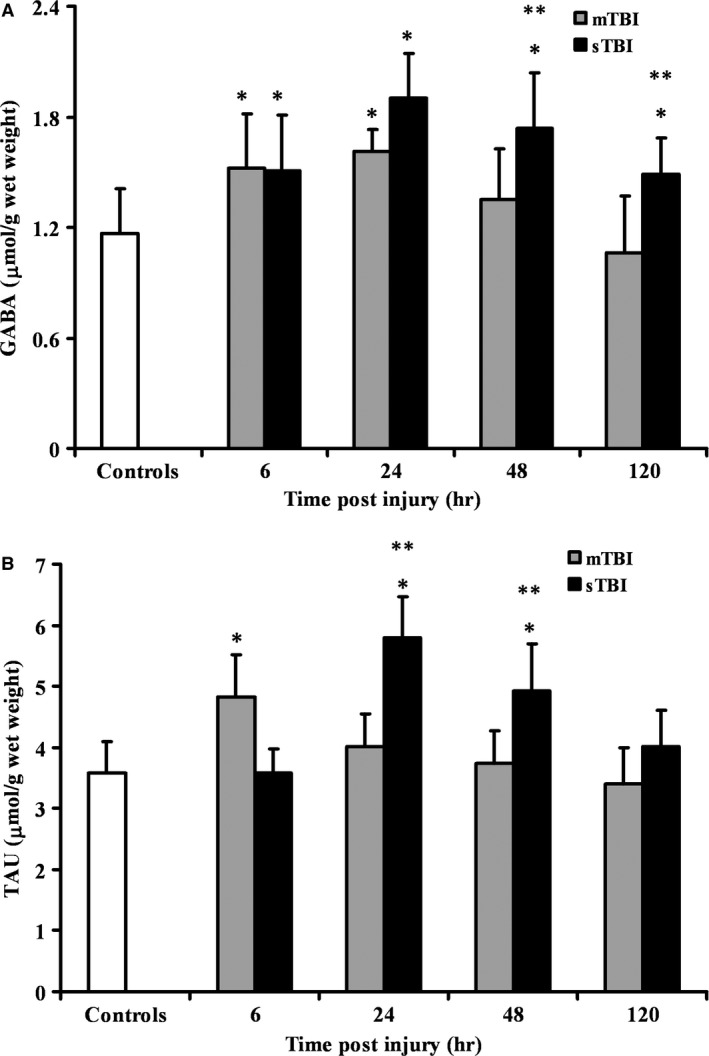
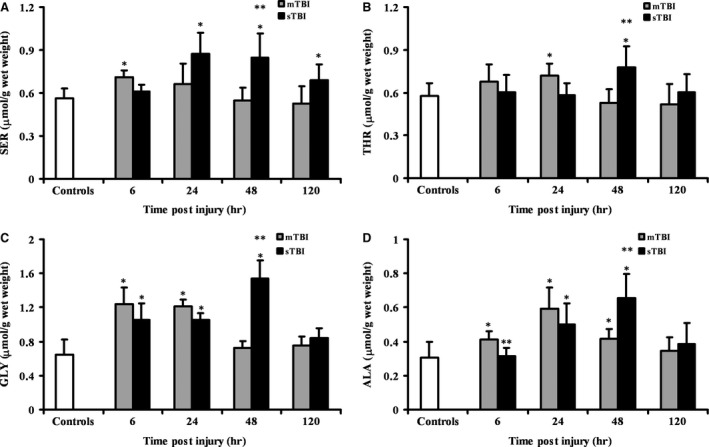
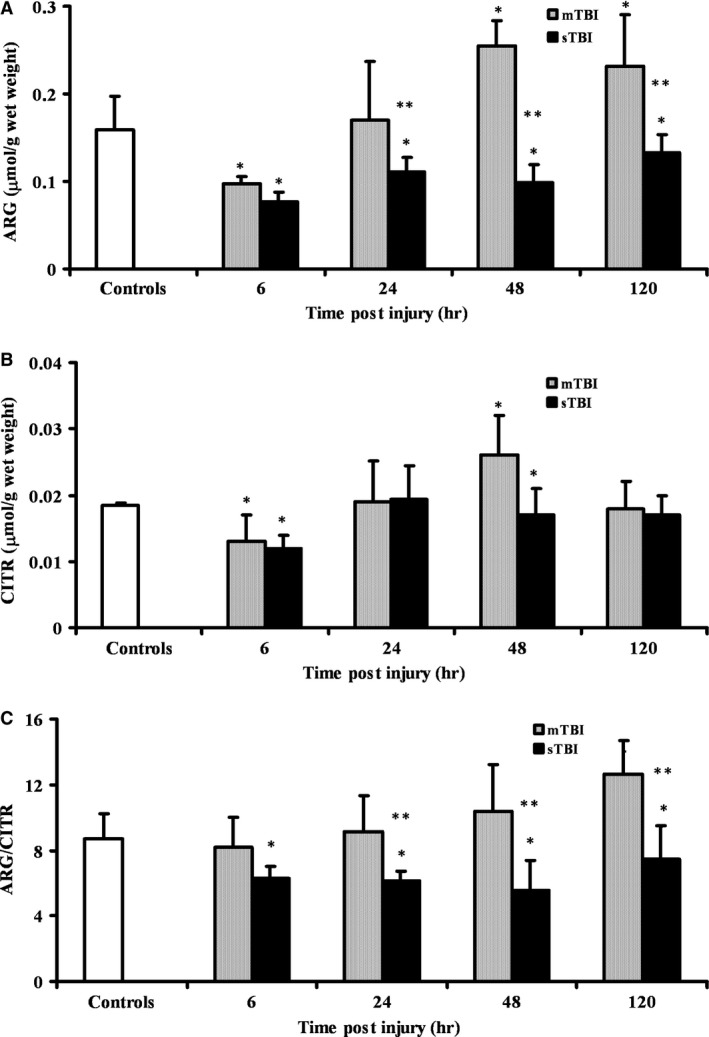
In this study, concentrations of free amino acids (FAA) and amino group containing compounds (AGCC) following graded diffuse traumatic brain injury (mild TBI, mTBI; severe TBI, sTBI) were evaluated. After 6, 12, 24, 48 and 120 hr aspartate (Asp), glutamate (Glu), asparagine (Asn), serine (Ser), glutamine (Gln), histidine (His), glycine (Gly), threonine (Thr), citrulline (Cit), arginine (Arg), alanine (Ala), taurine (Tau), γ-aminobutyrate (GABA), tyrosine (Tyr), S-adenosylhomocysteine (SAH), l-cystathionine (l-Cystat), valine (Val), methionine (Met), tryptophane (Trp), phenylalanine (Phe), isoleucine (Ile), leucine (Leu), ornithine (Orn), lysine (Lys), plus N-acetylaspartate (NAA) were determined in whole brain extracts (n = 6 rats at each time for both TBI levels). Sham-operated animals (n = 6) were used as controls. Results demonstrated that mTBI caused modest, transient changes in NAA, Asp, GABA, Gly, Arg. Following sTBI, animals showed profound, long-lasting modifications of Glu, Gln, NAA, Asp, GABA, Ser, Gly, Ala, Arg, Citr, Tau, Met, SAH, l-Cystat, Tyr and Phe. Increase in Glu and Gln, depletion of NAA and Asp increase, suggested a link between NAA hydrolysis and excitotoxicity after sTBI. Additionally, sTBI rats showed net imbalances of the Glu-Gln/GABA cycle between neurons and astrocytes, and of the methyl-cycle (demonstrated by decrease in Met, and increase in SAH and l-Cystat), throughout the post-injury period. Besides evidencing new potential targets for novel pharmacological treatments, these results suggest that the force acting on the brain tissue at the time of the impact is the main determinant of the reactions ignited and involving amino acid metabolism.
Keywords: N-acetylaspartate; cerebral free amino acids; excitotoxicity; high performance liquid chromatography; methyl-cycle; mild traumatic brain injury; severe traumatic brain injury.
© 2016 The Authors. Journal of Cellular and Molecular Medicine published by John Wiley & Sons Ltd and Foundation for Cellular and Molecular Medicine.
Figures
References
Publication types
MeSH terms
Substances
LinkOut - more resources
Full Text Sources
Other Literature Sources
Medical
Miscellaneous
