. 2016 Oct 18;113(42):11895-11900.
doi: 10.1073/pnas.1611028113. Epub 2016 Oct 3.

Environmental change explains cichlid adaptive radiation at Lake Malawi over the past 1.2 million years

Affiliations

Environmental change explains cichlid adaptive radiation at Lake Malawi over the past 1.2 million years

Sarah J Ivory et al. Proc Natl Acad Sci U S A. .

Abstract

Long paleoecological records are critical for understanding evolutionary responses to environmental forcing and unparalleled tools for elucidating the mechanisms that lead to the development of regions of high biodiversity. We use a 1.2-My record from Lake Malawi, a textbook example of biological diversification, to document how climate and tectonics have driven ecosystem and evolutionary dynamics. Before ∼800 ka, Lake Malawi was much shallower than today, with higher frequency but much lower amplitude water-level and oxygenation changes. Since ∼800 ka, the lake has experienced much larger environmental fluctuations, best explained by a punctuated, tectonically driven rise in its outlet location and level. Following the reorganization of the basin, a change in the pacing of hydroclimate variability associated with the Mid-Pleistocene Transition resulted in hydrologic change dominated by precession rather than the high-latitude teleconnections recorded elsewhere. During this time, extended, deep lake phases have abruptly alternated with times of extreme aridity and ecosystem variability. Repeated crossings of hydroclimatic thresholds within the lake system were critical for establishing the rhythm of diversification, hybridization, and extinction that dominate the modern system. The chronology of these changes closely matches both the timing and pattern of phylogenetic history inferred independently for the lake's extraordinary array of cichlid fish species, suggesting a direct link between environmental and evolutionary dynamics.

Keywords: adaptive radiation; cichlid evolution; paleoclimate; paleoecology; tropical climate.


Conflict of interest statement

The authors declare no conflict of interest.

Figures
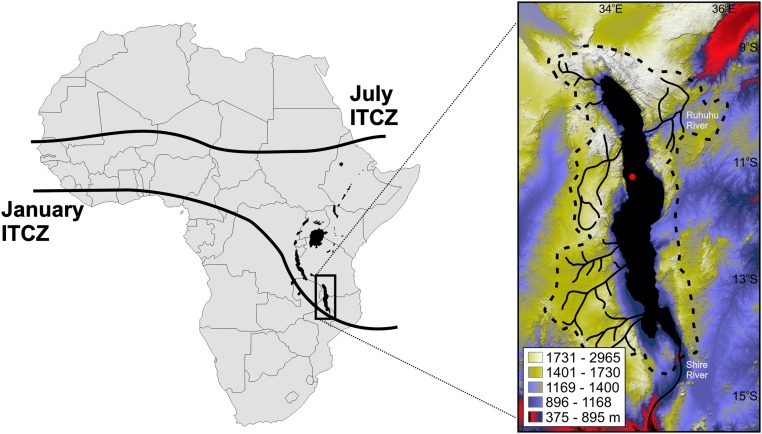
Fig. 1.
Fig. 1.
Map of Africa with the location of Lake Malawi with respect to July and January ITCZ positions. (Inset) Topographic map of Lake Malawi and its watershed, including the Ruhuhu River. The red dot indicates the core location.
Fig. 2.
Fig. 2.
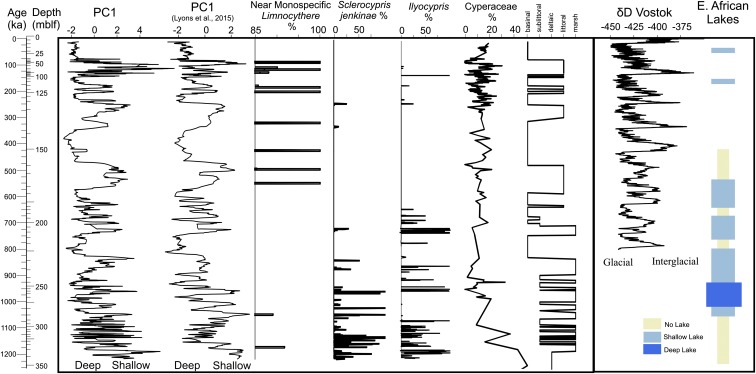
Lake Malawi paleoenvironments with global/regional records for the last 1.2 My. (Left to Right) First principal component of biogenic and mineralogical facies from MAL05-1B from this study, first principal component of physical properties (5) from MAL05-1B (both associated with lake-level variability), percent near monospecific Limnocythere ostracodes, percent S. jenkinae ostracodes, percent Ilyocypris ostracodes, percent Cyperaceae pollen (sedges), and inferred depositional environment from this study. Region/global records are δD from the Vostok ice core (39) and East African Rift Valley lake levels [adapted from Trauth et al. (26)]. mblf, Meters below lake floor.
Fig. 3.
Fig. 3.
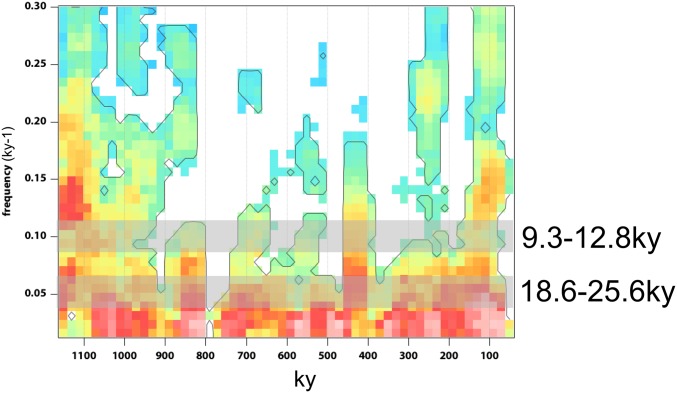
Evolutive spectrum of PC1 from core MAL05-1B using the multitaper mean method on 80-ky intervals with 20-ky steps. Color background is significant at 50% with 90% significance contour. Gray bars show precessional (18.6 to 25.6 ky) and suborbital frequencies (9.3 to 12.8 ky).
Fig. 4.
Fig. 4.
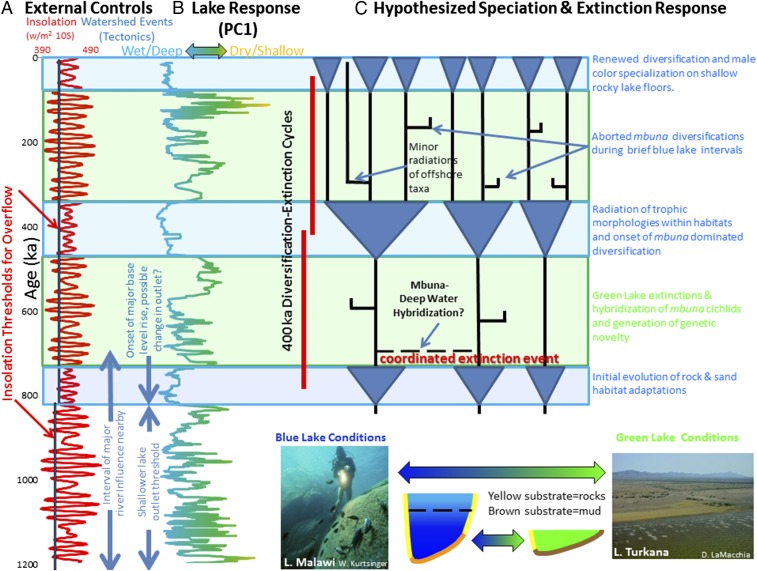
Proposed insolation thresholds (vertical bars) for maintaining overflow conditions during pre– and post–800-ka intervals. (A) A higher insolation threshold would have been required to maintain an open lake once the sill outlet elevation rose and the maximum lake depth deepened. (B) The lake responds to insolation variability above threshold values by rising and transforming in state. This is intensified during the post–800-ka period, when deep blue lake conditions prevail most continuously every 400 ky, comparable to modern Lake Malawi. This contrasts with green lakes during insolation lows below the insolation threshold, when the lake was comparable to modern Lake Turkana. (C) Evolutionary responses include major cycles of diversification and extinction every ∼400 ky. Other phylogenetic events that match this chronology discussed in the main text include an initial evolution of rock and sand habitat adaptations ∼800 ka, green lake phase extinctions and hybridization of rock-dwelling (mbuna) littoral cichlids, radiation of trophic morphologies at ∼400 ka, and diversification of modern color specializations during the most recent (current) blue lake phase.

Comment in

References

    1. Intergovernmental Panel on Climate Change (IPCC) In: Climate Change 2013: The Physical Science Basis. Working Group I Contribution to the Fifth Assessment Report of the Intergovernmental Panel on Climate Change. Stocker TF, et al., editors. Cambridge Univ Press; New York: 2013.
    1. Thieme ML, et al. Freshwater Ecoregions of Africa and Madagascar: A Conservation Assessment. Island; Washington, DC: 2005.
    1. Salzburger W, Van Bocxlaer B, Cohen AS. Ecology and evolution of the African Great Lakes and their faunas. Annu Rev Ecol Evol Syst. 2014;45:519–545.
    1. Cohen AS, et al. Ecological consequences of early Late Pleistocene megadroughts in tropical Africa. Proc Natl Acad Sci USA. 2007;104(42):16422–16427. - PMC - PubMed
    1. Lyons RP, et al. Continuous 1.3-million-year record of East African hydroclimate, and implications for patterns of evolution and biodiversity. Proc Natl Acad Sci USA. 2015;112(51):15568–15573. - PMC - PubMed

Publication types

LinkOut - more resources