. 2016 Oct 3:20:2331216516668303.
doi: 10.1177/2331216516668303.

Time-Varying Distortions of Binaural Information by Bilateral Hearing Aids: Effects of Nonlinear Frequency Compression

Affiliations

Time-Varying Distortions of Binaural Information by Bilateral Hearing Aids: Effects of Nonlinear Frequency Compression

Andrew D Brown et al. Trends Hear. .

Abstract

In patients with bilateral hearing loss, the use of two hearing aids (HAs) offers the potential to restore the benefits of binaural hearing, including sound source localization and segregation. However, existing evidence suggests that bilateral HA users' access to binaural information, namely interaural time and level differences (ITDs and ILDs), can be compromised by device processing. Our objective was to characterize the nature and magnitude of binaural distortions caused by modern digital behind-the-ear HAs using a variety of stimuli and HA program settings. Of particular interest was a common frequency-lowering algorithm known as nonlinear frequency compression, which has not previously been assessed for its effects on binaural information. A binaural beamforming algorithm was also assessed. Wide dynamic range compression was enabled in all programs. HAs were placed on a binaural manikin, and stimuli were presented from an arc of loudspeakers inside an anechoic chamber. Stimuli were broadband noise bursts, 10-Hz sinusoidally amplitude-modulated noise bursts, or consonant-vowel-consonant speech tokens. Binaural information was analyzed in terms of ITDs, ILDs, and interaural coherence, both for whole stimuli and in a time-varying sense (i.e., within a running temporal window) across four different frequency bands (1, 2, 4, and 6 kHz). Key findings were: (a) Nonlinear frequency compression caused distortions of high-frequency envelope ITDs and significantly reduced interaural coherence. (b) For modulated stimuli, all programs caused time-varying distortion of ILDs. (c) HAs altered the relationship between ITDs and ILDs, introducing large ITD-ILD conflicts in some cases. Potential perceptual consequences of measured distortions are discussed.

Keywords: binaural hearing; frequency lowering; hearing aids; sound localization.


Figures

Figure 1.
Figure 1.
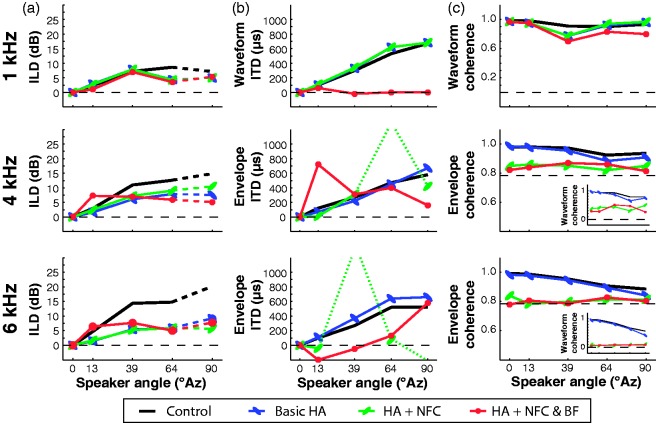
Hearing aids distort binaural cues in steady-state noise. (a) Whole-stimulus ILDs computed using Equation (3) for control recordings and recordings from three different HA programs (colors; see legend and text). Note that no data were measured between 64° and 90° azimuth, where the maximum of the ILD function is expected; thus the connector line is not meant as a meaningful interpolation (dashes). (b) Whole-stimulus waveform (top panel) and envelope (lower panels) ITD computed using Equation (1). ITD values exceeding the axes limits (and the physiologic range of ITD) are not shown, indicated by dotted lines. (c) Whole-stimulus waveform (top panel, insets) and envelope (lower two panels) interaural coherence, computed using Equation (1). Dashed lines indicate the theoretical lower limit of coherence (0 for waveform coherence; π/4 for envelope coherence—see text). Note. HA = hearing aid; ILDs = interaural level differences; ITD = interaural time difference.
Figure 2.
Figure 2.
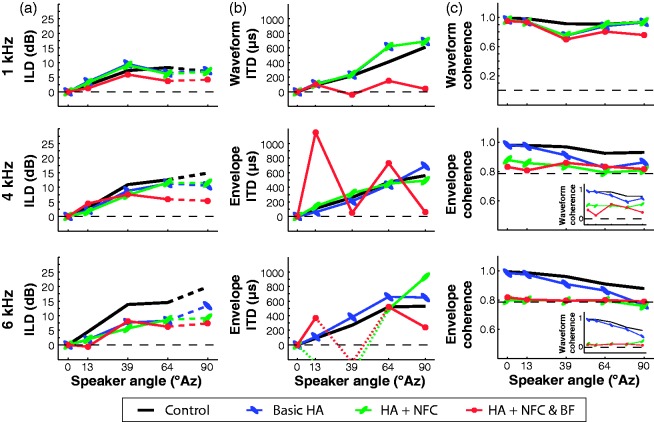
Hearing aids distort binaural cues in 10-Hz sinusoidally amplitude modulated noise. (a–c) Legend as in Figure 1. Note that the π/4 limit of envelope coherence is an approximation in this case, as the noise is no longer strictly Gaussian.
Figure 3.
Figure 3.
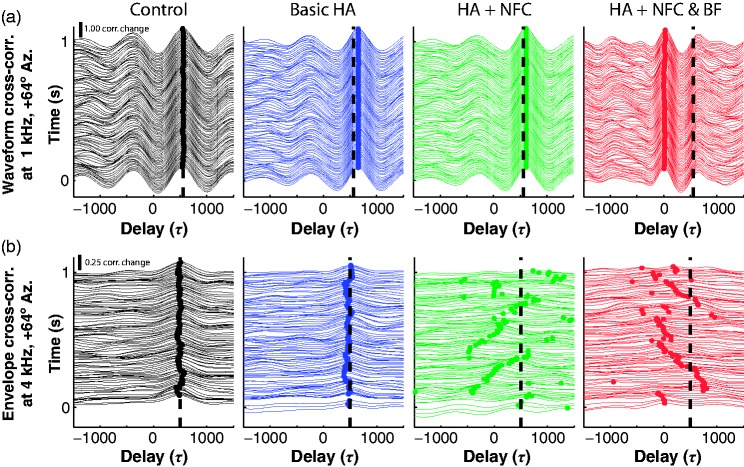
Calculation of time-varying ITD. (a) Normalized cross-correlation of left and right signal waveform at 1 kHz, computed according to Equation (2), for a 50-ms window running from the beginning to the end of a 10-Hz sinusoidally amplitude modulated noise presented from the +64° loudspeaker. Within each panel, the bold point along each trace indicates the estimated ITD for that temporal window, taken as the maximum value of the cross-correlation function (see text). In all panels, the vertical dashed line indicates the time-averaged ITD estimated in the Control condition (black). Scale bar indicates a change in correlation of 1.0. (b) As in (a), but for the signal envelope at 4 kHz. Scale bar indicates a change in correlation of 0.25. Note. ITD = interaural time difference.
Figure 4.
Figure 4.
Frequency compression distorts envelope ITD. Each panel depicts the right- and left-ear signals for the 10-Hz SAM noise stimulus presented at +39°, within a given frequency band and recording condition (control and three HA programs). The calculated time-varying envelope ITD is given above each signal trace, with color intensity weighted according to the average binaural level of the corresponding signal bin (see text). Dashed black lines give the physiologic range of ITD. Note. ITD = interaural time difference; SAM = sinusoidally amplitude-modulated; HA = hearing aid.
Figure 5.
Figure 5.
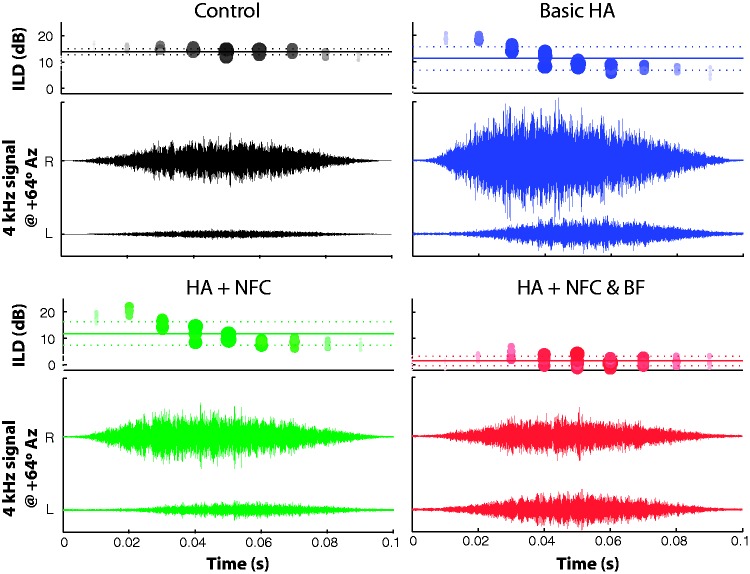
Hearing aids cause time-varying fluctuations of ILD. Each panel gives right- and left-ear signals for the 10-Hz SAM noise stimulus presented at ±64. The signal trace is wrapped to the period of the modulation cycle, 100 ms. Time-varying ILD, computed according to Equation (4), is given above each signal trace, with the size of points and color intensity weighted according to the average binaural level of the corresponding signal bin (see text). The solid colored line gives the weighted mean ILD across all bins, while the colored dashed lines give the weighted standard deviation. Note. ILD = interaural level difference; SAM = sinusoidally amplitude-modulated.
Figure 6.
Figure 6.
Binaural cue distortions evident in noise are also evident in speech signals. (a) Right- and left-ear signals for the CVC word “purse” presented from the speaker at 0° azimuth as measured through 2, 4, and 6 kHz filters. (b) Comparison of HA signal energy in the 4 kHz frequency band without (blue) and with (green) frequency compression enabled. Frequency compression reduces signal amplitude by 9 dB but also introduces notable asymmetries in the left and right signal envelopes (black arrows). (c) Time-varying ITD (upper row) and ILD (middle row) within the 4-kHz frequency band for the word purse presented from the speaker at �imuth across conditions. Note. HA = hearing aid; ILDs = interaural level differences; ITD = interaural time difference.
Figure 7.
Figure 7.
Binaural distortions introduce spatial conflict and spread of ITD and ILD cues. (a) Each panel schematically depicts the KEMAR manikin in the test arena. ILD (outer arc) and ITD (inner arc) were mapped onto azimuth by interpolating measured control ITD and ILD values across azimuth. Note that because of the limited number of speakers used to measure the cues, the interpolation is coarse, and the projection does not capture expected nuances such as nonmonotonicity in the ILD across azimuth. The spatial location and extent of each colored arc depends on the weighted mean and standard deviation of the computed cues. Cues are depicted for the 4 kHz band of the 10-Hz SAM noise with the source at 0 azimuth. (b) As in (a), but for �imuth. Data extending into the rear hemifield are plotted to maintain a sense of measured variance but faded out to convey that the front-back ambiguity inherent in pure ITD and ILD values limits their interpretation. Note. ILD = interaural level difference; ITD = interaural time difference; SAM = sinusoidally amplitude-modulated.

References

    1. Aaronson N. L., Hartmann W. M. (2010) Interaural coherence for noise bands: Waveforms and envelopes. The Journal of the Acoustical Society of America 127: 1367–1372. - PMC - PubMed
    1. Ahlstrom J. B., Horwitz A. R., Dubno J. R. (2009) Spatial benefit of bilateral hearing AIDS. Ear and Hearing 30: 203–218. - PMC - PubMed
    1. Akeroyd M. A. (2014) An overview of the major phenomena of the localization of sound sources by normal-hearing, hearing-impaired, and aided listeners. Trends in Hearing 18: 1–7. - PMC - PubMed
    1. Boymans M., Goverts S. T., Kramer S. E., Festen J. M., Dreschler W. A. (2008) A prospective multi-centre study of the benefits of bilateral hearing aids. Ear and Hearing 29: 930–941. - PubMed
    1. Byrne D., Noble W. (1998) Optimizing sound localization with hearing aids. Trends in Amplification 3: 51–73. - PMC - PubMed

LinkOut - more resources