


Weight losses with low-energy formula diets in obese patients with and without type 2 diabetes: systematic review and meta-analysis
- PMID: 27698345
- PMCID: PMC5368342
- DOI: 10.1038/ijo.2016.175
Weight losses with low-energy formula diets in obese patients with and without type 2 diabetes: systematic review and meta-analysis
Erratum in
-
Weight losses with low-energy formula diets in obese patients with and without type 2 diabetes: systematic review and meta-analysis.Int J Obes (Lond). 2017 Jun;41(6):997. doi: 10.1038/ijo.2017.46. Epub 2017 Mar 14. Int J Obes (Lond). 2017. PMID: 28290463 Free PMC article.
Abstract
Aim: To provide a systematic review, of published data, to compare weight losses following very low calorie (<800 kcal per day VLCD) or low-energy liquid-formula (>800 kcal per day LELD) diets, in people with and without type 2 diabetes mellitus (T2DM).
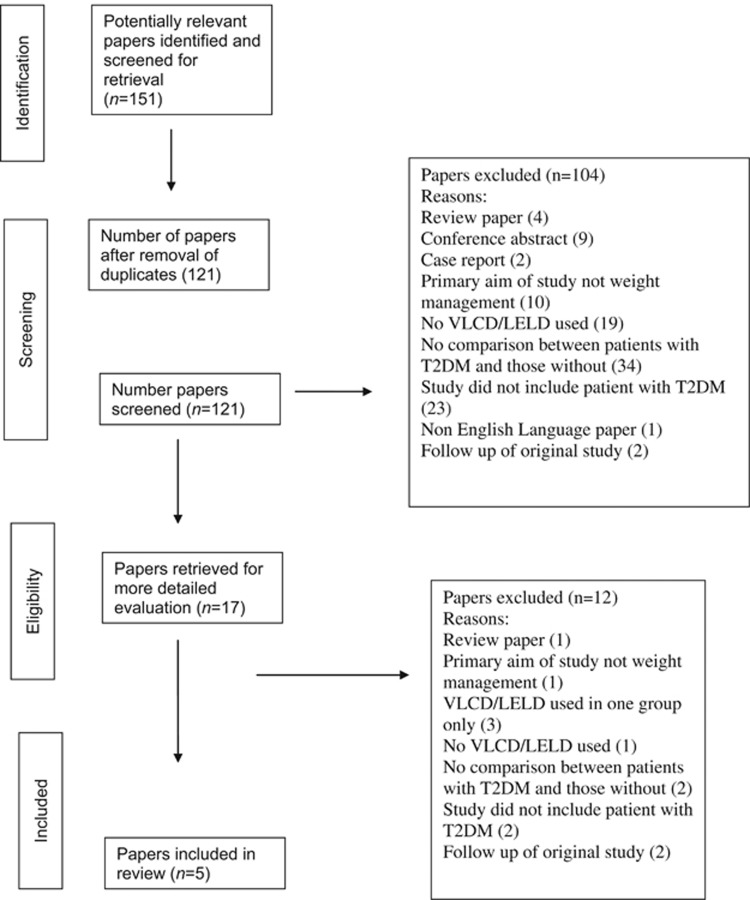
Methods: Systematic electronic searches of Medline (1946-2015) and Embase (1947-2015) to identify published studies using formula total diet replacement diets (VLCD/LELD). Random effects meta-analysis using weighted mean difference (WMD) in body weight between groups (with and without diabetes) as the summary estimate.
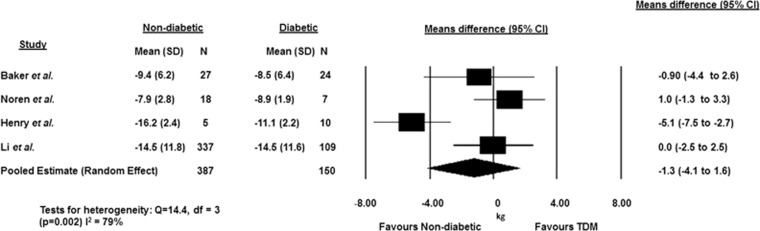
Results: Final weight loss, in the five included studies, weighted for study sizes, (n=569, mean BMI=35.5-42.6 kg/m2), was not significantly different between participants with and without T2DM: -1.2 kg; 95% CI: -4.1 to 1.6 kg). Rates of weight loss were also similar in the two groups -0.6 kg per week (T2DM) and 0.5 kg per week (no diabetes), and for VLCD (<800 kcal per day) and LELD (>800 kcal per day).
Conclusions: Weight losses with liquid-formula diets are very similar for VLCD and LELD and for obese subjects with or without T2DM. They can potentially achieve new weight loss/ maintenance targets of >15-20% for people with severe and medically complicated obesity.
Conflict of interest statement
WSL, MEJL and RT are currently engaged on the Diabetes Remission Clinical Trial (DiRECT) funded by Diabetes UK with additional support in kind from Cambridge Weight Plan. MEJL and RT have received support related to the use of formula diet products from Cambridge Weight Plan and from Nestle.
Figures
References
-
- Walker A. The Cost of Doing Nothing: The Economics of Obesity in Scotland. Robertson Centre for Biostatistics, University of Glasgow: Glasgow, 2003.
-
- Chan JM, Rimm EB, Colditz GA, Stampfer MJ, Willett WC. Obesity, fat distribution and weight gain as risk factors for clinical diabetes in men. Diabetes Care 1994; 17: 961–969. - PubMed
-
- UKPDS UK. Prospective Diabetes Study (UKPDS) VIII. Study, design, progress and performance. Diabetology 1991; 34: 877–890. - PubMed
-
- Lean ME, Powrie JK, Anderson AS, Garthwaite PH. Obesity, weight loss and prognosis in type 2 diabetes. Diabet Med 1990; 7: 228–233. - PubMed
-
- Scottish Health Survey. Available from: http://www.scotland.gov.uk/Publications/2009/09/28102003/0, 2008.
Publication types
MeSH terms
LinkOut - more resources
Full Text Sources
Other Literature Sources
Medical
