Review
. 2016 Sep 30;89(3):309-324.
eCollection 2016 Sep.

Breathing Better Through Bugs: Asthma and the Microbiome

Affiliations
Review

Breathing Better Through Bugs: Asthma and the Microbiome

Alexander J Adami et al. Yale J Biol Med. .

Abstract

Asthma is a highly heterogeneous disease characterized by inflammation of the airways, which invokes symptoms such as wheeze, dyspnea, and chest tightness. Asthma is the product of multiple interconnected immunological processes and represents a constellation of related, but distinct, disease phenotypes. The prevalence of asthma has more than doubled since the 1980s, and efforts to understand this increase have inspired consideration of the microbiome as a key player in the pathophysiology and regulation of this disease. While recent years have seen an explosion of new research in this area, researchers are only beginning to untangle to mechanisms by which the microbiome may influence asthma. This review will focus on the relationship between the microbiome and the immune system and how this influences development of asthma. This review will also highlight evidence that may point the way toward new therapies and potential cures for this ancient respiratory foe.

Keywords: allergy; asthma; hygiene hypothesis; immune system; immunity; microbiome; microbiota.


Figures
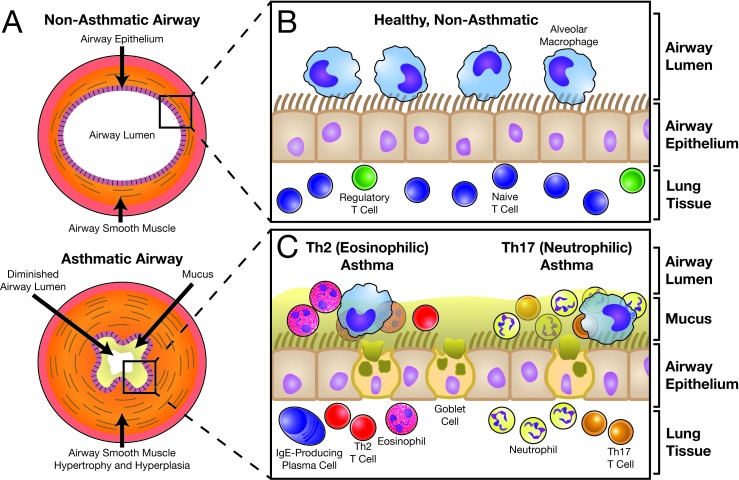
Figure 1
Figure 1
The Normal and Asthmatic Airway. The anatomy of a healthy, non-diseased airway (A, top) is similar to that of a hose or pipe, with a patent and unobstructed luminal space permitting free flow of air with respiration. Surrounding the airway lumen is a wall of connective tissue and airway smooth muscle. In an asthmatic airway (A, bottom), the airway smooth muscle has undergone hypertrophy and hyperplasia, obstructing the lumen through an increase in mass. Furthermore, asthmatic airway smooth muscle is classically hyperreactive to its triggering stimulus, which leads to constriction and further obstruction of airflow. Finally, heightened mucus production reduces the already diminished lumen, resulting in the sensations of dyspnea and chest tightness that are so characteristic of the disease. From a cellular perspective, the normal and asthmatic airways are dramatically different. In a healthy airway (B), a ciliated respiratory epithelium separates the airway lumen from the surrounding lung tissue. Alveolar macrophages are the dominant cell type within the airway. Within lung tissue, many cell types are present, including naive T cells and regulatory T cells (Tregs). A vigorous immune response is not present. By contrast, the asthmatic airway (C) is characterized by a robust immune response regardless of the asthma endotype. For Th2-driven, eosinophilic asthma (C, left), the airway space becomes dominated by eosinophils and Th2 cells, with more of these cells also present within the lung tissue. Plasma cells are also present and are responsible for production of allergen-specific IgE. For Th17-driven, neutrophilic asthma (C, right), the dominant cell types are Th17 cells and the neutrophils they recruit, with eosinophils, Th2 cells, and IgE being absent. Other cell types, including B cells, mast cells, and basophils, may be present depending on the endotype.
Figure 2
Figure 2
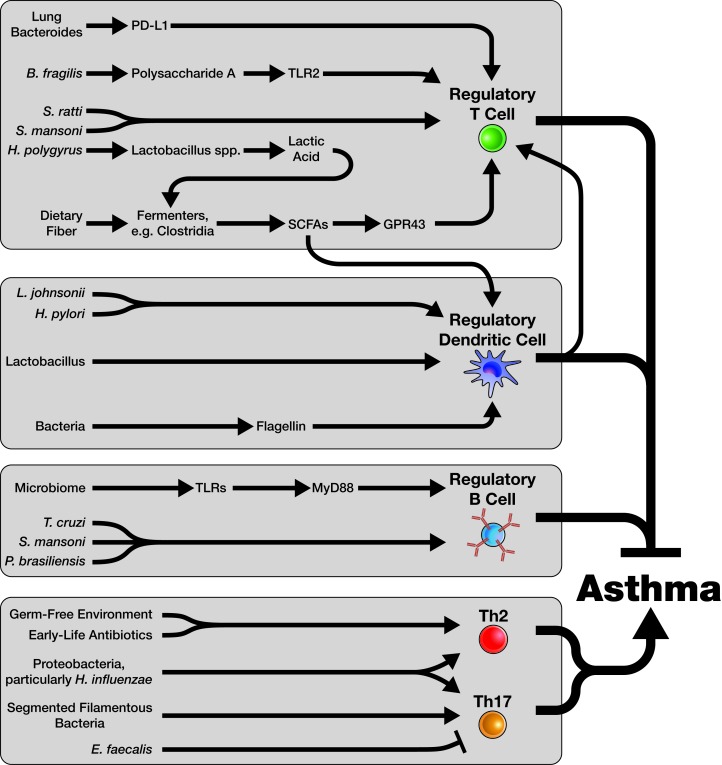
Immune-Microbiome Interactions in Asthma. The immune system is influenced by the microbiome in a myriad of ways, many of which we are only beginning to understand. With respect to asthma, four key areas of microbiome-immune interactions are particularly relevant. Regulatory T cells (Tregs) play a critical role in regulating asthma pathogenesis and preventing asthma in healthy individuals. The microbiome has a large role in the generation and maintenance of Tregs. Microbial products, particularly short-chain fatty acids (SCFAs); microbe-microbe interactions; and microbial sensing by elements of the immune system (such as through TLRs) all contribute to Treg formation and function. Dendritic cells (DCs) can also play key regulatory roles in the context of asthma. Multiple microbiome-related mechanisms drive regulatory DC formation, including sensing of bacterial products such as flagellin and production of SCFAs by certain microorganisms. Regulatory DCs may also promote the formation of Tregs. The role of the microbiome in generating Regulatory B cells (Bregs) is less clear, but similar mechanisms (e.g. sensing of microbes by TLRs) seem to play a role in this process. Specific microbial products which can induce Bregs are less understood, particularly when compared to Tregs. Tregs, Bregs, and regulatory DCs all act to inhibit asthma pathogenesis. However, pathogenic Th2 and Th17 immune responses can also be driven by the microbiome. An absence of microorganisms, particularly early in life, can drive a Th2 response to allergen, as in a germ free (GF) mouse. Similarly, early-life antibiotic use can promote Th2 responses. Proteobacteria, particularly Haemophilus influenzae, can induce either a Th2 or Th17 response depending on the timing of infection. Other specific organisms can either inhibit or promote Th17 responses. It is likely that many more such relationships will be discovered for both Th2 and Th17 responses as the science of the microbiome advances.
Figure 3
Figure 3
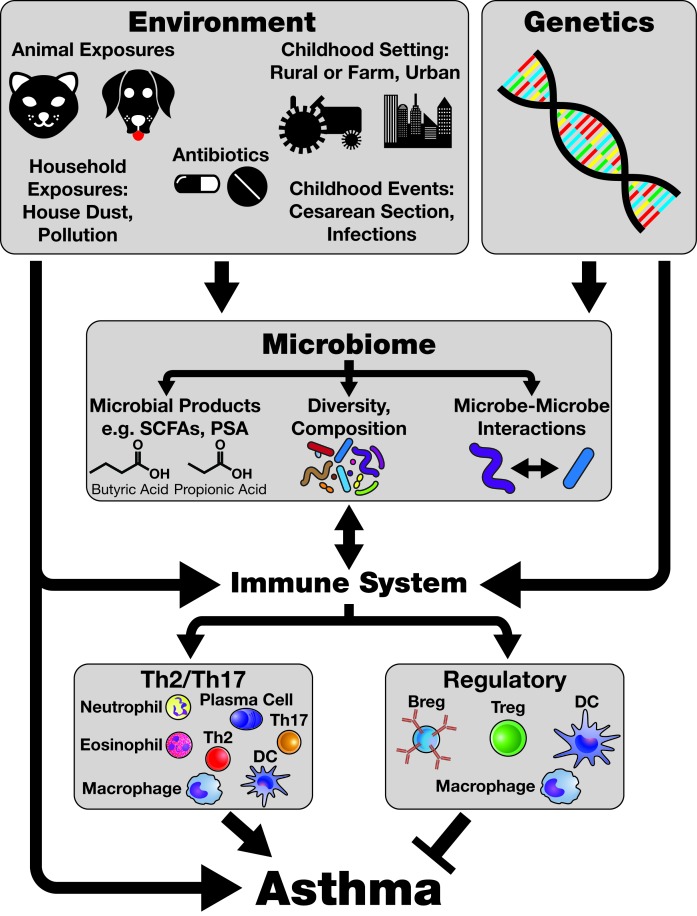
The Environmental-Microbiome-Immune Axis and Asthma. The relationships between the environment, the microbiome, the immune system, and asthma are extremely complex. Key points discussed in this review are highlighted in Figure 3. The exposures humans encounter in the Environment are particularly important in shaping the microbiome. Antibiotics can eliminate some microorganisms from the microbiome, while the setting in which humans live, such as on a farm as compared to a city apartment, can determine which microorganisms are acquired in childhood. These exposures influence and impact the Microbiome and can determine which microbial products, such as short-chain fatty acids (SCFAs) or polysaccharide A (PSA), are produced. Two SCFAs, butyric acid and propionic acid, are represented here. Factors which affect the microbiome can broadly influence microbiome diversity and composition, including down to the specific organismal level (e.g. antibiotic elimination of Helicobacter pylori). The microbiome can in turn influence the Immune System, which may also be altered by the environment. Many cells responsible for regulating immune activity (from regulatory T cells to dendritic cells, or DCs) and producing effector immune responses (Th2 cells, Th17 cells, eosinophils, and so on) are induced by or otherwise influenced through interaction with the microbiome and its products. This influence can impact the type of immune response generated in the context of asthma, promoting Th2-driven responses, Th17-driven responses, or even a combination thereof. Activity of the immune system is also capable of feeding back on the microbiome through, for example, production of antimicrobial proteins. The activity of the immune system, in conjunction with Genetic influences (which may also impact the microbiome), then determines Asthma pathophysiology, including the specific endotype present, steroid resistance, and how susceptible an individual is to developing asthma in the first place. All of these factors converge to create the constricted, obstructed asthmatic airway that produces such profound morbidity in this condition.

References

    1. Postma DS, Rabe KF. The Asthma-COPD Overlap Syndrome. N Engl J Med. 2015;373(13):1241–1249. - PubMed
    1. Berair R, Saunders R, Brightling CE. Origins of increased airway smooth muscle mass in asthma. BMC Med. 2013;11:145. - PMC - PubMed
    1. Fanta CH. Asthma. N Engl J Med. 2009;360(10):1002–1014. - PubMed
    1. Bisgaard H, Bønnelykke K. Long-term studies of the natural history of asthma in childhood. J Allergy Clin Immunol. 2010;126(2):187–199. - PubMed
    1. Wenzel SE. Asthma phenotypes: the evolution from clinical to molecular approaches. Nat Med. 2012;18(5):716–725. - PubMed

Publication types