


Longitudinal Outcomes Following a Randomized Controlled Trial of Dynamic Splint Stretching for Carpal Tunnel Syndrome
- PMID: 27698630
- PMCID: PMC5030854
- DOI: 10.1177/1558944715626925
Longitudinal Outcomes Following a Randomized Controlled Trial of Dynamic Splint Stretching for Carpal Tunnel Syndrome
Abstract
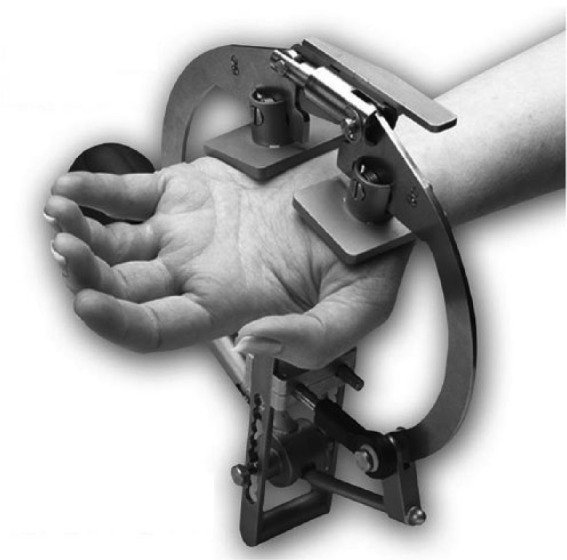
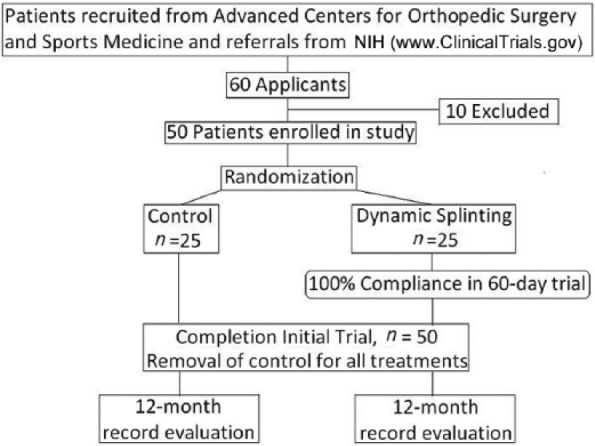
Background: The incidence of carpal tunnel syndrome (CTS) is 48 million patients in the United States. The purpose of this longitudinal study was to determine whether Dynasplint stretching (immediately after diagnosis) had an effect on a patient's decision to seek surgical treatment for CTS. Methods: Fifty patients (10 men, 40 women, mean age 51.2 ± 12 years) were recruited for this randomized, controlled, longitudinal trial. Patients were diagnosed with CTS by physical examination and nerve conduction studies. The intervention used was Dynasplint stretching that delivered a prolonged duration of low load stretching. Patients who were randomly chosen for the Experimental category wore the device for two 30-minute sessions per day with regular increases in splint tension for 60 days. Control patients received nonsteroidal anti-inflammatory medication plus instructions on daily home stretching. Results: The final, longitudinal outcome showed a 72% reduction in surgery chosen by the experimental group (n = 25), compared with 38% reduction for control patients (n = 25). Conclusions: Immediate treatment with Dynasplint stretching showed a 2 to 1 reduction in surgery, with abundant financial savings.
Keywords: Dynasplint; contracture reduction; home therapy; pain management.
Conflict of interest statement
The author(s) declared the following potential conflicts of interest with respect to the research, authorship, and/or publication of this article: Neither author has conflict of interest at this time. Neither author has received any earnings or compensation for this publication; nor will any earnings be awarded in the future. Dr. F.B.W. was employed by Galveston Clinical Research Foundation at the time of this study. He had a previous affiliation with the parent company of Dynasplint Systems, Inc. but the affiliation including all compensation or earnings were completed in 2013. B.F. was previously employed by Dynasplint Systems but her employment was also completed in 2013.
Figures
References
-
- Atroshi I, Gummesson C, Johnsson R, Ornstein E, Ranstam J, Rosén I. Prevalence of carpal tunnel syndrome in a general population. JAMA. 1999;282(2):153-158. - PubMed
-
- Baker NA, Moehling KK, Rubinstein EN, Wollstein R, Gustafson NP, Baratz M. The comparative effectiveness of combined lumbrical muscle splints and stretches on symptoms and function in carpal tunnel syndrome. Arch Phys Med Rehabil. 2012;93(1):1-10. - PubMed
-
- Berner SH, Willis FB, Martinez J. Treatment of carpal tunnel syndrome with Dynasplint: a randomized, controlled trial. J Med. 2008;1(1):90-94.
-
- Berner SH, Willis FB, Shanmugam R. Pain from carpal tunnel syndrome reduced with dynamic splinting: a retrospective study of 156 patients. J Clin Med Res. 2009;1(2):22-25.
-
- Burke FD, Wilgis EF, Dubin NH, Bradley MJ, Sinha S. Relationship between the duration and severity of symptoms and the outcome of carpal tunnel surgery. J Hand Surg Am. 2006;31(9):1478-1482. - PubMed
Publication types
MeSH terms
Substances
LinkOut - more resources
Full Text Sources
Other Literature Sources
Medical
Research Materials
