. 2016 Oct 4;14(10):e1002564.
doi: 10.1371/journal.pbio.1002564. eCollection 2016 Oct.

Associative Mechanisms Allow for Social Learning and Cultural Transmission of String Pulling in an Insect

Affiliations

Associative Mechanisms Allow for Social Learning and Cultural Transmission of String Pulling in an Insect

Sylvain Alem et al. PLoS Biol. .

Erratum in

Abstract

Social insects make elaborate use of simple mechanisms to achieve seemingly complex behavior and may thus provide a unique resource to discover the basic cognitive elements required for culture, i.e., group-specific behaviors that spread from "innovators" to others in the group via social learning. We first explored whether bumblebees can learn a nonnatural object manipulation task by using string pulling to access a reward that was presented out of reach. Only a small minority "innovated" and solved the task spontaneously, but most bees were able to learn to pull a string when trained in a stepwise manner. In addition, naïve bees learnt the task by observing a trained demonstrator from a distance. Learning the behavior relied on a combination of simple associative mechanisms and trial-and-error learning and did not require "insight": naïve bees failed a "coiled-string experiment," in which they did not receive instant visual feedback of the target moving closer when tugging on the string. In cultural diffusion experiments, the skill spread rapidly from a single knowledgeable individual to the majority of a colony's foragers. We observed that there were several sequential sets ("generations") of learners, so that previously naïve observers could first acquire the technique by interacting with skilled individuals and, subsequently, themselves become demonstrators for the next "generation" of learners, so that the longevity of the skill in the population could outlast the lives of informed foragers. This suggests that, so long as animals have a basic toolkit of associative and motor learning processes, the key ingredients for the cultural spread of unusual skills are already in place and do not require sophisticated cognition.


Conflict of interest statement

The authors have declared that no competing interests exist.

Figures
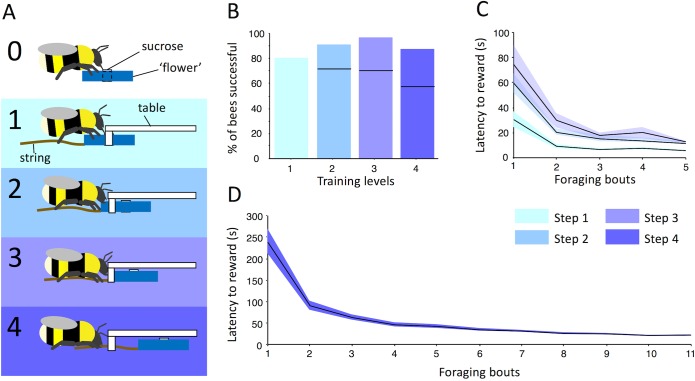
Fig 1
Fig 1. Training bees to pull a string to obtain a reward.
(A) Stepwise string pulling training protocol. Successive steps: Step 0, pretraining on blue artificial flowers (note that all bees were trained on this step); Step 1, 50% of the flower covered by the transparent table; Step 2, 75% of the flower covered; Steps 3 and 4, 100% of the flower covered. The flower was positioned at the edge in Step 3 and 2 cm under the table in Step 4. (B) Percentage of successful bees in Steps 1 to 4 (n = 40, 32, 29, and 28, respectively). Black horizontal lines within bars indicate the percentage of bees of the original 40. (C) and (D), mean ± standard error (s.e.) (line and shaded area, s) latency to obtain the reward in Steps 1–3 and 4. (C) Mean latency for the five foraging bouts of Steps 1–3. Data points, from left to right, in (D) indicate the latency to reward in Step 4 for the bout with first occurrence of string pulling and the ten foraging bouts that followed. Bees needed 6.17 ± 1.2 foraging bouts before displaying string pulling in Step 4 (see S1 Data).
Fig 2
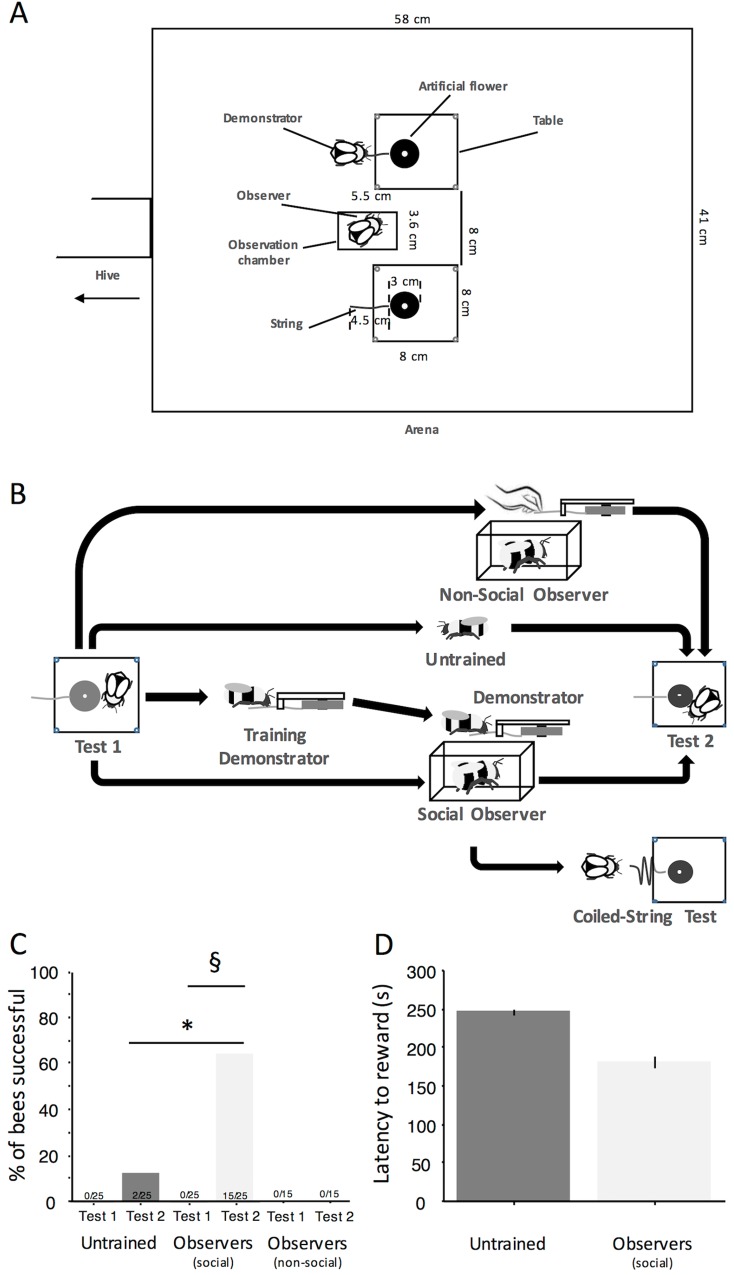
Fig 2. Social transmission of string pulling.
(A) Arena set up for the observation of string pulling. (B) The various testing procedures. Tests 1 and 2 were identical and consisted of giving 5 min to individual bees to solve the string pulling task. After having been trained to forage from blue artificial flowers, bees were tested a first time (Test 1). Then, demonstrators were trained (see Fig 1) and used to display string pulling (two instances, straight strings) during each of five foraging bouts to individual observers (n = 52) placed in a transparent Plexiglas cage. After the observation phase, 25 observers were tested again with the straight-string task (Test 2) and 27 with the coiled-string task. Fifteen different bees observed the flower moving without visible actor so that a forager could then obtain the sucrose solution (“Ghost control”) and, where tested, with the straight-string task subsequently. Untrained bees (n = 25) were also tested a second time with string pulling. (C) Percentage of successful untrained, social, and nonsocial observer bees in Tests 1 and 2. Asterisk: Fisher’s exact test, p ≤ 0.0001. Double S: McNemar test, χ21 = 13.067, p < 0.001. (D) Mean ± s.e. (s) latency in accessing the reward in untrained and observer bees. Observers’ latency was not different from that of the two “innovators” (Mann–Whitney U test, U15 = 6, p = 0.205), (see S1 Data).
Fig 3
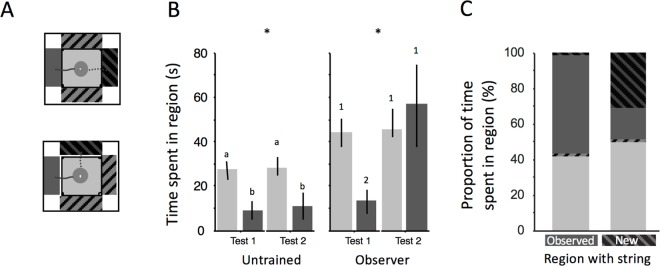
Fig 3. Areas explored by untrained bees and observers of successful string pullers.
(A) Regions of interest used for the video analysis of bee behaviors (not true to scale): the original region (where the demonstrator pulled a string, solid dark grey), top region (on the table, solid light grey), the two regions where the string could be presented when it was at variance with the location during the observation phase in the stimulus enhancement tests (thin grey stripes on black) and the adjacent regions where no string was presented (thin black stripes on grey). When testing stimulus enhancement, bees were challenged with a string protruding on the opposite side of one of Plexiglas tables or at 90° compared to the location where it was seen during observational conditioning (dotted lines). Regions were all 16 cm2 (adjacent areas: 8 x 2 cm; top region 4 x 4 cm). (B) Mean ± s.e. (s) time spent by unsuccessful observer (n = 10) and unsuccessful untrained bees in two of the four regions of interest in their first attempt to retrieve the reward (Test 1) the second attempt (Test 2). Light grey: top of table; dark grey: region where string protruded during observation. Asterisk: Friedman test, p < 0.01; letters and figures: post-hoc Tukey test. (C) Percentage of time spent by observer bees in the four regions of interest when the string was protruding in the region where bees had observed demonstrators (left bar, unsuccessful observers, n = 10) or the region of the table where the string protruded when it was incongruent with that seen from the observation chamber (right bar, bees tested for stimulus enhancement, n = 14). The shades in the various regions of the stacked bars correspond to the shades in Fig 3A (see S1 Data).
Fig 4
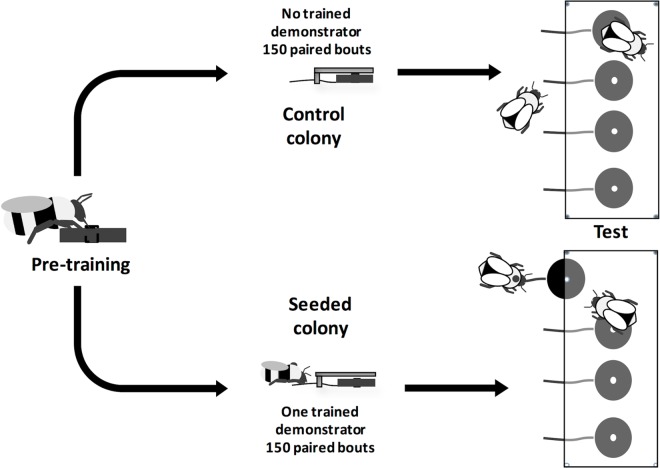
Fig 4. Cultural diffusion paradigm.
Bees were group-trained to feed from blue flowers in the foraging arena. Three bees were trained to pull a string to obtain an artificial flower from under a table where they would get reward (sucrose solution; see Fig 1A). These three demonstrators were placed in colonies 6, 7, and 8 (one each; seeded colonies), and bees that came out of the colony were paired up in order of exit from the hive to forage within the arena and tested with the string pulling task. Each bout was capped at 5 min, and we recorded 150 foraging bouts (150 bee pairs). In colonies 9, 10, and 11 (control colonies), no trained demonstrator was present. 150 foraging bouts were recorded (150 bee pairs) (see S2 Data).
Fig 5
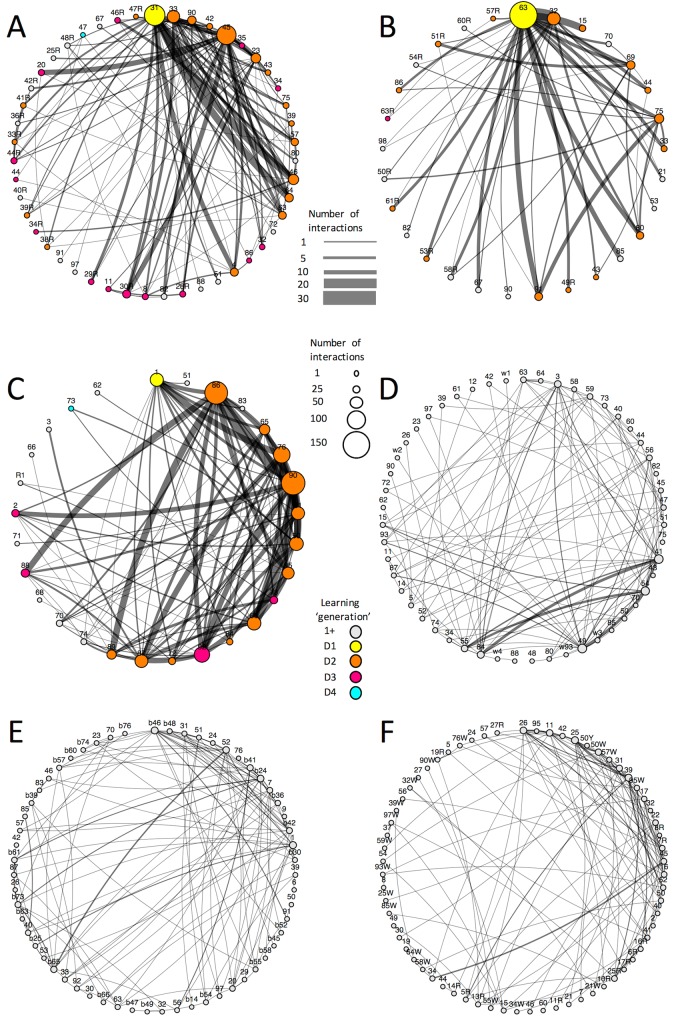
Fig 5. Diffusion of string pulling in bumblebee colonies.
(A–F) Nodes represent individual bees. Lines indicate that two bees interacted at least once. Thickness of lines represent total number of interactions between two individuals—one interaction equals one point line thickness and each interaction increases the line thickness by one point. See top insert for indication of line thickness and number of interactions. Size of nodes indicates number of interactions of that individual bee with any other bee—each interaction increases the size of a node by 15% of the original size (3% of the plot width). See middle insert for indication of node size and interactions. Color represents experience (learning “generation”) of that bee: prior to any experience, nodes are grey. After a bee interacts for the first time in the foraging arena, its node turns white. The “seeded” demonstrator (D1), pretrained to pull a string, is marked yellow and at the twelve o’clock position. Once a bee learns to string pull, its node turns from white to another color: orange for a first-order learner (D2, interacting with the seeded demonstrator and lower-order bees); pink for a second-order learner (D3, interacting with first-order and lower-order bees); blue for a third-order learner (D4, interacting with second-order and lower-order bees). See bottom insert for indication of node color and learning generation. Networks for the experiments (A–C) only show interactions within bouts where at least one bee pulled the string at least once. (A) Network for test colony 6 (bout n = 189). (B) Network for test colony 7 (bout n = 114). (C) Network for test colony 8 (bout n = 249). (D) Network for control colony 9 (bout n = 149). (E) Network for control colony 10 (bout n = 150). (F) Network for control colony 11 (bout n = 150) (see S2 Data).
Fig 6
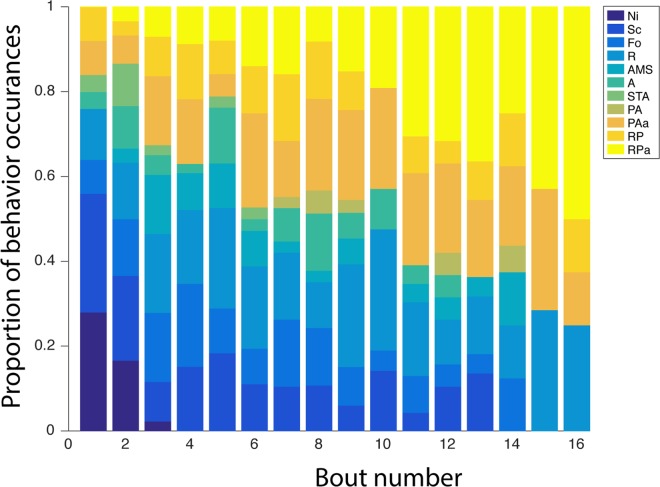
Fig 6. Change in learners’ behavioral interactions.
Stacked bars represent the proportion of interactions observed as a function of experience (number of paired foraging bouts). Colors indicate behavioral interactions (abbreviations, see Table 1). We evaluated the behavior of 15 randomly selected individuals (5 from each test colony that had been seeded with a trained demonstrator) for these interactions, scrutinizing 174 5-min videos totaling 14.5 h of footage (see S2 Data).

References

    1. Heyes CM, Galef BG. Social Learning In Animals: The Roots of Culture. Elsevier; 1996.
    1. Breed MD, Moore J. Encyclopedia of Animal Behavior 1st ed London: Academic Press; 2010.
    1. Galef BG. Social learning and traditions in animals: evidence, definitions, and relationship to human culture. Wiley Interdiscip Rev Cogn Sci. 2012;3: 581–592. 10.1002/wcs.1196 - DOI - PubMed
    1. Hopper LM, Whiten A. The comparative and evolutionary psychology of social learning and culture The Oxford Handbook of Comparative Evolutionary Psychology. Oxford University Press. J. Vonk & T. Shackelford; 2012. pp. 451–473.
    1. Whiten A, Caldwell CA, Mesoudi A. Cultural diffusion in humans and other animals. Curr Opin Psychol. 2016;8: 15–21. 10.1016/j.copsyc.2015.09.002 - DOI - PubMed

LinkOut - more resources