


An Evaluation of Passive and Active Approaches to Improve Tuberculosis Notifications in Afghanistan
- PMID: 27701446
- PMCID: PMC5049786
- DOI: 10.1371/journal.pone.0163813
An Evaluation of Passive and Active Approaches to Improve Tuberculosis Notifications in Afghanistan
Abstract
Background: In Afghanistan, improving TB case detection remains challenging. In 2014, only half of the estimated incident TB cases were notified, and notifications have decreased since peaking in 2007. Active case finding has been increasingly considered to improve TB case notifications. While access to health services has improved in Afghanistan, it remains poor and many people seeking health services won't receive proper care.
Methods: From October 2011 through December 2012 we conducted three separate case finding strategies in six provinces of Afghanistan and measured impact on TB case notification. Systematically screening cough among attendees at 47 health facilities, active household contact investigation of smear-positive index TB patients, and active screening at 15 camps for internally displaced people were conducted. We collected both intervention yield and official quarterly notification data. Additional TB notifications were calculated by comparing numbers of cases notified during the intervention with those notified before the intervention, then adjusting for secular trends in notification.
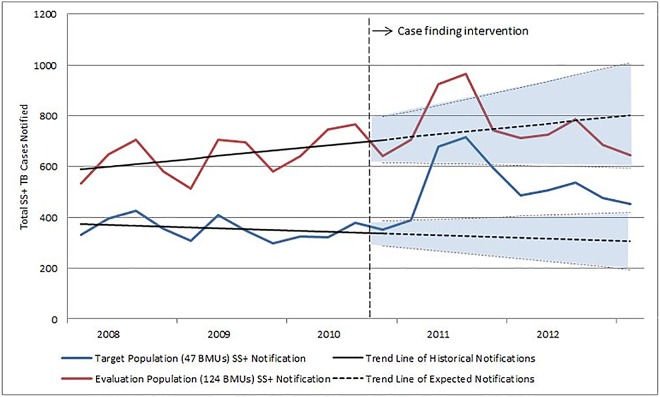
Results: We screened 2,022,127 people for TB symptoms during the intervention, tested 59,838 with smear microscopy and detected 5,046 people with smear-positive TB. Most cases (81.7%, 4,125) were identified in health facilities while nearly 20% were found through active case finding. A 56% increase in smear-positive TB notifications was observed between the baseline and intervention periods among the 47 health facilities, where cases detected by all three strategies were notified.
Discussion: While most people with TB are likely to be identified through health facility screening, there are many people who remain without a proper diagnosis if outreach is not attempted. This is especially true in places like Afghanistan where access to general services is poor. Targeted active case finding can improve the number of people who are detected and treated for TB and can push towards the targets of the Stop TB Global Plan and End TB Strategy.
Conflict of interest statement
Author RHS was employed by commercial company Mott MacDonald (which is not the funder) during the time that the intervention described in this manuscript was carried out. Mott MacDonald was hired by the Stop TB Partnership as the independent monitoring and evaluation company for this project. His role was to help ensure an appropriate study design and to monitor and evaluate data generated by the intervention. This commercial affiliation does not alter our adherence to PLOS ONE policies on sharing data and materials.
Figures
References
-
- World Health Organization. Global tuberculosis report 2013. WHO/HTM/TB/2013.11. Geneva, Switzerland: WHO; 2013.
-
- Afghanistan’s National Tuberculosis Control Program: 2005 Operational Plan. Ministry of Public Health National Tuberculosis Control Program; Rural Expansion of Afghanistan’s Community-Based Healthcare (REACH), Management Sciences for Health; 2006. January http://pdf.usaid.gov/pdf_docs/Pnadf336.pdf.
-
- Ahmadzai H, Kakar F, Rashidi M, Suarez PG, Ameli O, Hartman AF. Scaling up TB DOTS in a fragile state: post-conflict Afghanistan. Int J Tuberc Lung Dis. 2008. February; 12(2):180–5. - PubMed
MeSH terms
LinkOut - more resources
Full Text Sources
Other Literature Sources
Medical
