


Glucagon-like peptide-1 (GLP-1) mediates cardioprotection by remote ischaemic conditioning
- PMID: 27702763
- PMCID: PMC5157137
- DOI: 10.1093/cvr/cvw216
Glucagon-like peptide-1 (GLP-1) mediates cardioprotection by remote ischaemic conditioning
Abstract
Aims: Although the nature of the humoral factor which mediates cardioprotection established by remote ischaemic conditioning (RIc) remains unknown, parasympathetic (vagal) mechanisms appear to play a critical role. As the production and release of many gut hormones is modulated by the vagus nerve, here we tested the hypothesis that RIc cardioprotection is mediated by the actions of glucagon-like peptide-1 (GLP-1).
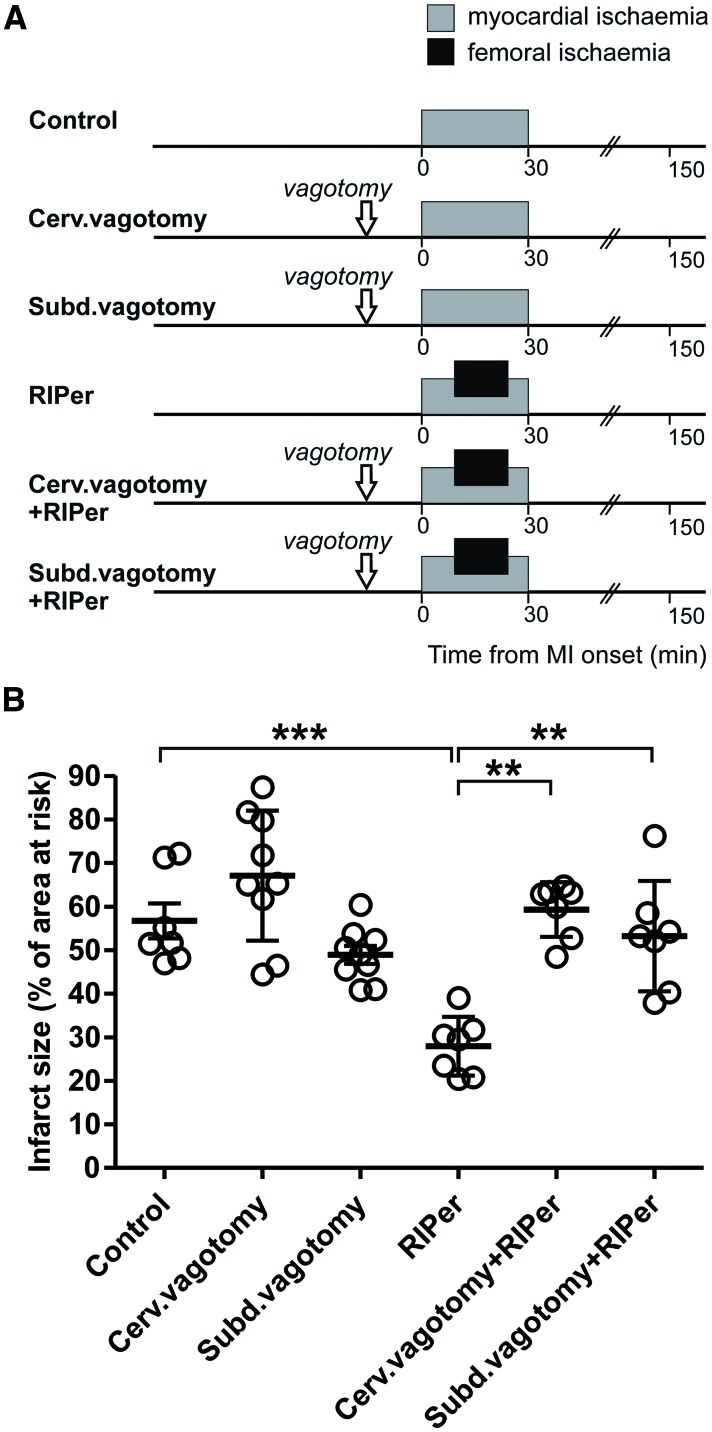
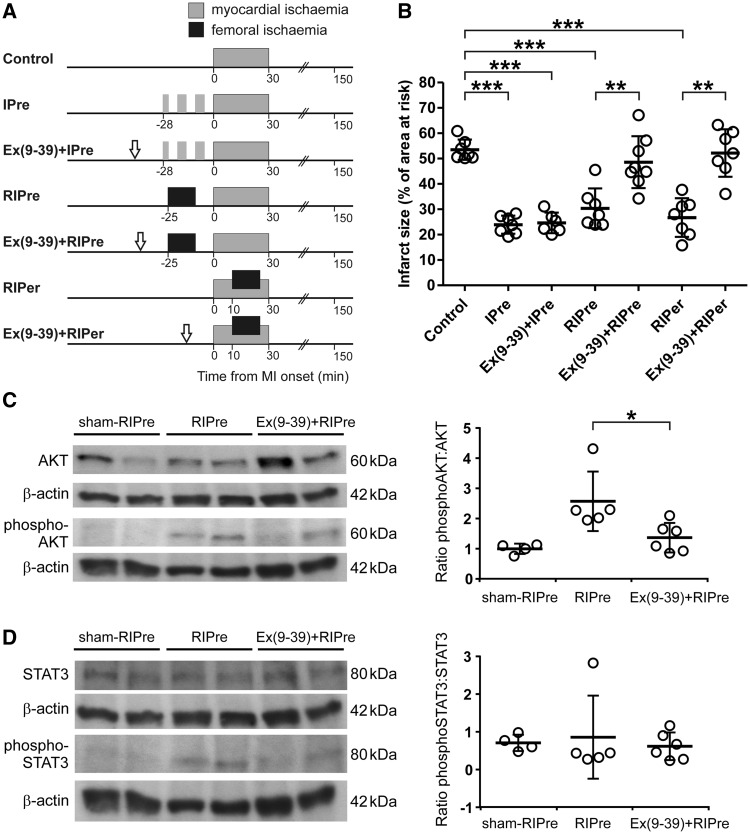
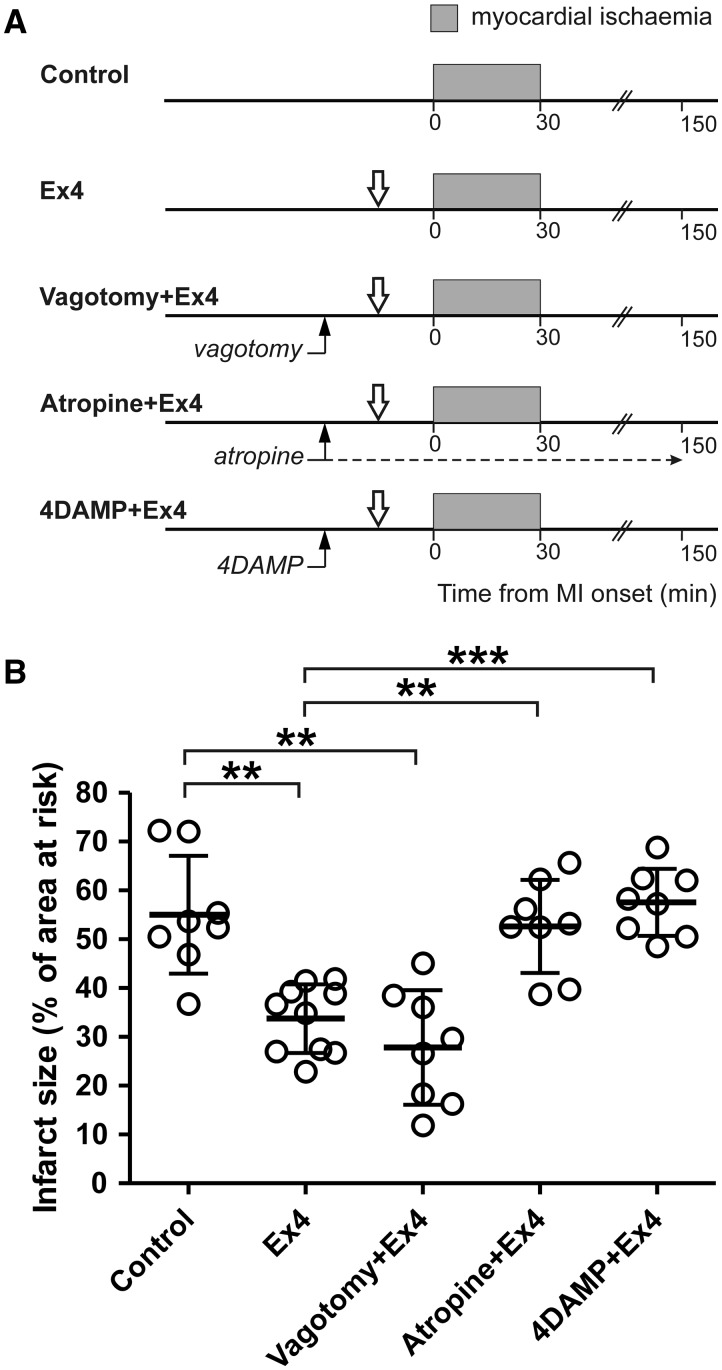
Methods and results: A rat model of myocardial infarction (coronary artery occlusion followed by reperfusion) was used. Remote ischaemic pre- (RIPre) or perconditioning (RIPer) was induced by 15 min occlusion of femoral arteries applied prior to or during the myocardial ischaemia. The degree of RIPre and RIPer cardioprotection was determined in conditions of cervical or subdiaphragmatic vagotomy, or following blockade of GLP-1 receptors (GLP-1R) using specific antagonist Exendin(9-39). Phosphorylation of PI3K/AKT and STAT3 was assessed. RIPre and RIPer reduced infarct size by ∼50%. In conditions of bilateral cervical or subdiaphragmatic vagotomy RIPer failed to establish cardioprotection. GLP-1R blockade abolished cardioprotection induced by either RIPre or RIPer. Exendin(9-39) also prevented RIPre-induced AKT phosphorylation. Cardioprotection induced by GLP-1R agonist Exendin-4 was preserved following cervical vagotomy, but was abolished in conditions of M3 muscarinic receptor blockade.
Conclusions: These data strongly suggest that GLP-1 functions as a humoral factor of remote ischaemic conditioning cardioprotection. This phenomenon requires intact vagal innervation of the visceral organs and recruitment of GLP-1R-mediated signalling. Cardioprotection induced by GLP-1R activation is mediated by a mechanism involving M3 muscarinic receptors.
Keywords: Cardioprotection; Glucagon-like peptide-1; Myocardial infarction; Myocardial ischaemia; Parasympathetic; Remote ischaemic conditioning; Reperfusion; Vagus nerve.
© The Author 2016. Published by Oxford University Press on behalf of the European Society of Cardiology.
Figures
Comment in
-
Remote ischemic conditioning: the enigmatic transfer of protection.Cardiovasc Res. 2017 Jan;113(1):1-2. doi: 10.1093/cvr/cvw240. Cardiovasc Res. 2017. PMID: 28069695 No abstract available.
-
Letter in response to glucagon-like peptide-1 mediates cardioprotection by remote ischaemic conditioning.Cardiovasc Res. 2017 Jan;113(1):13. doi: 10.1093/cvr/cvw237. Cardiovasc Res. 2017. PMID: 28069699 No abstract available.
References
-
- Heusch G. Molecular basis of cardioprotection: signal transduction in ischemic pre-, post-, and remote conditioning. Circ Res 2015;116:674–699. - PubMed
-
- Bøtker HE, Kharbanda R, Schmidt MR, Bøttcher M, Kaltoft AK, Terkelsen CJ, Munk K, Andersen NH, Hansen TM, Trautner S, Lassen JF, Christiansen EH, Krusell LR, Kristensen SD, Thuesen L, Nielsen SS, Rehling M, Sørensen HT, Redington AN, Nielsen TT. Remote ischaemic conditioning before hospital admission, as a complement to angioplasty, and effect on myocardial salvage in patients with acute myocardial infarction: a randomised trial. Lancet 2010;375:727–734. - PubMed
-
- White SK, Frohlich GM, Sado DM, Maestrini V, Fontana M, Treibel TA, Tehrani S, Flett AS, Meier P, Ariti C, Davies JR, Moon JC, Yellon DM, Hausenloy DJ. Remote ischemic conditioning reduces myocardial infarct size and edema in patients with ST-segment elevation myocardial infarction. JACC Cardiovasc Interv 2015;8:178–188. - PubMed
MeSH terms
Substances
Grants and funding
LinkOut - more resources
Full Text Sources
Other Literature Sources
Medical
Miscellaneous
