. 2017 Jul 1;19(7):1211-1219.
doi: 10.1093/europace/euw154.

Antiadrenergic autoimmunity in postural tachycardia syndrome

Affiliations

Antiadrenergic autoimmunity in postural tachycardia syndrome

Artur Fedorowski et al. Europace. .

Abstract

Aims: Postural tachycardia syndrome (POTS), a common and debilitating cardiovascular disorder, is characterized by an exaggerated heart rate increase during orthostasis and a wide spectrum of adrenergic-related symptoms. To determine the aetiology of POTS, we examined a possible pathophysiological role for autoantibodies against α1-adrenergic (α1AR) and β1/2-adrenergic receptors (β1/2AR).

Methods and results: Immunoglobulin G (IgG) derived from 17 POTS patients, 7 with recurrent vasovagal syncope (VVS), and 11 normal controls was analysed for its ability to modulate activity and ligand responsiveness of α1AR and β1/2AR in transfected cells and to alter contractility of isolated rat cremaster arterioles in vitro. Immunoglobulin G activation of α1AR and β1/2AR was significantly higher in POTS compared with VVS and controls in cell-based assays. Eight, 11, and 12 of the 17 POTS patients possessed autoantibodies that activated α1AR, β1AR and β2AR, respectively. Pharmacological blockade suppressed IgG-induced activation of α1AR and β1/2AR. Eight of 17 POTS IgG decreased the α1AR responsiveness to phenylephrine and 13 of 17 POTS IgG increased the β1AR responsiveness to isoproterenol irrespective of their ability to directly activate their receptors. Postural tachycardia syndrome IgG contracted rat cremaster arterioles, which was reversed by α1AR blockade. The upright heart rate correlated with IgG-mediated β1AR and α1AR activity but not with β2AR activity.

Conclusion: These data confirm a strong relationship between adrenergic autoantibodies and POTS. They support the concept that allosteric-mediated shifts in the α1AR and β1AR responsiveness are important in the pathophysiology of postural tachycardia.

Keywords: Adrenergic receptors; Allosteric activation; Autoimmunity; Postural tachycardia syndrome; Vasovagal syncope.


Figures

Figure 1
Figure 1
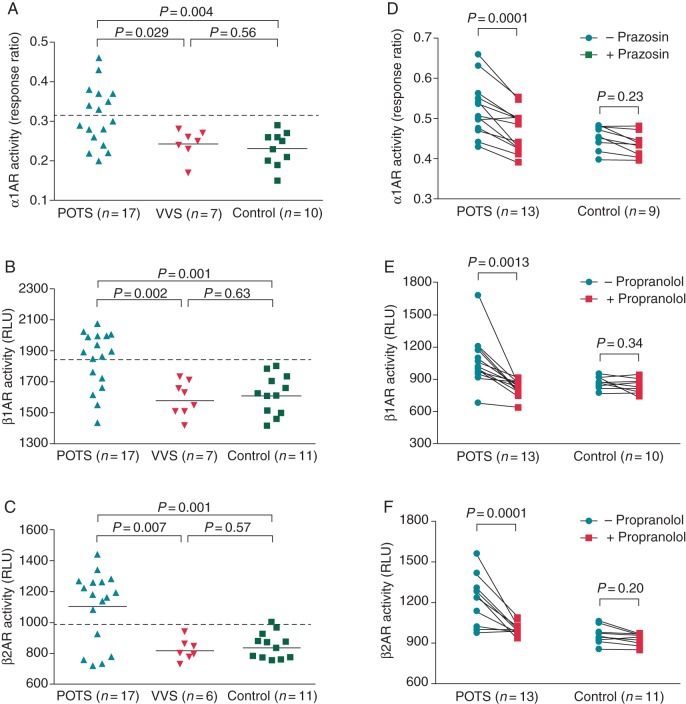
Effects of serum IgG (0.1 mg/mL) from POTS and VVS patients and healthy control subjects on direct activation of α1AR, β1AR, and β2AR in cell-based bioassays. The α1AR activity is expressed as the FRET blue/green response ratio, and the β1/2AR activity is expressed as RLU. There was a significant increase in α1AR (A), β1AR (B), and β2AR (C) activity in the POTS group compared with the VVS and control groups. The addition of the α1 blocker prazosin (10 µM) or non-selective β-blocker propranolol (1 µM), respectively, suppressed the α1AR (D), β1AR (E), and β2AR (F) activity values to control levels. The dashed line is the threshold derived from the mean activity values + 2SD of the healthy controls.
Figure 2
Figure 2
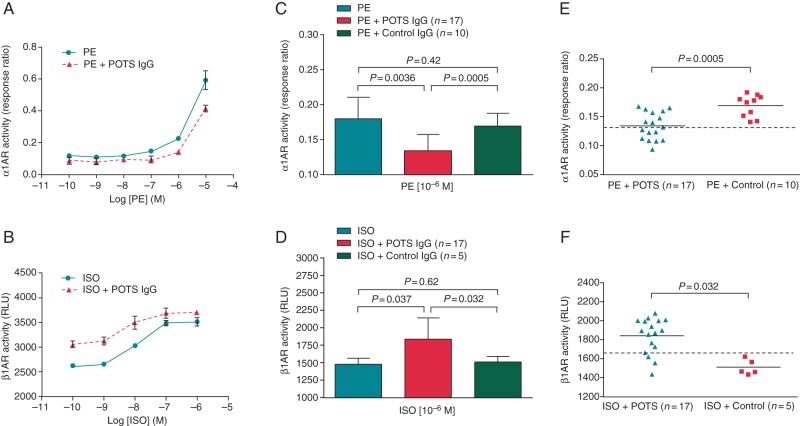
Effects of IgG (0.1 mg/mL) from POTS patients on PE and ISO responses in cell-based assays. IgG from 3 POTS patients with α1AR-activating activity shifted the PE dosage response curve to the right indicating an inhibitory allosteric effect (A). In contrast, IgG from 3 β1AR antibody-positive POTS patients shifted the ISO dosage response curve to the left compatible with a positive allosteric effect. Control IgG failed to alter these curves. When IgG from all 17 POTS patients was tested in the presence of PE (1 µM) or isoproterenol (1 µM), there was a significant decrease in the PE response compared with PE alone and control IgG (C) and a significant increase in the ISO response compared with ISO alone and control IgG (D). Control IgG showed minimal modulating effects. Individual data from (C) and (D) for the POTS and control subjects are shown in (E) and (F), respectively. The dashed line is the threshold derived from the control mean values—2SD for the α1AR-modulating effect or control mean values + 2SD for the β1AR-modulating effect.
Figure 3
Figure 3
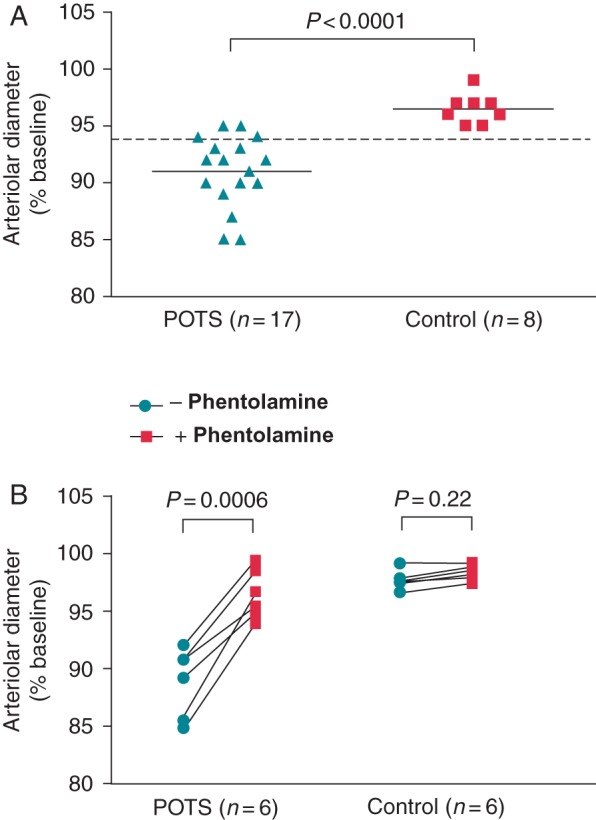
Effects of IgG (0.05 mg/mL) from POTS patients and healthy control subjects on arteriolar contractility in isolated rat cremaster arteriole assay. Values are expressed as % of buffer baseline. IgG was tested in the presence of propranolol (1 µM) and the nitric oxide synthase inhibitor L-NAME (1 µM) to eliminate any β2AR- and M3 muscarinic receptor-mediated vasodilation. Thirteen of the 17 POTS patients demonstrated significant vasoconstrictive activity compared with eight control subjects (A). No significant vasoconstriction was observed for the control subjects. The dashed line is the threshold derived from the mean contractility values—2SD of the healthy controls. The addition of the α1AR blocker phentolamine (10 µM) markedly suppressed and reversed POTS IgG-mediated contractility to control levels (B). There was no significant change in contractile activity with phentolamine for the control IgG.

References

    1. Benarroch EE. Postural tachycardia syndrome: a heterogeneous and multifactorial disorder. Mayo Clin Proc 2012;87:1214–25. - PMC - PubMed
    1. Sheldon RS, Grubb BP 2nd, Olshansky B, Shen WK, Calkins H, Brignole M et al. 2015 Heart Rhythm Society Expert Consensus Statement on the diagnosis and treatment of postural tachycardia syndrome, inappropriate sinus tachycardia, and vasovagal syncope. Heart Rhythm 2015;12:e41–63. - PMC - PubMed
    1. Low PA, Opfer-Gehrking TL, Textor SC, Benarroch EE, Shen WK, Schondorf R et al. Postural tachycardia syndrome (POTS). Neurology 1995;45:S19–25. - PubMed
    1. Moya A, Sutton R, Ammirati F, Blanc JJ, Brignole M, Dahm JB et al. Guidelines for the diagnosis and management of syncope (version 2009). Eur Heart J 2009;30:2631–71. - PMC - PubMed
    1. Brignole M, Menozzi C, Del Rosso A, Costa S, Gaggioli G, Bottoni N et al. New classification of haemodynamics of vasovagal syncope: beyond the VASIS classification. Analysis of the pre-syncopal phase of the tilt test without and with nitroglycerin challenge. Vasovagal Syncope International Study. Europace 2000;2:66–76. - PubMed

MeSH terms

Substances