


Low birth weight and features of neuroticism and mood disorder in 83 545 participants of the UK Biobank cohort
- PMID: 27703752
- PMCID: PMC4995581
- DOI: 10.1192/bjpo.bp.115.002154
Low birth weight and features of neuroticism and mood disorder in 83 545 participants of the UK Biobank cohort
Abstract
Background: Low birth weight has been inconsistently associated with risk of developing affective disorders, including major depressive disorder (MDD). To date, studies investigating possible associations between birth weight and bipolar disorder (BD), or personality traits known to predispose to affective disorders such as neuroticism, have not been conducted in large cohorts.
Aims: To assess whether very low birth weight (<1500 g) and low birth weight (1500-2490 g) were associated with higher neuroticism scores assessed in middle age, and lifetime history of either MDD or BD. We controlled for possible confounding factors.
Method: Retrospective cohort study using baseline data on the 83 545 UK Biobank participants with detailed mental health and birth weight data. Main outcomes were prevalent MDD and BD, and neuroticism assessed using the Eysenck Personality Inventory Neuroticism scale - Revised (EPIN-R).
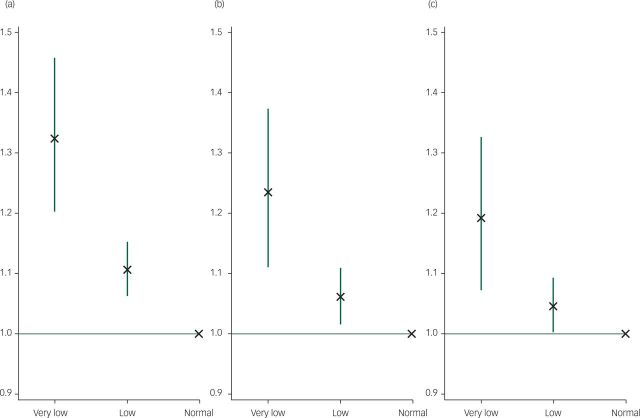
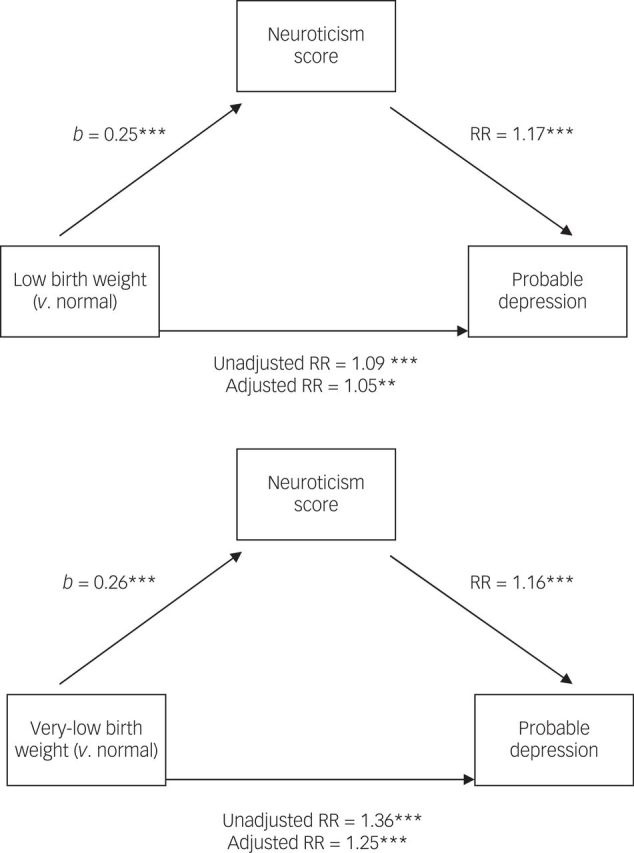
Results: Referent to normal birth weight, very low/low birth weight were associated with higher neuroticism scores, increased MDD and BD. The associations between birth weight category and MDD were partially mediated by higher neuroticism.
Conclusions: These findings suggest that intrauterine programming may play a role in lifetime vulnerability to affective disorders.
Declaration of interest: None.
Copyright and usage: © The Royal College of Psychiatrists 2016. This is an open access article distributed under the terms of the Creative Commons Non-Commercial, No Derivatives (CC BY-NC-ND) licence.
Figures
References
-
- Whincup PH, Kaye SJ, Owen CG, Huxley R, Cook DG, Anazawa S, et al. Birth weight and risk of type 2 diabetes: a systematic review. JAMA 2008; 300: 2886–97. - PubMed
-
- Pesonen AK, Räikkönen K, Heinonen K, Andersson S, Hovi P, Järvenpää AL, et al. Personality of young adults born prematurely: the Helsinki study of very low birth weight adults. J Child Psychol Psychiatry Allied Discip 2008; 49: 609–17. - PubMed
-
- Schmidt LA, Miskovic V, Boyle MH, Saigal S. Shyness and timidity in young adults who were born at extremely low birth weight. Pediatrics 2008; 122: e181–7. - PubMed
-
- Allin M, Rooney M, Cuddy M, Wyatt J, Walshe M, Rifkin L, et al. Personality in young adults who are born preterm. Pediatrics 2006; 117: 309–16. - PubMed
Grants and funding
LinkOut - more resources
Full Text Sources
Other Literature Sources
