Review
. 2016:2016:8268569.
doi: 10.1155/2016/8268569. Epub 2016 Sep 14.

Advanced Hemodynamic Management in Patients with Septic Shock

Affiliations
Review

Advanced Hemodynamic Management in Patients with Septic Shock

Bernd Saugel et al. Biomed Res Int. 2016.

Abstract

In patients with sepsis and septic shock, the hemodynamic management in both early and later phases of these "organ dysfunction syndromes" is a key therapeutic component. It needs, however, to be differentiated between "early goal-directed therapy" (EGDT) as proposed for the first 6 hours of emergency department treatment by Rivers et al. in 2001 and "hemodynamic management" using advanced hemodynamic monitoring in the intensive care unit (ICU). Recent large trials demonstrated that nowadays protocolized EGDT does not seem to be superior to "usual care" in terms of a reduction in mortality in emergency department patients with early identified septic shock who promptly receive antibiotic therapy and fluid resuscitation. "Hemodynamic management" comprises (a) making the diagnosis of septic shock as one differential diagnosis of circulatory shock, (b) assessing the hemodynamic status including the identification of therapeutic conflicts, and (c) guiding therapeutic interventions. We propose two algorithms for hemodynamic management using transpulmonary thermodilution-derived variables aiming to optimize the cardiocirculatory and pulmonary status in adult ICU patients with septic shock. The complexity and heterogeneity of patients with septic shock implies that individualized approaches for hemodynamic management are mandatory. Defining individual hemodynamic target values for patients with septic shock in different phases of the disease must be the focus of future studies.


Figures
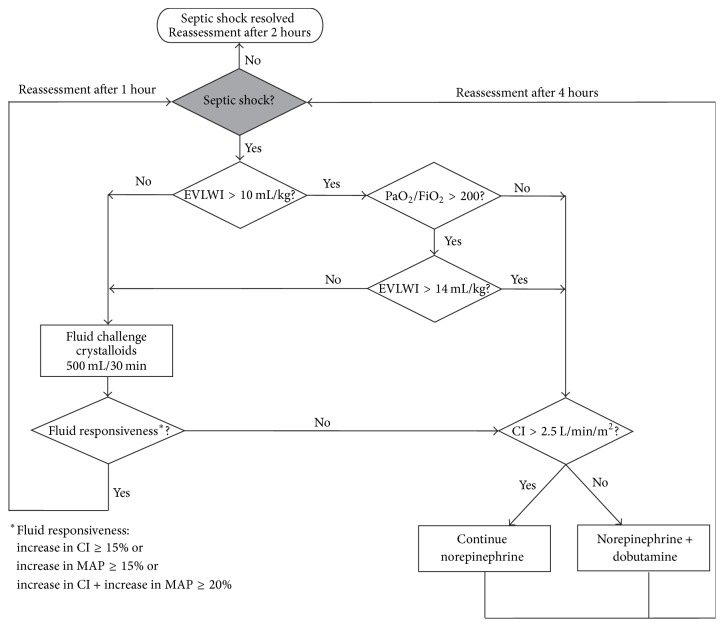
Figure 1
Figure 1
Algorithm  1—treatment algorithm for the first 24 hours of hemodynamic management. Hemodynamic therapeutic interventions in Algorithm  1 include fluids (crystalloids), a vasopressor (norepinephrine), and an inotrope (dobutamine) titrated according to extravascular lung water index (EVLWI) and cardiac index (CI). Crystalloids are given as a bolus of 500 mL (fluid challenge). We define fluid responsiveness as an increase in CI of ≥15% or an increase in mean arterial pressure (MAP) of ≥15% or a cumulative increase in CI and MAP of ≥20% (given that the dose of vasopressors is kept constant). EVLWI is complemented by the arterial partial pressure of oxygen (PaO2)/fraction of inspired oxygen (FiO2) ratio to account for the individual pulmonary function of the patient.
Figure 2
Figure 2
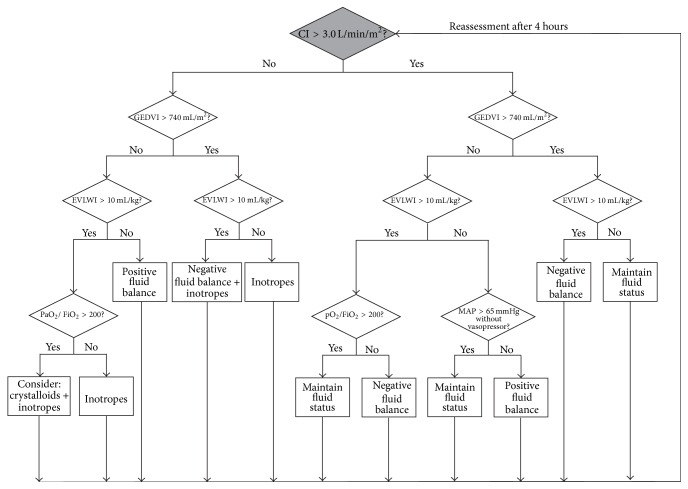
Algorithm  2—treatment algorithm for hemodynamic management during the intensive care unit stay following the initial 24 hours. Algorithm  2 gives treatment recommendations based on cardiac index (CI), global end-diastolic volume index (GEDVI), extravascular lung water index (EVLWI), and mean arterial pressure (MAP). EVLWI is complemented by the arterial partial pressure of oxygen (PaO2)/fraction of inspired oxygen (FiO2) ratio to account for the individual pulmonary function of the patient. During treatment according to Algorithm  2 all patients receive norepinephrine to maintain a MAP of ≥65 mmHg.

References

    1. Singer M., Deutschman C. S., Seymour C. W., et al. The third international consensus definitions for sepsis and septic shock (Sepsis-3) The Journal of the American Medical Association. 2016;315(8):801–810. doi: 10.1001/jama.2016.0287. - DOI - PMC - PubMed
    1. Rivers E., Nguyen B., Havstad S., et al. Early goal-directed therapy in the treatment of severe sepsis and septic shock. The New England Journal of Medicine. 2001;345(19):1368–1377. doi: 10.1056/nejmoa010307. - DOI - PubMed
    1. Dellinger R. P., Levy M. M., Rhodes A., et al. Surviving sepsis campaign: international guidelines for management of severe sepsis and septic shock: 2012. Critical Care Medicine. 2013;41(2):580–637. doi: 10.1097/ccm.0b013e31827e83af. - DOI - PubMed
    1. Yealy D. M., Kellum J. A., Huang D. T., et al. A randomized trial of protocol-based care for early septic shock. The New England Journal of Medicine. 2014;370(18):1683–1693. doi: 10.1056/nejmoa1401602. - DOI - PMC - PubMed
    1. Peake S. L., Delaney A., Bailey M., et al. Goal-directed resuscitation for patients with early septic shock. The New England Journal of Medicine. 2014;371(16):1496–1506. doi: 10.1056/nejmoa1404380. - DOI - PubMed

LinkOut - more resources