. 2016 Sep 28;1(5):e00213-16.
doi: 10.1128/mSphere.00213-16. eCollection 2016 Sep-Oct.

Genome Diversity, Recombination, and Virulence across the Major Lineages of Paracoccidioides

Affiliations

Genome Diversity, Recombination, and Virulence across the Major Lineages of Paracoccidioides

José F Muñoz et al. mSphere. .

Abstract

The Paracoccidioides genus includes two species of thermally dimorphic fungi that cause paracoccidioidomycosis, a neglected health-threatening human systemic mycosis endemic to Latin America. To examine the genome evolution and the diversity of Paracoccidioides spp., we conducted whole-genome sequencing of 31 isolates representing the phylogenetic, geographic, and ecological breadth of the genus. These samples included clinical, environmental and laboratory reference strains of the S1, PS2, PS3, and PS4 lineages of P. brasiliensis and also isolates of Paracoccidioides lutzii species. We completed the first annotated genome assemblies for the PS3 and PS4 lineages and found that gene order was highly conserved across the major lineages, with only a few chromosomal rearrangements. Comparing whole-genome assemblies of the major lineages with single-nucleotide polymorphisms (SNPs) predicted from the remaining 26 isolates, we identified a deep split of the S1 lineage into two clades we named S1a and S1b. We found evidence for greater genetic exchange between the S1b lineage and all other lineages; this may reflect the broad geographic range of S1b, which is often sympatric with the remaining, largely geographically isolated lineages. In addition, we found evidence of positive selection for the GP43 and PGA1 antigen genes and genes coding for other secreted proteins and proteases and lineage-specific loss-of-function mutations in cell wall and protease genes; these together may contribute to virulence and host immune response variation among natural isolates of Paracoccidioides spp. These insights into the recent evolutionary events highlight important differences between the lineages that could impact the distribution, pathogenicity, and ecology of Paracoccidioides. IMPORTANCE Characterization of genetic differences between lineages of the dimorphic human-pathogenic fungus Paracoccidioides can identify changes linked to important phenotypes and guide the development of new diagnostics and treatments. In this article, we compared genomes of 31 diverse isolates representing the major lineages of Paracoccidioides spp. and completed the first annotated genome sequences for the PS3 and PS4 lineages. We analyzed the population structure and characterized the genetic diversity among the lineages of Paracoccidioides, including a deep split of S1 into two lineages (S1a and S1b), and differentiated S1b, associated with most clinical cases, as the more highly recombining and diverse lineage. In addition, we found patterns of positive selection in surface proteins and secreted enzymes among the lineages, suggesting diversifying mechanisms of pathogenicity and adaptation across this species complex. These genetic differences suggest associations with the geographic range, pathogenicity, and ecological niches of Paracoccidioides lineages.

Keywords: Paracoccidioides; evolution; genetic recombination; genome analysis; mycology; population genetics.


Figures
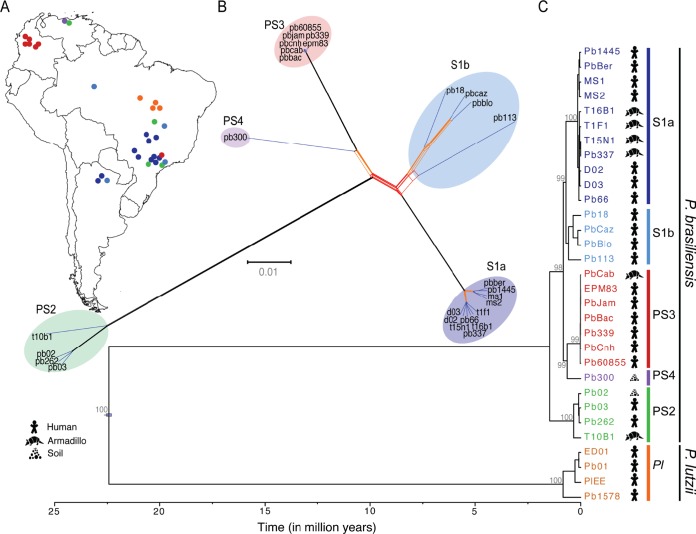
FIG 1
FIG 1
Phylogeny and recombination in Paracoccidioides. Two methods were used to examine strain relationships originating from across South America (A): using 614,570 SNPs, including a phylogenetic network constructed with SplitsTree4 (B), and a Bayesian calibrated phylogeny constructed with BEAST (C); bootstrap values from maximum likelihood phylogeny constructed with RAxML were included for major subdivisions. Both methods show evidence of five distinct lineages in P. brasiliensis: S1 (blue), which is divided into two groups S1a (dark blue) and S1b (light blue), PS2 (green), PS3 (red), and the recently described PS4 (purple). Also, this phylogeny supports the divergence between P. brasiliensis and P. lutzii (Pl [orange]) as a different species. In addition, the phylogenetic network of P. brasiliensis suggests patterns of recombination (red branches).
FIG 2
FIG 2
Classification of population-specific SNP alleles. The percentage of the distribution of SNP alleles is shown for each pairwise comparison among the six lineages of Paracoccidioides spp. SNP alleles were classified as fixed (blue), shared (red), private A (light gray [for each pairwise comparison specific to the first lineage in the x axis]), and private B (dark gray [specific to the second lineage]).
FIG 3
FIG 3
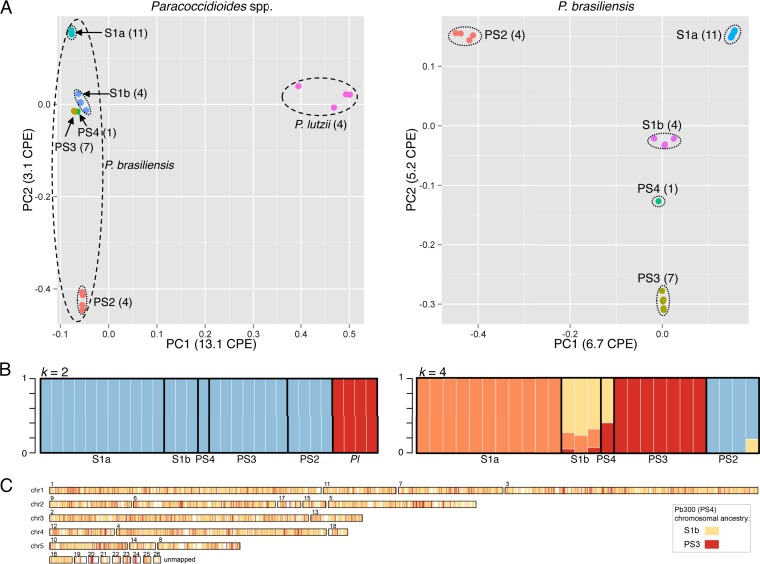
Genetic population structure of Paracoccidioides. (A) PCA of genetic variants in Paracoccidioides is shown as a two-dimensional plot for all isolates (n = 31) (left) or for all P. brasiliensis isolates (n = 26) (right). In each plot, circles indicate isolates and colors indicate the lineage. (B) Population structure of Paracoccidioides spp. (left) and P. brasiliensis (right) inferred from 476,589 and 339,966 SNPs, respectively, using the Structure software program with different k values of 2 and 4, respectively. An admixture model with correlated allele frequencies and site-by-site analysis was used. Each isolate is represented by a single vertical line broken into k-colored segments, with lengths proportional to each of the k inferred clusters. (C) Whole-genome plot for Pb300 (PS4) deducted from Structure site-by-site analysis showing the chromosomal ancestry.
FIG 4
FIG 4
Genome-wide nucleotide diversity (π [Pi]), Tajima’s D (TD), and population divergence analysis (FST) in Paracoccidioides. (A) Genome-wide average of nucleotide diversity (π) and TD for sliding windows of 10-kb regions within the main Paracoccidioides lineages. (B) Average of genome-wide (10-kb windows) variation in (θ), Weir’s formulation of Wright’s fixation index (FST), for pairwise comparisons in each lineage. (C) Distribution of the average nucleotide diversity (π), TD, and FST for sliding windows of 10-kb regions for the S1a, S1b, PS3, and PS3 Paracoccidioides lineages.
FIG 5
FIG 5
Genes under positive selection in Paracoccidioides. Shown is a histogram of the dN/dS values comparing P. brasiliensis (Pb18) and P. lutzii (Pb01). Genes undergoing positive selection (dN/dS of >1) are in blue.

References

    1. Bocca AL, Amaral AC, Teixeira MM, Sato PK, Shikanai-Yasuda MA, Soares Felipe MS. 2013. Paracoccidioidomycosis: eco-epidemiology, taxonomy and clinical and therapeutic issues. Future Microbiol 8:1177–1191. doi: 10.2217/fmb.13.68. - DOI - PubMed
    1. Bellissimo-Rodrigues F, Vitali LH, Martinez R. 2010. Serological diagnosis of paracoccidioidomycosis in HIV-coinfected patients. Mem Inst Oswaldo Cruz 105:904–907. doi: 10.1590/S0074-02762010000700011. - DOI - PubMed
    1. Brummer E, Castaneda E, Restrepo A. 1993. Paracoccidioidomycosis: an update. Clin Microbiol Rev 6:89–117. doi: 10.1128/CMR.6.2.89. - DOI - PMC - PubMed
    1. Teixeira MM, Theodoro RC, de Carvalho MJ, Fernandes L, Paes HC, Hahn RC, Mendoza L, Bagagli E, San-Blas G, Felipe MS. 2009. Phylogenetic analysis reveals a high level of speciation in the Paracoccidioides genus. Mol Phylogenet Evol 52:273–283. doi: 10.1016/j.ympev.2009.04.005. - DOI - PubMed
    1. Matute DR, McEwen JG, Puccia R, Montes BA, San-Blas G, Bagagli E, Rauscher JT, Restrepo A, Morais F, Niño-Vega G, Taylor JW. 2006. Cryptic speciation and recombination in the fungus Paracoccidioides brasiliensis as revealed by gene genealogies. Mol Biol Evol 23:65–73. doi: 10.1093/molbev/msj008. - DOI - PubMed