


Age-related alterations in female obturator internus muscle
- PMID: 27704154
- PMCID: PMC5450648
- DOI: 10.1007/s00192-016-3167-5
Age-related alterations in female obturator internus muscle
Abstract
Introduction and hypothesis: Pelvic floor muscle rehabilitation is a widely utilized, but often challenging therapy for pelvic floor disorders, which are prevalent in older women. Regimens involving the use of appendicular muscles, such as the obturator internus (OI), have been developed for strengthening of the levator ani muscle (LAM). However, changes that lead to potential dysfunction of these alternative targets in older women are not well known. We hypothesized that aging negatively impacts OI architecture, the main determinant of muscle function, and intramuscular extracellular matrix (ECM), paralleling age-related alterations in LAM.
Methods: OI and LAM were procured from three groups of female cadaveric donors (five per group): younger (20 - 40 years), middle-aged (41 - 60 years), and older (≥60 years). Architectural predictors of the excursional (fiber length, L f), force-generating (physiological cross-sectional area, PCSA) and sarcomere length (L s) capacity of the muscles, and ECM collagen content (measure of fibrosis) were determined using validated methods. The data were analyzed using one-way ANOVA and Tukey's post-hoc test with a significance level of 0.05, and linear regression.
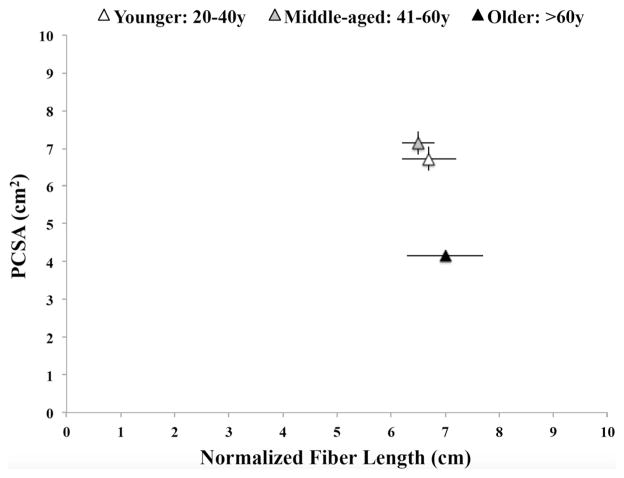
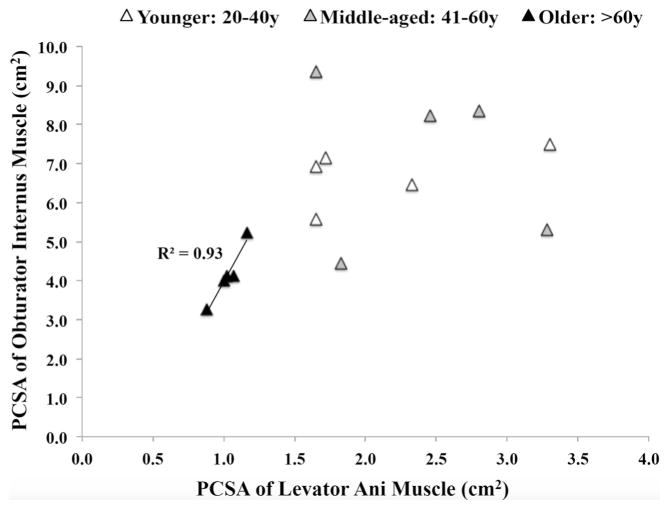
Results: The mean ages of the donors in the three groups were 31.2 ± 2.3 years, 47.6 ± 1.2 years, and 74.6 ± 4.2 years (P < 0.005). The groups did not differ with respect to parity or body mass index (P > 0.5). OI L f and L s were not affected by aging. Age >60 years was associated with a substantial decrease in OI PCSA and increased collagen content (P < 0.05). Reductions in OI and LAM force-generating capacities with age were highly correlated (r 2 = 0.9).
Conclusions: Our findings of age-related decreases in predicted OI force production and fibrosis suggest that these alterations should be taken into consideration, when designing pelvic floor fitness programs for older women.
Keywords: Aging; Muscle architecture; Obturator internus; Pelvic floor rehabilitation.
Conflict of interest statement
Figures
References
-
- DeLancey JO. Pelvic organ prolapse: clinical management and scientific foundations. Clin Obstet Gynecol. 1993;36:895–896.
-
- Subak LL, Waetjen LE, van den Eeden S, Thom DH, Vittinghoff E, Brown JS. Cost of pelvic organ prolapse surgery in the United States. Obstet Gynecol. 2001;98:646–651. - PubMed
-
- Wilson L, Brown JS, Shin GP, Luc KO, Subak LL. Annual direct cost of urinary incontinence. Obstet Gynecol. 2001;98:398–406. - PubMed
-
- Bo K, Kvarstein B, Nygaard I. Lower urinary tract symptoms and pelvic floor muscle exercise adherence after 15 years. Obstet Gynecol. 2005;105:999–1005. - PubMed
MeSH terms
Substances
Grants and funding
LinkOut - more resources
Full Text Sources
Other Literature Sources
Medical
