


Recent Tissue Engineering Advances for the Treatment of Temporomandibular Joint Disorders
- PMID: 27704395
- PMCID: PMC5106310
- DOI: 10.1007/s11914-016-0327-y
Recent Tissue Engineering Advances for the Treatment of Temporomandibular Joint Disorders
Abstract
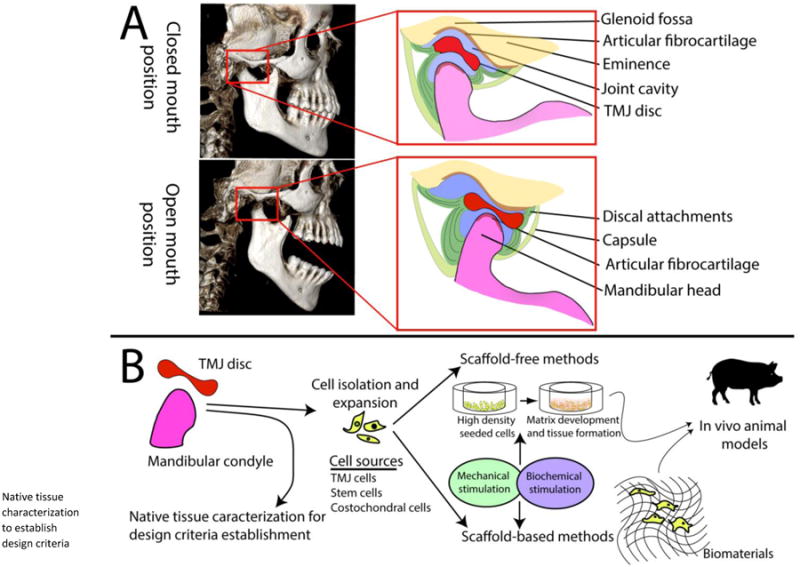
Temporomandibular disorders (TMDs) are among the most common maxillofacial complaints and a major cause of orofacial pain. Although current treatments provide short- and long-term relief, alternative tissue engineering solutions are in great demand. Particularly, the development of strategies, providing long-term resolution of TMD to help patients regain normal function, is a high priority. An absolute prerequisite of tissue engineering is to understand normal structure and function. The current knowledge of anatomical, mechanical, and biochemical characteristics of the temporomandibular joint (TMJ) and associated tissues will be discussed, followed by a brief description of current TMD treatments. The main focus is on recent tissue engineering developments for regenerating TMJ tissue components, with or without a scaffold. The expectation for effectively managing TMD is that tissue engineering will produce biomimetic TMJ tissues that recapitulate the normal structure and function of the TMJ.
Keywords: Condylar fibrocartilage; Scaffold-based tissue engineering; Scaffold-free tissue engineering; TMD treatment methods; Temporomandibular joint disc; Temporomandibular joint disorder.
Conflict of interest statement
Compliance with Ethics Guidelines: Ashkan Aryaei, Natalia Vapniarsky, and Jerry Hu report no conflicts of interest.
Figures
References
-
- Gatchel RJ, Stowell AW, Wildenstein L, Riggs R, Ellis E. Efficacy of an early intervention for patients with acute temporomandibular disorder–related pain: a one-year outcome study. J Am Dent Assoc. 2006;137:339–347. - PubMed
-
- Solberg WK, Woo MW, Houston JB. Prevalence of mandibular dysfunction in young adults. J Am Dent Assoc. 1979;98:25–34. - PubMed
-
- Zarb GA, Carlsson GE. Temporomandibular disorders: osteoarthritis. J Orofac Pain. 1999;13 - PubMed
-
- Van Loon JP, De Bont L, Stegenga B, Spijkervet F, Verkerke G. Groningen temporomandibular joint prosthesis. Development and first clinical application. Int J Oral Maxillofac Surg. 2002;31:44–52. - PubMed
Publication types
MeSH terms
Grants and funding
LinkOut - more resources
Full Text Sources
Other Literature Sources
Medical
