Reliability of Actigraphy and Subjective Sleep Measurements in Adults: The Design of Sleep Assessments
- PMID: 27707448
- PMCID: PMC5181612
- DOI: 10.5664/jcsm.6384
Reliability of Actigraphy and Subjective Sleep Measurements in Adults: The Design of Sleep Assessments
Abstract
Study objectives: The aim of the study was to investigate how many nights of measurement are needed for a reliable measure of sleep in a working population including adult women and men.
Methods: In all, 54 individuals participated in the study. Sleep was assessed for 7 consecutive nights using actigraphy as an objective measure, and the Karolinska sleep diary for a subjective measure of quality. Using intra-class correlation and the Spearman-Brown formula, calculations of how many nights of measurements were required for a reliable measure were performed. Differences in reliability according to whether or not weekend measurements were included were investigated. Further, the correlation between objectively (actigraphy) measured sleep and subjectively measured sleep quality was studied over the different days of the week.
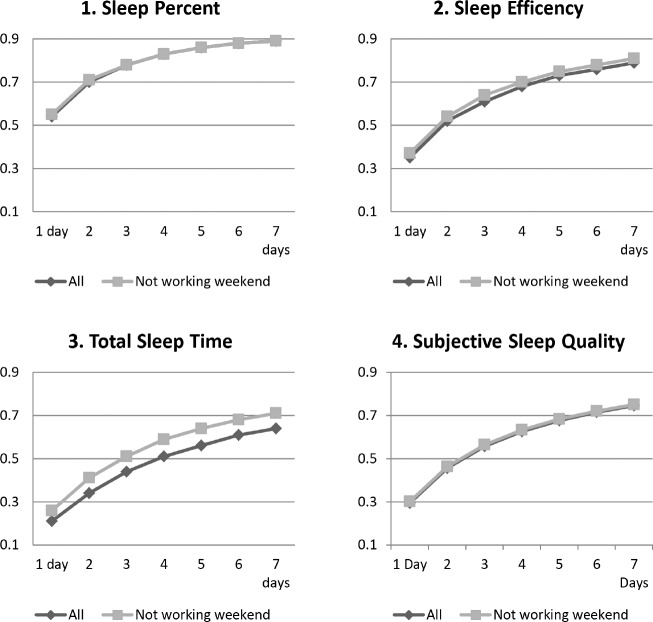
Results/conclusions: The results concerning actigraphy sleep measures suggest that data from at least 2 nights are to be recommended when assessing sleep percent and at least 5 nights when assessing sleep efficiency. For actigraphy-measured total sleep time, more than 7 nights are needed. At least 6 nights of measurements are required for a reliable measure of self-reported sleep. Fewer nights (days) are required if measurements include only week nights. Overall, there was a low correlation between the investigated actigraphy sleep parameters and subjective sleep quality, suggesting that the two methods of measurement capture different dimensions of sleep.
Keywords: actigraph; method; repeated measures; sleep diary; sleep efficiency; sleep quality.
© 2017 American Academy of Sleep Medicine
Figures
References
-
- The Swedish Social Insurance Agency Web site. [Accessed October, 2015]. https://www.forsakringskassan.se/statistik/statistik_och_analys2/Sjuk/sj....
-
- Akerstedt T, Kecklund G, Gillberg M. Sleep and sleepiness in relation to stress and displaced work hours. Physiol Behav. 2007;92(1-2):250–255. - PubMed
-
- de Lange AH, Kompier MA, Taris TW, et al. A hard day's night: a longitudinal study on the relationships among job demands and job control, sleep quality and fatigue. J Sleep Res. 2009;18(3):374–383. - PubMed
-
- Elovainio M, Kivimaki M, Vahtera J, Keltikangas-Jarvinen L, Virtanen M. Sleeping problems and health behaviors as mediators between organizational justice and health. Health Psychol. 2003;22(3):287–293. - PubMed
Publication types
MeSH terms
LinkOut - more resources
Full Text Sources
Other Literature Sources
Medical