


Characterizing the reproduction number of epidemics with early subexponential growth dynamics
- PMID: 27707909
- PMCID: PMC5095223
- DOI: 10.1098/rsif.2016.0659
Characterizing the reproduction number of epidemics with early subexponential growth dynamics
Abstract
Early estimates of the transmission potential of emerging and re-emerging infections are increasingly used to inform public health authorities on the level of risk posed by outbreaks. Existing methods to estimate the reproduction number generally assume exponential growth in case incidence in the first few disease generations, before susceptible depletion sets in. In reality, outbreaks can display subexponential (i.e. polynomial) growth in the first few disease generations, owing to clustering in contact patterns, spatial effects, inhomogeneous mixing, reactive behaviour changes or other mechanisms. Here, we introduce the generalized growth model to characterize the early growth profile of outbreaks and estimate the effective reproduction number, with no need for explicit assumptions about the shape of epidemic growth. We demonstrate this phenomenological approach using analytical results and simulations from mechanistic models, and provide validation against a range of empirical disease datasets. Our results suggest that subexponential growth in the early phase of an epidemic is the rule rather the exception. Mechanistic simulations show that slight modifications to the classical susceptible-infectious-removed model result in subexponential growth, and in turn a rapid decline in the reproduction number within three to five disease generations. For empirical outbreaks, the generalized-growth model consistently outperforms the exponential model for a variety of directly and indirectly transmitted diseases datasets (pandemic influenza, measles, smallpox, bubonic plague, cholera, foot-and-mouth disease, HIV/AIDS and Ebola) with model estimates supporting subexponential growth dynamics. The rapid decline in effective reproduction number predicted by analytical results and observed in real and synthetic datasets within three to five disease generations contrasts with the expectation of invariant reproduction number in epidemics obeying exponential growth. The generalized-growth concept also provides us a compelling argument for the unexpected extinction of certain emerging disease outbreaks during the early ascending phase. Overall, our approach promotes a more reliable and data-driven characterization of the early epidemic phase, which is important for accurate estimation of the reproduction number and prediction of disease impact.
Keywords: effective reproduction number; epidemics; exponential growth; generalized-growth model; phenomenological model; subexponential growth.
© 2016 The Author(s).
Figures
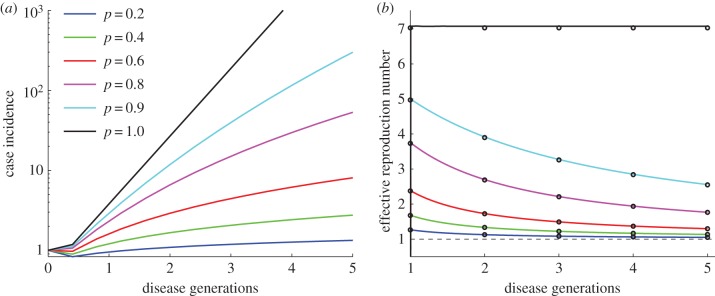
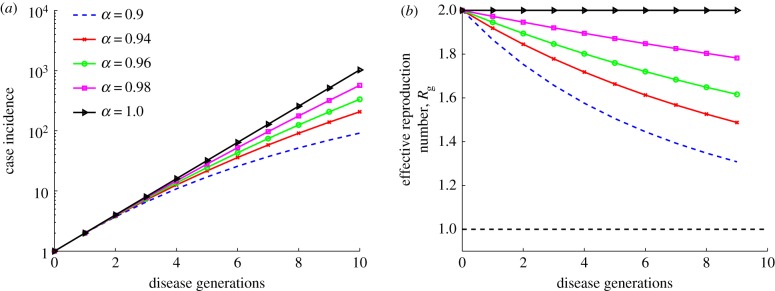
 . When p < 1 (subexponential growth) the reproduction number gradually declines over time and approaches 1.0 asymptotically. The black circles correspond to
  calculated using the analytical formula in equation (2.6), whereas the solid lines correspond to the estimates from numerical solutions based on renewal equation (2.7). (Online version in colour.)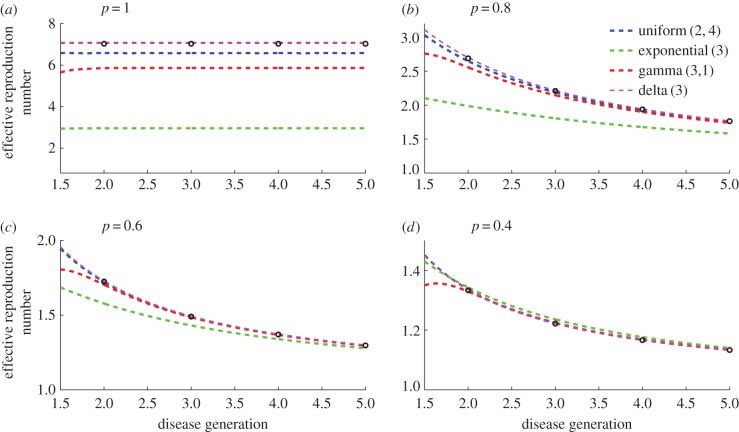
 when the generation interval is exponentially distributed [20],
  when the generation interval is fixed [20], and
  when the generation interval follows a gamma distribution with the shape and scale parameters given by a = 9 and b = 1/3 [20], respectively. For p < 1 (subexponential growth), the effective reproduction number approaches 1.0 asymptotically over disease generations. The reproduction number
  at fixed generation intervals can be explicitly computed using equation (2.6) (black circles). (Online version in colour.)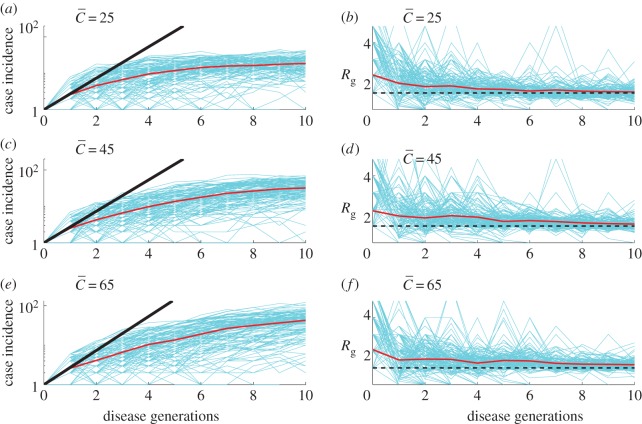
 , 45 and 65 households) while keeping the household size H fixed at 5. The household reproduction number R0H was set at 2.0 and the community reproduction number R0c was set at 0.7 based on a previous Ebola mathematical modelling study [12]. Each simulation started with one infectious individual. Early subexponential growth dynamics are observed across all scenarios, which is consistent with a declining trend in the effective reproduction number Rg. For comparison with exponential growth dynamics, the dark solid line illustrates exponential growth in case incidence over disease generations with a fixed reproduction number of 2.7. The horizontal dashed line at Rg = 1.0 is shown for reference. (Online version in colour.)
References
-
- Anderson RM, May RM. 1991. Infectious diseases of humans. Oxford, UK: Oxford University Press.
-
- Diekmann O, Heesterbeek J. 2000. Mathematical epidemiology of infectious diseases: model building, analysis and interpretation. London, UK: Wiley.
-
- Ross R. 1911. The prevention of malaria. London, UK: John Murray.
-
- Mollison D. 1995. Epidemic models: their structure and relation to data. Cambridge, UK: Cambridge University Press.
MeSH terms
Grants and funding
LinkOut - more resources
Full Text Sources
Other Literature Sources
