


Resistance to PARP inhibitors by SLFN11 inactivation can be overcome by ATR inhibition
- PMID: 27708213
- PMCID: PMC5340226
- DOI: 10.18632/oncotarget.12266
Resistance to PARP inhibitors by SLFN11 inactivation can be overcome by ATR inhibition
Abstract
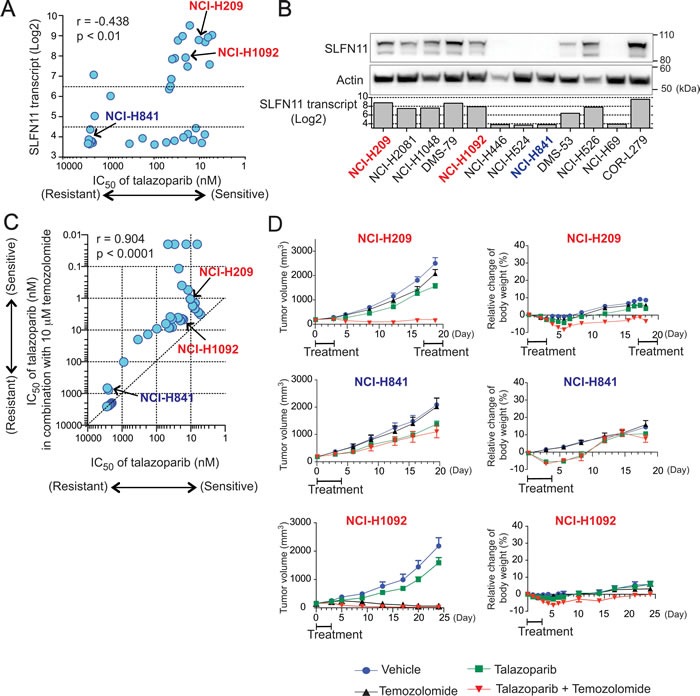
Poly(ADP-ribose) polymerase inhibitors (PARPIs) kill cancer cells by trapping PARP1 and PARP2. Talazoparib, the most potent PARPI inhibitor (PARPI), exhibits remarkable selectivity among the NCI-60 cancer cell lines beyond BRCA inactivation. Our genomic analyses reveal high correlation between response to talazoparib and Schlafen 11 (SLFN11) expression. Causality was established in four isogenic SLFN11-positive and -negative cell lines and extended to olaparib. Response to the talazoparib-temozolomide combination was also driven by SLFN11 and validated in 36 small cell lung cancer cell lines, and in xenograft models. Resistance in SLFN11-deficient cells was caused neither by impaired drug penetration nor by activation of homologous recombination. Rather, SLFN11 induced irreversible and lethal replication inhibition, which was independent of ATR-mediated S-phase checkpoint. The resistance to PARPIs by SLFN11 inactivation was overcome by ATR inhibition, mechanistically because SLFN11-deficient cells solely rely on ATR activation for their survival under PARPI treatment. Our study reveals that SLFN11 inactivation, which is common (~45%) in cancer cells, is a novel and dominant resistance determinant to PARPIs.
Keywords: ATR; BRCA; PARP inhibitor; PARP-trapping; homologous recombination.
Conflict of interest statement
Y. Feng, G. K. Yu, Y. Ru, and Y. Shen are employees of and have ownership interest in BioMarin Pharmaceutical Inc.. No potential conflicts of interest were disclosed by the other authors.
Figures



References
-
- Shen Y, Rehman FL, Feng Y, Boshuizen J, Bajrami I, Elliott R, Wang B, Lord CJ, Post LE, Ashworth A. BMN 673, a novel and highly potent PARP1/2 inhibitor for the treatment of human cancers with DNA repair deficiency. Clin Cancer Res. 2013;19:5003–15. doi: 10.1158/1078-0432.CCR-13-1391. - DOI - PMC - PubMed
-
- Benjamin RC, Gill DM. ADP-ribosylation in mammalian cell ghosts. Dependence of poly(ADP-ribose) synthesis on strand breakage in DNA. J Biol Chem. 1980;255:10493–501. doi: - PubMed
-
- Durkacz BW, Omidiji O, Gray DA, Shall S. (ADP-ribose)n participates in DNA excision repair. Nature. 1980;283:593–6. doi: - PubMed
MeSH terms
Substances
Grants and funding
LinkOut - more resources
Full Text Sources
Other Literature Sources
Miscellaneous
