Review
. 2016 Sep 21:7:1483.
doi: 10.3389/fmicb.2016.01483. eCollection 2016.

Multidrug Efflux Pumps at the Crossroad between Antibiotic Resistance and Bacterial Virulence

Affiliations
Review

Multidrug Efflux Pumps at the Crossroad between Antibiotic Resistance and Bacterial Virulence

Manuel Alcalde-Rico et al. Front Microbiol. .

Abstract

Multidrug efflux pumps can be involved in bacterial resistance to antibiotics at different levels. Some efflux pumps are constitutively expressed at low levels and contribute to intrinsic resistance. In addition, their overexpression may allow higher levels of resistance. This overexpression can be transient, in the presence of an effector (phenotypic resistance), or constitutive when mutants in the regulatory elements of the expression of efflux pumps are selected (acquired resistance). Efflux pumps are present in all cells, from human to bacteria and are highly conserved, which indicates that they are ancient elements in the evolution of different organisms. Consequently, it has been suggested that, besides antibiotic resistance, bacterial multidrug efflux pumps would likely contribute to other relevant processes of the microbial physiology. In the current article, we discuss some specific examples of the role that efflux pumps may have in the bacterial virulence of animals' and plants' pathogens, including the processes of intercellular communication. Based in these evidences, we propose that efflux pumps are at the crossroad between resistance and virulence of bacterial pathogens. Consequently, the comprehensive study of multidrug efflux pumps requires addressing these functions, which are of relevance for the bacterial-host interactions during infection.

Keywords: antibiotic resistance mechanisms; global regulation; multidrug efflux pumps; quorum sensing; virulence.


Figures
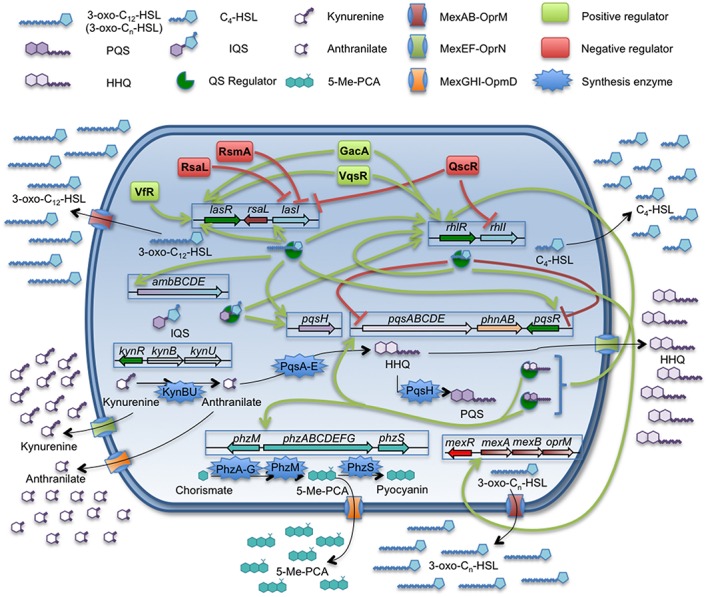
FIGURE 1
FIGURE 1
Quorum sensing network and related efflux pumps in P. aeruginosa. The QS signals produced by P. aeruginosa are: 3-oxo-C12-HSL, C4-HSL, PQS/HHQ, and the recently discovered IQS. The figure sums up the complexity of the QS regulation network and the implications of MexAB-OprM, MexEF-OprN, and MexGHI-OpmD efflux pumps on the extrusion of QSSMs, their precursors or molecules which expression is QS-regulated. Despite of C4-HSL is able to cross the cell envelopes by free diffusion, the expression of mexAB-oprM is triggered in presence of this autoinducer. Further, this efflux pump is able to extrude 3-oxo-C12-HSL and others related 3-oxo-Cn-HSL. The MexEF-OprN system is able to extrude HHQ and kynurenine, a precursor of 4-alkyl-quinolones, having an impact on the QS response. In the case of MexGHI-OpmD, its role has been recently linked to the extrusion of 5-Me-PCA, a precursor of the phenazine pyocyanin, whose production is induced upon the QS response. However, it has been proposed that this system is able to efflux anthranilic acid, another AQs intermediate, which is toxic for the cell at high concentrations. P. aeruginosa is a good example for the potential role of efflux systems in modulating the cell-to-cell communication networks.
FIGURE 2
FIGURE 2
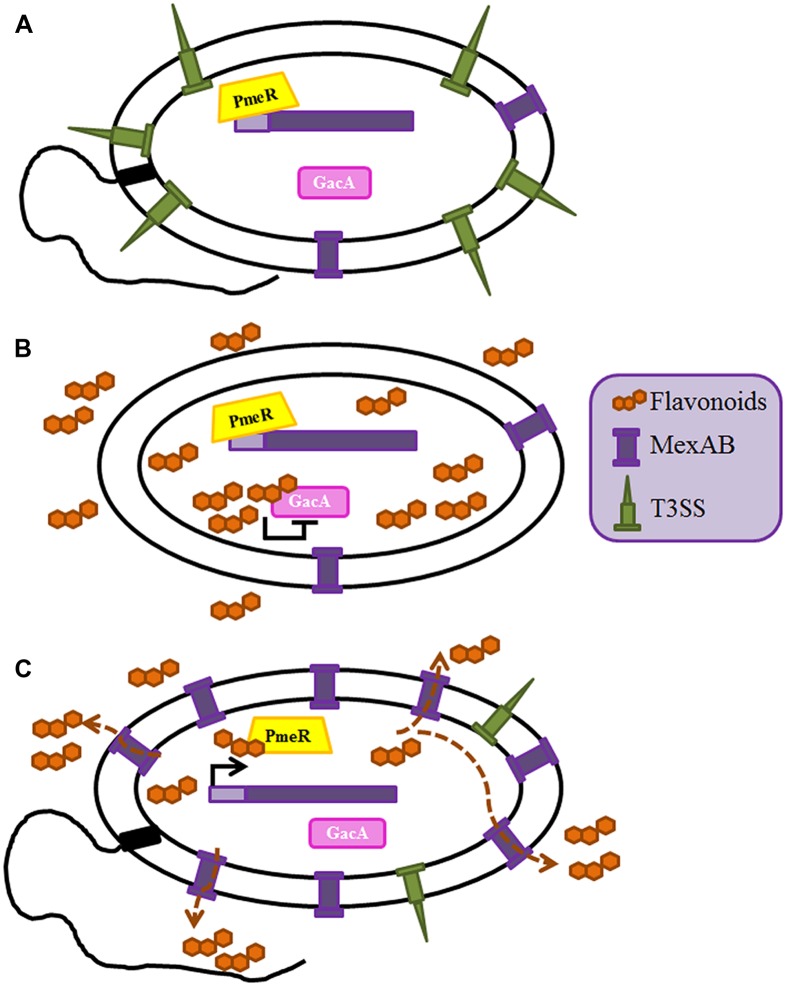
Role of the MexAB-OprM efflux pump in the adaptive co-evolution of plant defense and P. syringae virulence. The intracellular amount of the plant flavonoids is regulated by MexAB-OprM efflux pump. (A) Expression of mexAB-oprM is controlled by the transcriptional repressor PmeR; in the absence of flavonoids the expression of this efflux pump is repressed and expression of virulence determinants as the T3SS or bacterial motility is activated through the GacS/A TCS (Vargas et al., 2011). (B) The presence of flavonoids inhibits GacS/A, hence leading a transient low virulence phenotype, in which the expression of the T3SS and the motility are low (Vargas et al., 2013). (C) The accumulation of flavonoids inside the cell leads to over-expression of mexAB-oprM through the release of its transcriptional regulator PmeR from its operator. Since flavonoids are substrates of MexAB-OprM, under these conditions they are efficiently extruded and their intracellular concentration falls down below the threshold required for inactivating GacS/GacA. As a consequence of this situation, the virulent state of P. syringae is restored.

References

    1. Aendekerk S., Diggle S. P., Song Z., Hoiby N., Cornelis P., Williams P., et al. (2005). The MexGHI-OpmD multidrug efflux pump controls growth, antibiotic susceptibility and virulence in Pseudomonas aeruginosa via 4-quinolone-dependent cell-to-cell communication. Microbiology 151(Pt. 4), 1113–1125. 10.1099/mic.0.27631-0 - DOI - PubMed
    1. Al-Karablieh N., Weingart H., Ullrich M. S. (2009). The outer membrane protein TolC is required for phytoalexin resistance and virulence of the fire blight pathogen Erwinia amylovora. Microb. Biotechnol. 2 465–475. 10.1111/j.1751-7915.2009.00095.x - DOI - PMC - PubMed
    1. Alonso A., Martinez J. L. (2000). Cloning and characterization of SmeDEF, a novel multidrug efflux pump from Stenotrophomonas maltophilia. Antimicrob. Agents Chemother. 44 3079–3086. 10.1128/AAC.44.11.3079-3086.2000 - DOI - PMC - PubMed
    1. Alonso A., Martinez J. L. (2001). Expression of multidrug efflux pump SmeDEF by clinical isolates of Stenotrophomonas maltophilia. Antimicrob. Agents Chemother. 45 1879–1881. 10.1128/AAC.45.6.1879-1881.2001 - DOI - PMC - PubMed
    1. Alonso A., Rojo F., Martinez J. L. (1999). Environmental and clinical isolates of Pseudomonas aeruginosa show pathogenic and biodegradative properties irrespective of their origin. Environ. Microbiol. 1 421–430. 10.1046/j.1462-2920.1999.00052.x - DOI - PubMed

LinkOut - more resources