


Development of foraging skills in two orangutan populations: needing to learn or needing to grow?
- PMID: 27708679
- PMCID: PMC5041519
- DOI: 10.1186/s12983-016-0178-5
Development of foraging skills in two orangutan populations: needing to learn or needing to grow?
Erratum in
-
Correction to: development of foraging skills in two orangutan populations: needing to learn or needing to grow?Front Zool. 2018 Feb 8;15:2. doi: 10.1186/s12983-017-0237-6. eCollection 2018. Front Zool. 2018. PMID: 29449865 Free PMC article.
Abstract
Background: Orangutans have one of the slowest-paced life histories of all mammals. Whereas life-history theory suggests that the time to reach adulthood is constrained by the time needed to reach adult body size, the needing-to-learn hypothesis instead suggests that it is limited by the time needed to acquire adult-level skills. To test between these two hypotheses, we compared the development of foraging skills and growth trajectories of immature wild orangutans in two populations: at Tuanan (Pongo pygmaeus wurmbii), Borneo, and Suaq Balimbing (Pongo abelii), Sumatra. We collected behavioral data on diet repertoire, feeding rates and ranging competence during focal follows, and estimated growth through non-invasive laser photogrammetry.
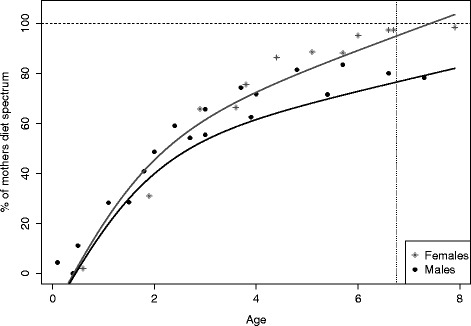
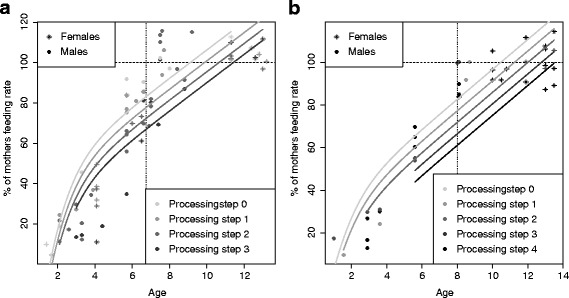
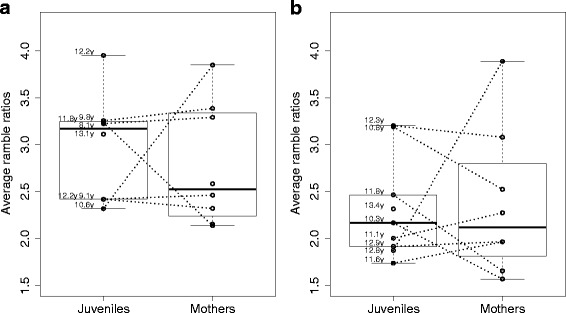
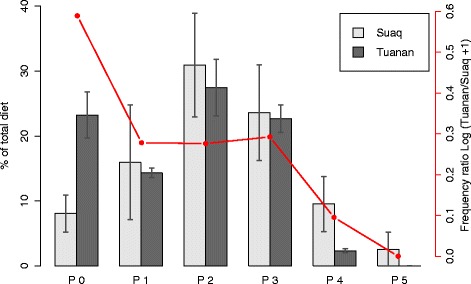
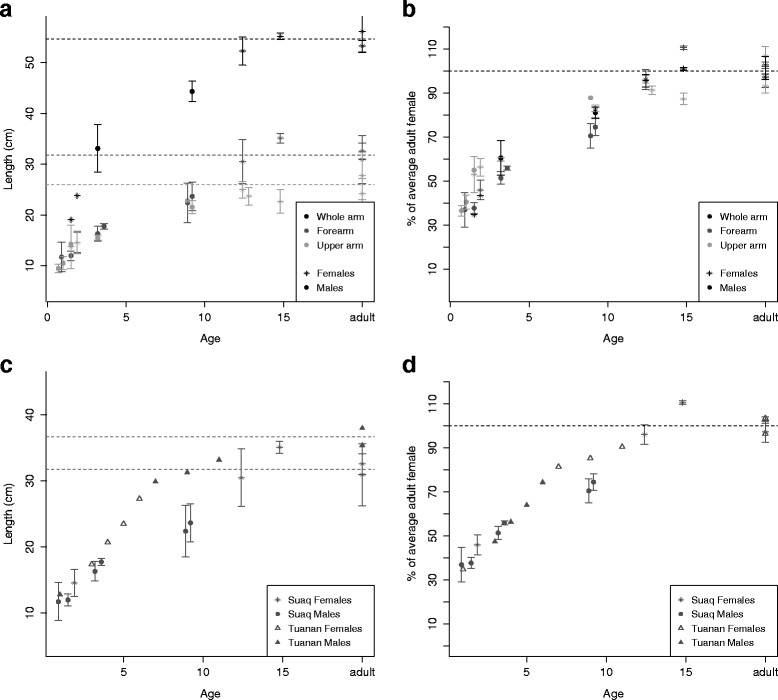
Results: We found that adult-like diet repertoires are attained around the age of weaning and that female immatures increase their repertoire size faster than their male peers. Adult-level feeding rates of easy techniques are reached just after weaning, but several years later for more difficult techniques, albeit always before adulthood (i.e. age at first reproduction). Independent immatures had faster feeding rates for easy to process items than their mothers, with male immatures achieving faster feeding rates earlier in development relative to females. Sumatran immatures reach adult-level feeding rates 2-3 years later than their Bornean peers, in line with their higher dietary complexity and later weaning. The range-use competence of independently ranging and weaned immatures is similar to that of adult females. Body size measurements showed, immatures grow until female age of first reproduction.
Conclusions: In conclusion, unlike in humans, orangutan foraging skills are in place prior to reproduction. Growth trajectories suggest that energetic constraints, rather than skills, best explain the length of immaturity. However, skill competence for dietary independence is reached later where the adult niche is more complex, which is consistent with the relatively later weaning age with increasing brain size found generally in primates, and apes in particular.
Keywords: Body growth; Development; Diet repertoire; Feeding rates; Foraging skills; Life history; Needing-to-learn hypothesis; Orangutans; Ranging; Skill learning.
Figures
References
-
- Charnov EL, Berrigan D. Why do female primates have such long lifespans and so few babies? or Life in the slow lane. Evolutionary Anthropology. 1993;1:191–194. doi: 10.1002/evan.1360010604. - DOI
-
- Read AF, Harvey PH. Life history differences among the eutherian radiations. J Zool (Lond) 1989;219:329–353. doi: 10.1111/j.1469-7998.1989.tb02584.x. - DOI
-
- van Schaik CP, Barrickman N, Bastian ML, Krakauer EB, Van Noordwijk MA. Primate life histories and the role of brains. In: Hawkes K, Paine RR, editors. The Evolution of Human Life History. Santa Fe: School of American Research Press; 2006. pp. 127–154.
-
- Charnov EL. The optimal balance between growth rate and survival in mammals. Evol Ecol Res. 2004;6:307–313. doi: 10.1007/BF02270967. - DOI
LinkOut - more resources
Full Text Sources
Other Literature Sources
