Review
. 2016 Sep 29:13:64.
doi: 10.1186/s12986-016-0124-8. eCollection 2016.

The impact of protein quality on the promotion of resistance exercise-induced changes in muscle mass

Affiliations
Review

The impact of protein quality on the promotion of resistance exercise-induced changes in muscle mass

Stuart M Phillips. Nutr Metab (Lond). .

Abstract

Protein supplementation during resistance exercise training augments hypertrophic gains. Protein ingestion and the resultant hyperaminoacidemia provides the building blocks (indispensable amino acids - IAA) for, and also triggers an increase in, muscle protein synthesis (MPS), suppression of muscle protein breakdown (MPB), and net positive protein balance (i.e., MPS > MPB). The key amino acid triggering the rise in MPS is leucine, which stimulates the mechanistic target of rapamycin complex-1, a key signalling protein, and triggers a rise in MPS. As such, ingested proteins with a high leucine content would be advantageous in triggering a rise in MPS. Thus, protein quality (reflected in IAA content and protein digestibility) has an impact on changes in MPS and could ultimately affect skeletal muscle mass. Protein quality has been measured by the protein digestibility-corrected amino acid score (PDCAAS); however, the digestible indispensable amino acid score (DIAAS) has been recommended as a better method for protein quality scoring. Under DIAAS there is the recognition that amino acids are individual nutrients and that protein quality is contingent on IAA content and ileal (as opposed to fecal) digestibility. Differences in protein quality may have important ramifications for exercise-induced changes in muscle mass gains made with resistance exercise as well as muscle remodelling. Thus, the purpose of this review is a critical appraisal of studies examining the effects of protein quality in supplementation on changes in muscle mass and strength as well as body composition during resistance training.

Keywords: DIAAS; Hypertrophy; Leucine.


Figures
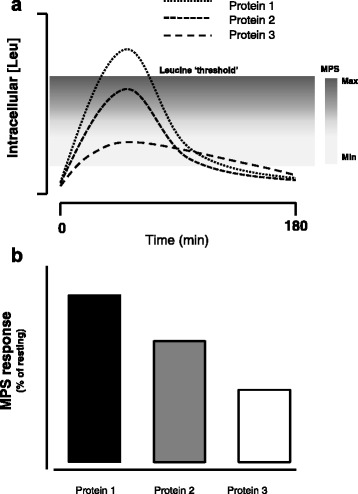
Fig. 1
Fig. 1
Schematic showing the impact of proteins with differing leucine contents on skeletal muscle fibre intracellular concentration of leucine and subsequent stimulation of muscle protein synthesis (MPS). The concept is that certain proteins with high leucine content and digestibility would raise intracellular Leu concentration and bind with Sestrin2 (see text for details) to trigger activation of MPS of varying degrees (a). The resultant MPS response (shown as a percent stimulation above resting) is shown in (b)
Fig. 2
Fig. 2
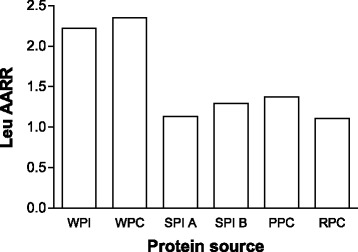
The Leucine (Leu) amino acid reference ratio (AARR – defined as the content of leucine in the protein measured compared to a hypothetical best protein to provide the EAA needed) for various protein concentrates and protein isolates. Values are from reference [47]. Whey PI and PC 392: all from the Fonterra Co-operative Group; soy PI A (Supro 670) and soy PI B (Supro XF) were from Solae; pea PC (Nutralys S85) from Roquette; and rice PC (Oryzatein 90) was from Axiom Foods. Values are from reference [47]
Fig. 3
Fig. 3
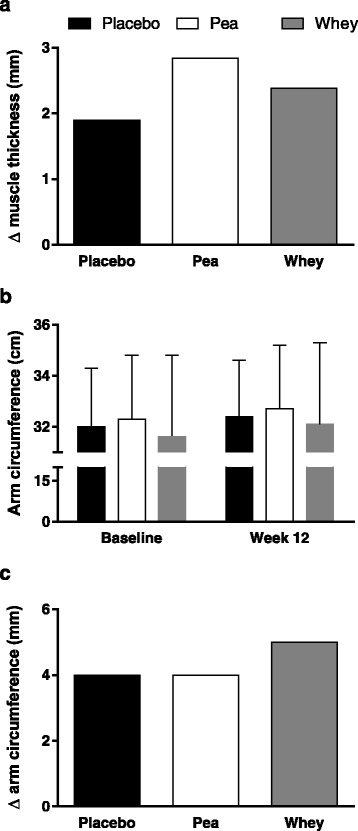
Reanalysis of data from Babault et al. [63], showing changes in muscle thickness in all groups (a) with data estimated from mean changes. Arm circumferences (b) from the same study. And the changes, estimated from means, of the change in arm circumference of the three groups (c)

References

    1. Wernbom M, Augustsson J, Thomee R. The influence of frequency, intensity, volume and mode of strength training on whole muscle cross-sectional area in humans. Sports Med. 2007;37(3):225–64. doi: 10.2165/00007256-200737030-00004. - DOI - PubMed
    1. Bamman MM, Petrella JK, Kim JS, Mayhew DL, Cross JM. Cluster analysis tests the importance of myogenic gene expression during myofiber hypertrophy in humans. J Appl Physiol. 2007;102(6):2232–9. doi: 10.1152/japplphysiol.00024.2007. - DOI - PubMed
    1. Kim JS, Petrella JK, Cross JM, Bamman MM. Load-mediated downregulation of myostatin mRNA is not sufficient to promote myofiber hypertrophy in humans: a cluster analysis. J Appl Physiol. 2007;103(5):1488–95. doi: 10.1152/japplphysiol.01194.2006. - DOI - PubMed
    1. Petrella JK, Kim JS, Mayhew DL, Cross JM, Bamman MM. Potent myofiber hypertrophy during resistance training in humans is associated with satellite cell-mediated myonuclear addition: a cluster analysis. J Appl Physiol. 2008;104(6):1736–42. doi: 10.1152/japplphysiol.01215.2007. - DOI - PubMed
    1. Hartman JW, Tang JE, Wilkinson SB, Tarnopolsky MA, Lawrence RL, Fullerton AV, et al. Consumption of fat-free fluid milk after resistance exercise promotes greater lean mass accretion than does consumption of soy or carbohydrate in young, novice, male weightlifters. Am J Clin Nutr. 2007;86(2):373–81. - PubMed

LinkOut - more resources