


A qualitative study of professional caregivers' perceptions of processes contributing to mealtime agitation in persons with dementia in nursing home wards and strategies to attain calmness
- PMID: 27708807
- PMCID: PMC5047321
- DOI: 10.1002/nop2.24
A qualitative study of professional caregivers' perceptions of processes contributing to mealtime agitation in persons with dementia in nursing home wards and strategies to attain calmness
Abstract
Aim: Describe professional caregivers' perceptions of factors and processes contributing to mealtime agitation and strategies for attaining and maintaining calm mealtimes.
Design: Qualitative and descriptive.
Methods: A convenience sample of professional caregivers working in two wards for residents with dementia was used. Data were collected during two focus-group interviews and supplemented with field notes from six reflection groups. Thematic content analysis was conducted. Data collection occurred from 2010-2011.
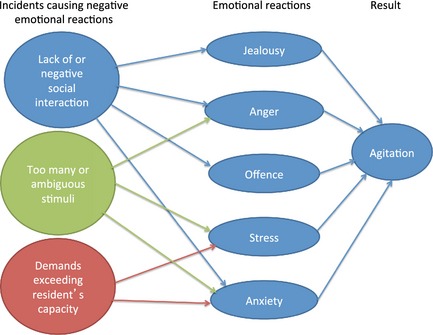
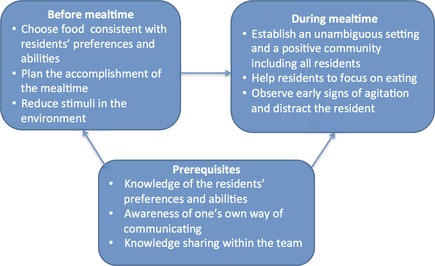
Results: Professional caregivers perceived agitation during mealtime as resulting from negative feelings in residents triggered by a lack of or negative social interaction, too much or ambiguous stimuli or demands exceeding residents' capacity. Strategies for attaining calm mealtimes involved thorough planning beforehand. During mealtime, professional caregivers focused on establishing a positive community around the table, helping residents focus on eating and continuously observing residents for subtle signals indicating that agitation was about to develop. The prerequisites to succeed with the strategies were knowledge of the residents' preferences and abilities, knowledge sharing within the team and awareness of one's own communication style. Thus, the professional caregivers operationalized person-centred care in a mealtime context.
Keywords: Agitation; dementia; mealtime; nursing homes; professional caregivers' perspective.
Figures
References
-
- Amella E.J. (2004) Feeding and hydration issues for older adults with dementia. Nursing Clinics of North America 39(3), 607–623. - PubMed
-
- Aselage M.B. & Amella E.J. (2010) An evolutionary analysis of mealtime difficulties in older adults with dementia. Journal of Clinical Nursing 19(1–2), 33–41. - PubMed
-
- Aselage M.B., Amella E.J. & Watson R. (2011) State of the science: alleviating mealtime difficulties in nursing home residents with dementia. Nursing Outlook 59(4), 210–214. - PubMed
-
- Beattie E.R.A., Algase D.L. & Song J. (2004) Keeping wandering nursing home residents at the table: improving food intake using a behavioral communication intervention. Aging & Mental Health 8(2), 109–116. - PubMed
-
- Bergland Å. & Kirkevold M. (2011) Which factors in the physical environment promote or hinder function, thriving and well‐being among persons with dementia? A literature review. [Hvilke faktorer i de fysiske omgivelsene hemmer og fremmer funksjon, trivsel og velvære hos personer med demens?] Sykepleien Forskning 6(1), 14–26.
LinkOut - more resources
Full Text Sources
Other Literature Sources
