Review
. 2016:96:245-286.
doi: 10.1016/bs.aivir.2016.08.003. Epub 2016 Aug 30.

Molecular Basis of Coronavirus Virulence and Vaccine Development

Affiliations
Review

Molecular Basis of Coronavirus Virulence and Vaccine Development

L Enjuanes et al. Adv Virus Res. 2016.

Abstract

Virus vaccines have to be immunogenic, sufficiently stable, safe, and suitable to induce long-lasting immunity. To meet these requirements, vaccine studies need to provide a comprehensive understanding of (i) the protective roles of antiviral B and T-cell-mediated immune responses, (ii) the complexity and plasticity of major viral antigens, and (iii) virus molecular biology and pathogenesis. There are many types of vaccines including subunit vaccines, whole-inactivated virus, vectored, and live-attenuated virus vaccines, each of which featuring specific advantages and limitations. While nonliving virus vaccines have clear advantages in being safe and stable, they may cause side effects and be less efficacious compared to live-attenuated virus vaccines. In most cases, the latter induce long-lasting immunity but they may require special safety measures to prevent reversion to highly virulent viruses following vaccination. The chapter summarizes the recent progress in the development of coronavirus (CoV) vaccines, focusing on two zoonotic CoVs, the severe acute respiratory syndrome CoV (SARS-CoV), and the Middle East respiratory syndrome CoV, both of which cause deadly disease and epidemics in humans. The development of attenuated virus vaccines to combat infections caused by highly pathogenic CoVs was largely based on the identification and characterization of viral virulence proteins that, for example, interfere with the innate and adaptive immune response or are involved in interactions with specific cell types, such as macrophages, dendritic and epithelial cells, and T lymphocytes, thereby modulating antiviral host responses and viral pathogenesis and potentially resulting in deleterious side effects following vaccination.

Keywords: Biosafety; Human coronaviruses; Immune response; Innate immune response; Live-attenuated vaccines; Protection; Vaccines; Virulence.


Figures

Fig. 1
Fig. 1
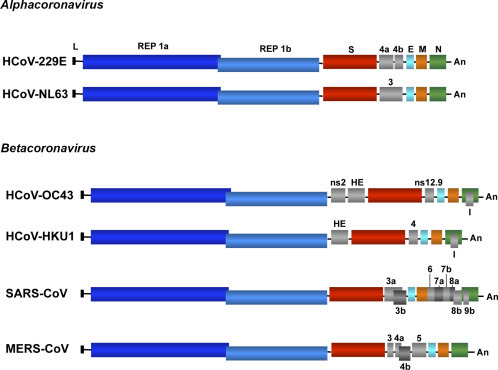
Genome structure of human CoVs. Each bar represents the genomic organization of a human CoV. The tags above the bars indicate the name of each gene. Genus-specific genes are represented in light and dark gray colors. An, poly(A) tail; I, internal ORF; L, leader sequence; REP 1a and REP 1b, replicase gene (comprised of ORFs 1a and 1b).
Fig. 2
Fig. 2
Innate immunity signaling pathways affected by human CoV proteins. The main pathways leading to IFN and proinflammatory cytokine production are represented in the figure. These signaling routes are activated by dsRNA, which acts as a pathogen-associated molecular pattern (PAMP). The viral proteins affecting these pathways are indicated in the dark blue boxes. SARS, SARS-CoV; MERS, MERS-CoV; 229E, HCoV-229E; OC43, HCoV-OC43; NL63, HCoV-NL63.
Fig. 3
Fig. 3
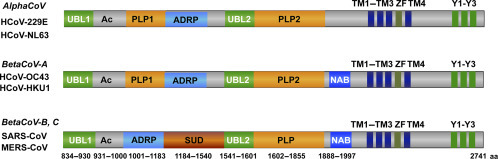
Multidomain structure of CoV nonstructural protein nsp3. The approximate boundaries of each domain in SARS-CoV protein are indicated underneath by the amino acid numbers in the replicase polyprotein. Ac, Glu-rich acidic domain; ADPR, ADP-ribose-1″-phosphatase (also called macrodomain or X domain); NAB, nucleic acid-binding domain; SUD, SARS-unique domain; TM1–TM4, transmembrane domains forming an additional domain containing a metal-binding region (ZF); UBL, ubiquitin-like domain; Y1–Y3, Y domains preceding the C-terminal PLP cleavage sequence at nsp3/4.
Fig. 4
Fig. 4
Inhibitors of p38 MAPK activation protects mice infected with recombinant SARS-CoV. (A) Syntenin initiates a signaling cascade resulting in the phosphorylation (and activation) of p38 MAPK, a protein involved in the expression of proinflammatory cytokines. (B) Inhibition of p38 MAPK phosphorylation led to the survival of 80% of the mice infected with recombinant SARS-CoV, confirming the antiviral potency of this drug (Jimenez-Guardeno et al., 2015). E, SARS-CoV envelope protein; ECM, extracellular matrix; FAK, signaling adhesion kinase protein; Mock, noninfected mice; P, phosphorylated residue; P38 MAPK, p38 MAP kinase; SB203580, inhibitor of p38 MAPK; Wt, mice infected with virulent SARS-CoV.

References

    1. Adedeji A.O., Sarafianos S.G. Antiviral drugs specific for coronaviruses in preclinical development. Curr. Opin. Virol. 2014;8:45–53. - PMC - PubMed
    1. Agrawal A.S., Garron T., Tao X., Peng B.H., Wakamiya M., Chan T.S. Generation of a transgenic mouse model of Middle East respiratory syndrome coronavirus infection and disease. J. Virol. 2015;89:3659–3670. - PMC - PubMed
    1. Almazan F., Gonzalez J.M., Penzes Z., Izeta A., Calvo E., Plana-Duran J. Engineering the largest RNA virus genome as an infectious bacterial artificial chromosome. Proc. Natl. Acad. Sci. U.S.A. 2000;97:5516–5521. - PMC - PubMed
    1. Almazan F., DeDiego M.L., Sola I., Zuñiga S., Nieto-Torres J.L., Marquez-Jurado S. Engineering a replication-competent, propagation-defective Middle East respiratory syndrome coronavirus as a vaccine candidate. MBio. 2013;4 e00650-13. - PMC - PubMed
    1. Altenburg A.F., Kreijtz J.H., de Vries R.D., Song F., Fux R., Rimmelzwaan G.F. Modified vaccinia virus ankara (MVA) as production platform for vaccines against influenza and other viral respiratory diseases. Viruses. 2014;6:2735–2761. - PMC - PubMed

MeSH terms