Review
. 2016 Nov;26(4):601-620.
doi: 10.1016/j.nic.2016.06.008. Epub 2016 Sep 2.

Metastasis in Adult Brain Tumors

Affiliations
Review

Metastasis in Adult Brain Tumors

Ramon Francisco Barajas Jr et al. Neuroimaging Clin N Am. 2016 Nov.

Abstract

Metastatic cancer to the central nervous system is primarily deposited by hematogenous spread in various anatomically distinct regions: calvarial, pachymeningeal, leptomeningeal, and brain parenchyma. A patient's overall clinical status and the information needed to make treatment decisions are the primary considerations in initial imaging modality selection. Contrast-enhanced MR imaging is the preferred imaging modality. Morphologic MR imaging is limited to delineating anatomic deraignment of tissues. Dynamic susceptibility contrast-enhanced perfusion and diffusion-weighted physiology-based MR imaging sequences have been developed that complement morphologic MR imaging by providing additional diagnostic information.

Keywords: Brain; DSC perfusion; MR Imaging; Metastasis.


Figures

Figure 1
Figure 1
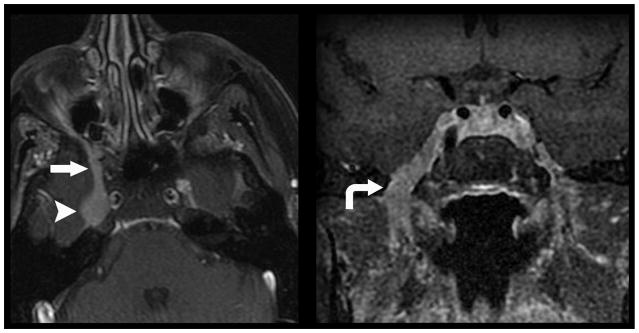
Direct geographical invasion of primary head and neck cancer. 56-year old woman with no significant past medical history presented with 3 months right facial pain. Axial (left) and coronal (right) T1 weighted fat saturated post contrast MR imaging of the skull base demonstrates nodular enhancement of the right trigeminal nerve ganglion (arrow head) with mass like expansion of Meckle’s Cave. Linear thickening and enhancement is noted to extend through foramen rotundum (straight arrow) and foramen ovale (curved arrow). Tissue sampling of the lesion demonstrated Adenoid Cystic Carcinoma of the trigeminal nerve ganglion.
Figure 2
Figure 2
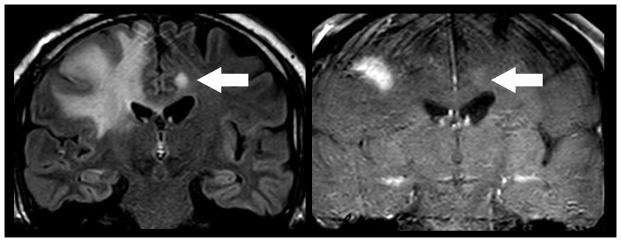
Direct geographical invasion of Glioblastoma. 63 year old man with altered mental status presented for MR imaging. Coronal FLAIR (left) and T1 weighted post contrast (right) MR imaging of the brain demonstrates extensive FLAIR signal within the right cingulate, superior frontal, middle frontal, and inferior frontal gyri that extends across the corpus callosum to involve the contralateral cingulate gryus (arrow). Focal enhancement is noted within the ipsilateral mass and contralateral cingulate gyrus lesion. Subsequent resection of the right frontal mass demonstrated Glioblastoma. Multifocal glioma can occur at initial presentation with metastatic disease occurring via direct peri-neural infiltration.
Figure 3
Figure 3
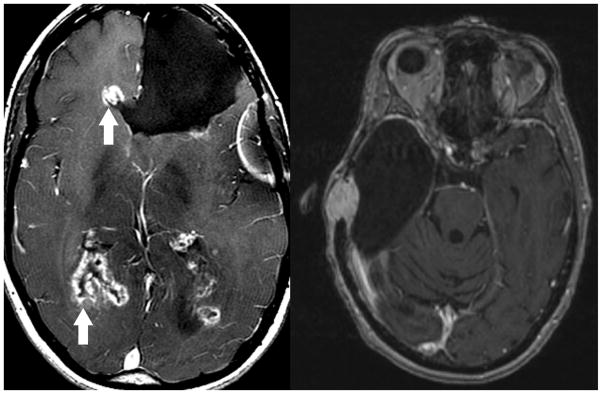
Direct geographical invasion of Glioblastoma. Axial T1 weighted post contrast MR imaging in two patients with prior brain parenchymal resection for Glioblastoma demonstrate direct geographical invasion of disease along the ependymal margins of the lateral ventricular system (left, arrows) and dura (right). While rare, systemic or primary metastatic tumor can demonstrate direct invasion along any CNS surface.
Figure 4
Figure 4
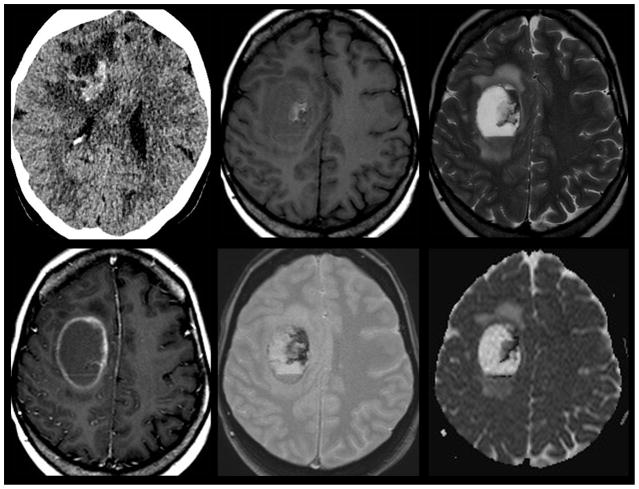
Hemorrhagic Brain Metastasis. 58-year old woman with history of metastatic breast cancer presents with right sided weakness. Non-contrast CT imaging (top left) was utilized as a screening modality given the patients acute presentation demonstrates a hyperdense hemorrhagic mass with surrounding edema that spares the cortex centered within the deep right fontal white matter. Subsequent contrast enhanced T1 weighted MR imaging (bottom left) demonstrated a mixed solid and cystic rim enhancing mass with layering blood products of differing ages on gradient T2* weighted imaging (bottom center). Susceptibility from the blood products mimics the appearance of reduced diffusion on ADC map (bottom right). The age of blood products can be delineated by using T1 (top middle) and T2 (top right) signal intensity. Acute blood products are noted to layer within the dependent portion of the lesion. Early subacute blood products are noted within the mid-medial aspect of the lesion.
Figure 5
Figure 5
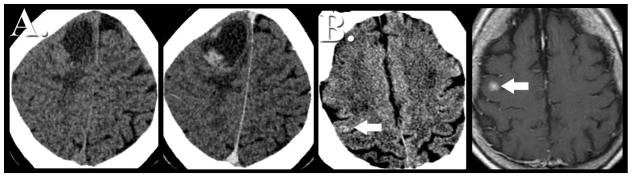
CT Imaging of Brain Metastasis. A) Most brain metastasis are hypodense or isodense by non-contrast CT imaging (left). Upon contrast administration the solid nodular tissue within the lesion often is seen to enhance (center left). The peripheral hypodense component on CT presents vasogenic edema whereas any central hypodensity represents cystic fluid collection. B) Occasionally, brain metastasis can appear hyperdense (center right; arrow) on non-contrast CT, however, these lesions are often very subtle given the propensity to involve the grey white matter junction. Subsequent contrast enhanced MR imaging (right) easily delineates the same lesion. This example highlights the improved sensitivity at detecting CNS metastatic disease by MR imaging.
Figure 6
Figure 6
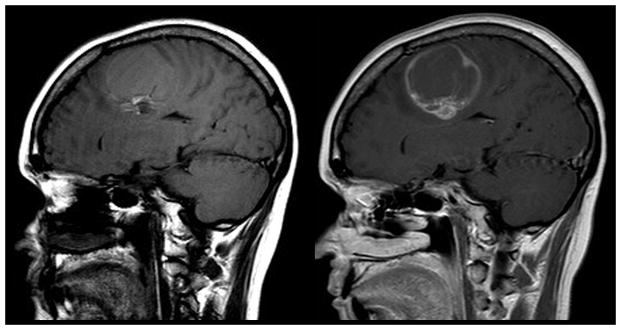
Examination of T1 weighted non-contrast sequence. T1 weighted contrast enhanced images (right) should always be compared to pre-contrast images (left). A number of substances including gadolinium contrast, blood products, fat, melanin, and proteinaceous fluid induce T1 hypeintensity (shortening). Sagittal T1 pre-contrast image demonstrates T1 shortening within the caudal component of the lesion consistent with blood products. Contrast enhanced image demonstrates a rim enhancing mass. Note the similar T1 signal intensity in the caudal component of the lesion on both images. Failure to examine the pre-contrast images with the contrast enhanced images can led to the misidentification of contrast enhancement.
Figure 7
Figure 7
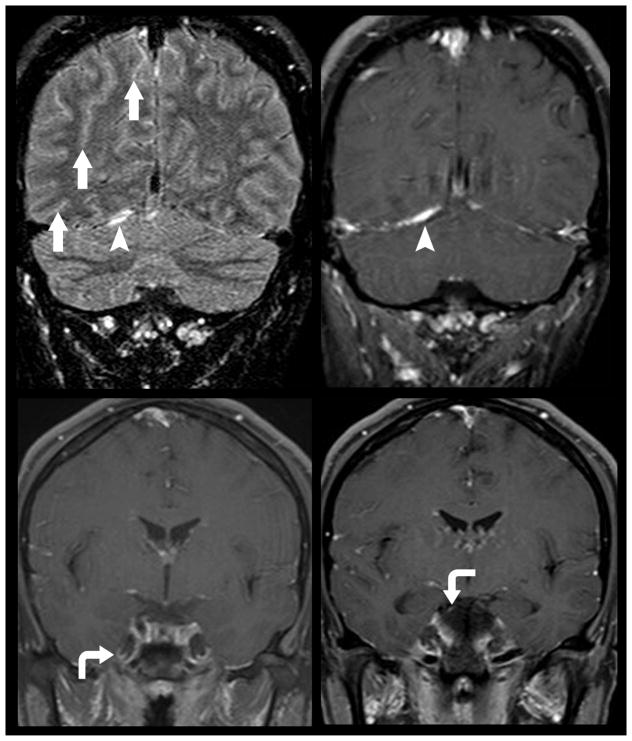
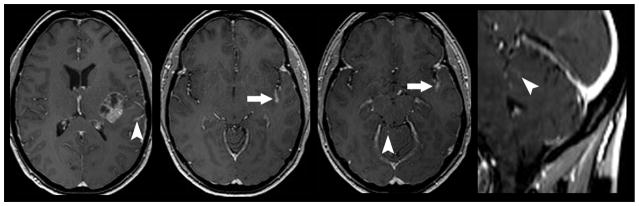
Diffuse leptomeningeal spread of metastatic disease. 47-year old woman with known systemic spread of metastatic breast cancer presented for follow-up MR imaging. Diffuse leptomeningeal spread of disease is noted to involve multiple cranial nerves (curved arrows) including right trigeminal nerve as it courses through Meckle’s Cave (bottom left) and the right oculomotor nerve (bottom right). FLAIR imaging can be helpful in delineating subtle leptomeningeal metastatic diesae (top left). FLAIR hyperintensity within multiple sulci (arrows) is nonspecific but in this patient suggests sites of disease burden. The right tentorium also demonstrates FLAIR hyperintensity and enhancement (top right; arrow head) suggesting metastatic focus.
Figure 8
Figure 8
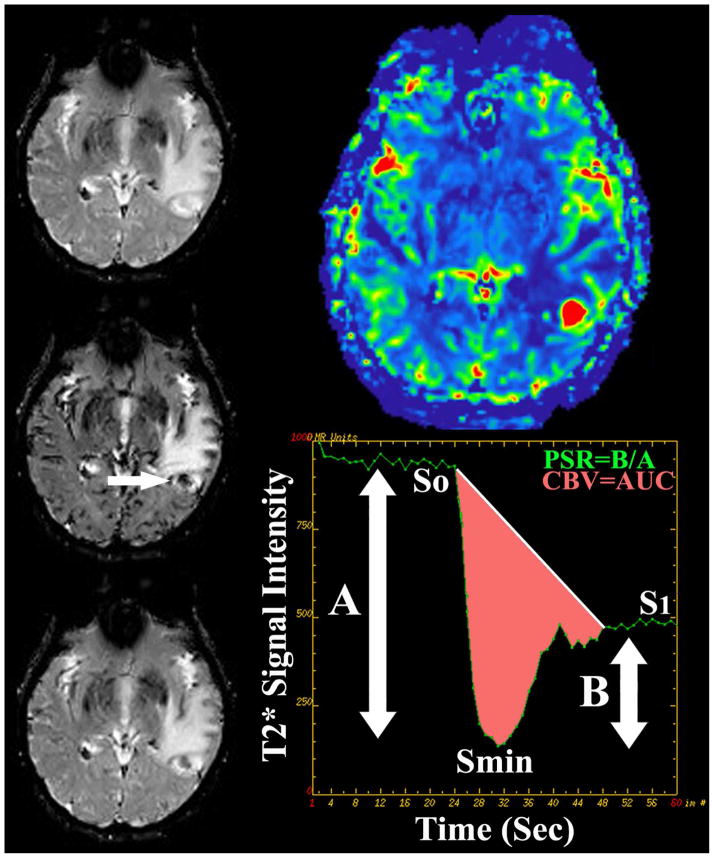
DSC perfusion MR imaging in metastatic disease. 55 year old man with metastatic lung cancer presented for preoperative perfusion MR imaging. Sequential T2* weighted imaging prior to (top left), concurrent with (middle left), and following (bottom left) bolus intravenous power injection of gadiolinum contrast allows for the generation of signal intensity-time curve (bottom right) of intra-parenchymal metastatic disease (arrow). Integration of the area under the curve (pink shaded area) allows for calculation of cerebral blood volume (CBV) metrics. Percentage of signal intensity recovery (PSR) is calculated by dividing the relative post bolus signal intensity value (B) by the relative pre-bolus signal intensity value. Elevated CBV (top right) within the enhancing component of the enhancing focus is nonspecific for the diagnosis of neoplastic etiology (high grade glioma versus metastatic). Reduced PSR values have been shown to be specific for the initial diagnosis and subsequent recurrence of intra-parenchymal metastatic disease following standard therapy.
Figure 9
Figure 9
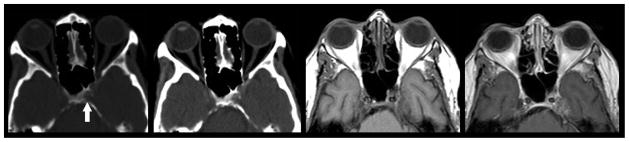
Lytic metastatic disease of the skull base. Non-contrast CT in bone (left) and soft tissue (left middle) windows demonstrates a subcentimeter lytic mass within the left lateral aspect of the clivus. Pre (middle right) and post-contrast (right) T1 weighted MR imaging in the same patient demonstrates enhancing mass extending from the left aspect of the clivus to involve the cavernous sinus. CT and MR imaging can complement different biological manifestations of metastatic disease. CT is superior at delineating the destructive lysis of the clivus. Conversely, MR better delineates the degree of soft tissue invasion of the adjacent cavernous sinus.
Figure 10
Figure 10
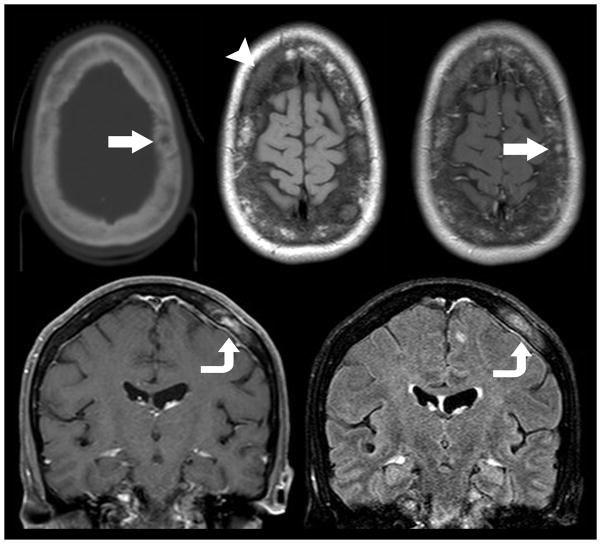
Mixed lytic and sclerotic metastatic disease of the calvarium. Non-contrast axial CT (top left) in a 49 year old woman with metastatic breast cancer demonstrates a mixed lytic sclerotic diploic space mass (arrow). Subsequent pre (top middle) and post-contrast enhanced (top right) MR imaging demonstrates extensive loss of fatty diploic space marrow (arrow head) with evidence of focal contrast enhancing mass (arrow). Coronal T1 weighted post contrast (bottom left) and FLAIR (bottom right) MR imaging demonstrates the enhancing diploic space mass with direct extension to the subjacent dura (curved arrow) suggesting parchymeningeal involvement. Contrast enhanced MR imaging is superior to CT in the detection of metastatic disease within the diploic space, dura, and brain.
Figure 11
Figure 11
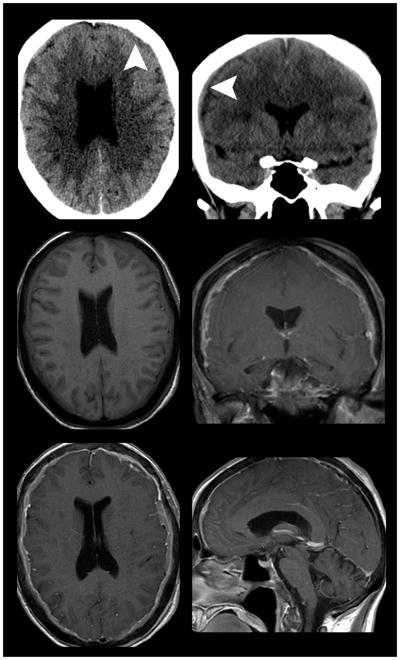
Diffuse pachymeningeal carcinomatosis. Non-contrast axial (top left) and coronal (top right) CT imaging in a 52-year old woman with four months new onset headaches demonstrates a nonspecific subtle holo-hemispheric extra-axial isodensity. Subsequent pre- (middle left) and post-contrast enhanced MR imaging (middle right and bottom) demonstrates extensive dural thickening and enhancement. The lack of findings suggesting intracranial hypotension (enlarged pituitary gland, brain stem sagging, down ward tonsillar displacement, among others) suggested the presence of pachymeningeal carcinomatosis from an undiagnosed primary neoplasm. Whole body cancer screening which included mammography and tissue sampling of right breast mass revealed the underlying diagnosis of breast cancer as the etiology of pachymeningeal carcinomatosis.
Figure 12
Figure 12
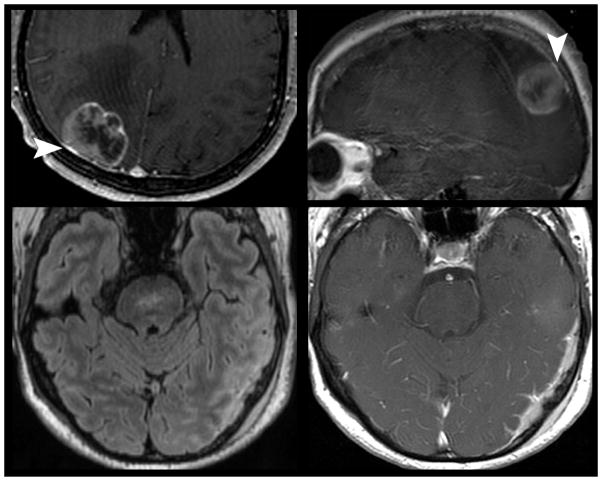
Nodular pachymeningeal metastatic disease. 68-year old man with history of lung cancer presents with progressive altered mental status and right sided weakness. Contrast enhanced MR imaging (top) demonstrates mixed solid and cystic right parietal lobe mass with subjacent nodular dural thickening suggesting metastatic disease (arrow). Another site of pachymeningeal and leptomeningeal disease is evidenced by nodular dural and pial thickening, FLAIR hyperintensity (bottom left), and enhancement (bottom right) is noted in the same patient.
Figure 13
Figure 13
Nodular and sheet leptomeningeal metastatic disease enhancing patterns. Preoperative MR imaging in a 56-year old woman with history of metastatic breast cancer demonstrates mixed solid and cystic left subinsular mass with local sheet like extension of leptomeningeal disease involving the adjacent sylvian fissure (arrow). Multifocal nodular leptomeningeal disease was also observed within the adjacent brain sulci and distantly in the cerebellar follia (arrow heads) suggesting diffuse CSF seeding with metastatic cells.
Figure 14
Figure 14
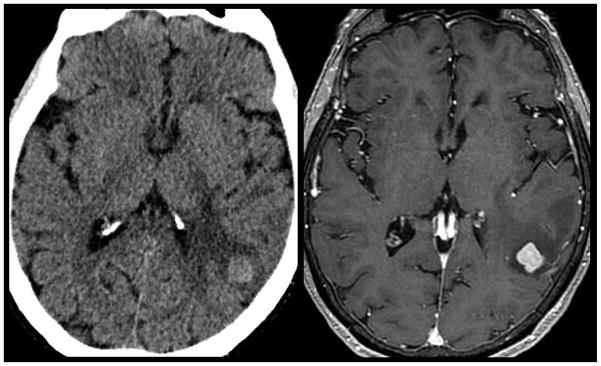
Hyperdense brain parenchymal metastatic disease. 55-year old man with history of lung cancer presents for CT imaging with acute left sided weakness. Non-contrast CT (left) demonstrates a left temporal hyperdense mass with surrounding white matter hypodensity. Subsequent contrast enhanced MR imaging (right) demonstrated a enhancing mass with surrounding vasogenic edema consistent with metastatic disease. A majority of intraparenchymal metastatic lesions will appear iso- to hypodense on non-contrast CT imaging. Lesions with a high nuclear to cytoplasmic ratio often appear hyperdense on non-contrast CT despite the lack of underlying hemorrhage
Figure 15
Figure 15
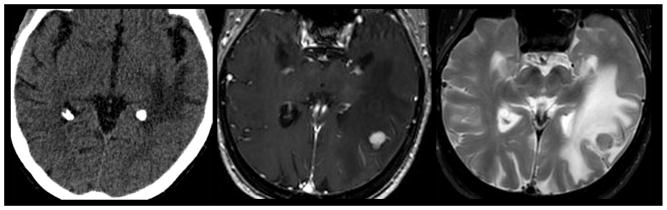
Disproportionate vasogenic edema observed in metastatic disease. A 63-year old woman with history breast cancer presented for CT imaging in the setting of acute onset altered mental status. Non-contrast CT (left) demonstrated extensive left temporal occipital lobe white matter hypodensity without loss of grey white differentiation . Subsequent MR imaging demonstrates a nodular intraparenchymal enhancing mass on T1 weighted post contrast imaging (middle) with disproportionate white matter T2 hyperintensity for the size of the lesion (right). A common imaging appearance of intraparenchymal metastatic disease is the presence of robust peri-tumoral vasogenic edema that preserves the grey-white matter interface.
Figure 16
Figure 16
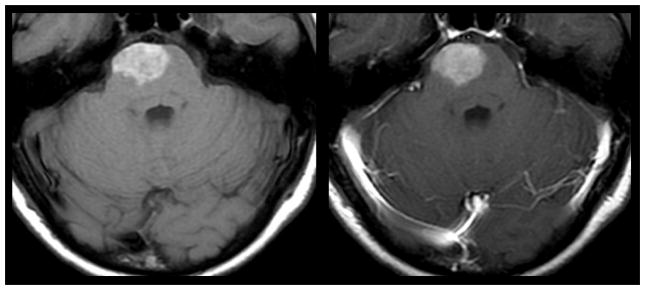
Intrinsic T1 hyperintensity of melanoma metastasis. 43-year old woman with history of cutaneous melanoma presented with acute onset weakness. Pre (left) and post-contrast (right) T1 weighted MR imaging demonstrates intrinsic T1 hyperintenisty in a right pontine lesion consistent with metastatic melanoma. Hyperintensity on pre-contrast T1 weighted MR imaging can occur as a result of late subacute hemorrhage, protenaceous fluid, focal macrocellular fat, or melanin deposition.
Figure 17
Figure 17
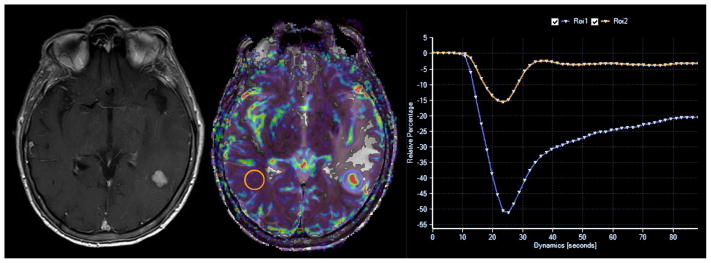
DSC perfusion MR imaging characteristics of metastatic disease. Pre-operative MR imaging in a 63-year old woman with history of metastatic breast cancer demonstrates a contrast enhancing mass within the left temporal lobe. Cerebral blood volume map (center) and signal intensity/time curve (right) calculated from DSC perfusion MR imaging sequence (not shown) demonstrates elevated cerebral blood volume with reduced percentage of signal intensity recovery metrics (blue region of interest) when compared to contralateral normal appearing white matter (orange region of interest). Prior investigators have demonstrated that elevated cerebral blood volume within an enhancing mass is nonspecific for either high-grade glioma or metastatic disease. However, reduced percentage of signal intensity recovery values have been shown to be specific for the diagnosis of intra-parenchymal metastatic disease.
Figure 18
Figure 18
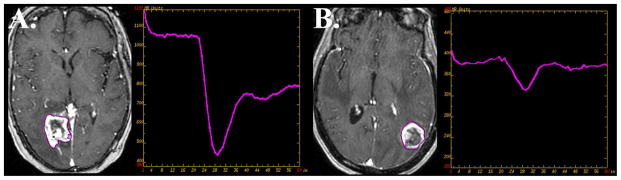
Differentiating recurrent metastatic disease from the effects of stereotactic radiation therapy. Distinguishing progression of metastatic disease in patients who have previously undergone stereotactic radiation therapy can be markedly challenging as the effects of radiation therapy can have nearly identical morphological appearance on contrast-enhanced MR imaging. DSC perfusion MR imaging has been shown to help in this diagnostic dilemma. Lesion wide analysis of recurrent metastatic disease (A) tends to demonstrate elevated cerebral blood volume with reduced percentage of signal intensity recovery. Radiation necrosis (B) while appearing similarly as a progressively enhancing lesion tends to have normal to minimally elevated cerebral blood volume with near normal recovery metrics. Prior retrospective studies have suggested signal intensity recovery measurements are reliable to distinguish metastatic tumor recurrence from radiation necrosis with 96% sensitivity and 100% specificity.

References

    1. Barnholtz-Sloan JS, Sloan AE, Davis FG, Vigneau FD, Lai P, Sawaya RE. Incidence proportions of brain metastases in patients diagnosed (1973 to 2001) in the metropolitan Detroit cancer surveillance system. J Clin Oncol. 2004;22:2865–2872. - PubMed
    1. Nussbaum ES, Djalilian HR, Cho KH, Hall WA. Brain metastases. Histology, multiplicity, surgery, and survival. Cancer. 1996;78(8):1781–1788. - PubMed
    1. Das A, Hochberg FH. Clinical presentation of intracranial metastases. Neurosurg Clin N Am. 1996;7(3):377–391. - PubMed
    1. Svokos KA, Salhia B, Toms SA. Molecular biology of brain metastasis. Int J Mol Sci. 2014 May 28;15(6):9519–30. - PMC - PubMed
    1. Beasley KD, Toms SA. The molecular pathobiology of metastasis to the brain. A review. Neurosurg Clin N Am. 2011;22:7–14. - PubMed