


A chronological review of experimental infection studies of the role of wild animals and livestock in the maintenance and transmission of Crimean-Congo hemorrhagic fever virus
- PMID: 27713073
- PMCID: PMC5102700
- DOI: 10.1016/j.antiviral.2016.09.013
A chronological review of experimental infection studies of the role of wild animals and livestock in the maintenance and transmission of Crimean-Congo hemorrhagic fever virus
Abstract
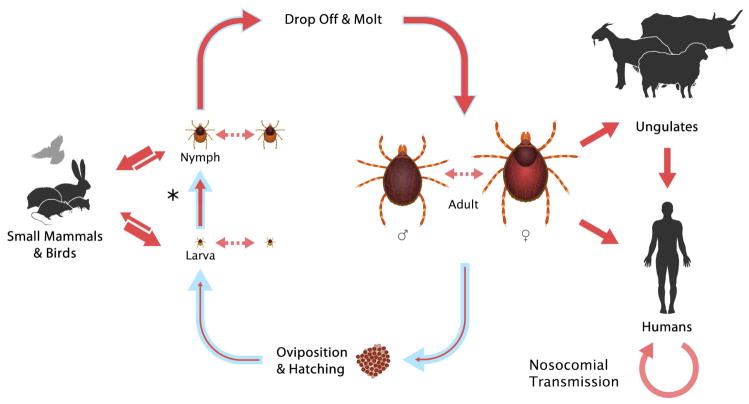
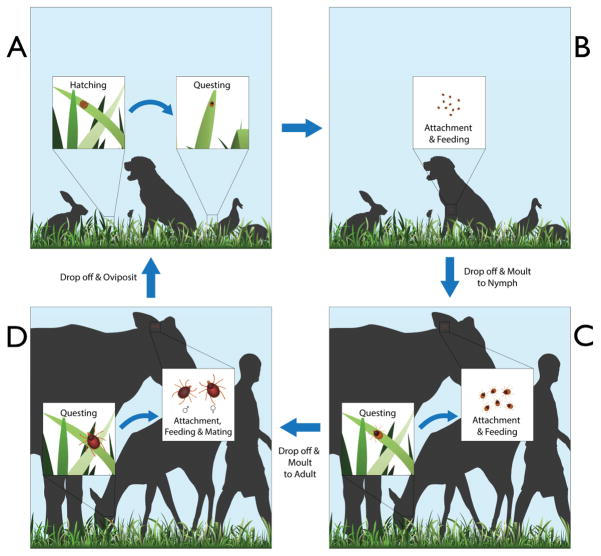
This article provides a definitive review of experimental studies of the role of wild animals and livestock in the maintenance and transmission of Crimean-Congo hemorrhagic fever virus (CCHFV), the etiologic agent of Crimean-Congo hemorrhagic fever (CCHF), beginning with the first recognized outbreak of the human disease in Crimea in 1944. Published reports by researchers in the former Soviet Union, Bulgaria, South Africa, and other countries where CCHF has been observed show that CCHFV is maintained in nature in a tick-vertebrate-tick enzootic cycle. Human disease most commonly results from the bite of an infected tick, but may also follow crushing of infected ticks or exposure to the blood and tissues of infected animals during slaughter. Wild and domestic animals are susceptible to infection with CCHFV, but do not develop clinical illness. Vertebrates are important in CCHF epidemiology, as they provide blood meals to support tick populations, transport ticks across wide geographic areas, and transmit CCHFV to ticks and humans during the period of viremia. Many aspects of vertebrate involvement in the maintenance and spread of CCHFV are still poorly understood. Experimental investigations in wild animals and livestock provide important data to aid our understanding of CCHFV ecology. This article is the second in a series of reviews of more than 70 years of research on CCHF, summarizing important findings, identifying gaps in knowledge, and suggesting directions for future research.
Keywords: Bunyavirus; Crimean-Congo hemorrhagic fever; Tick-borne; Transmission; Viral hemorrhagic fever.
Copyright © 2016 Elsevier B.V. All rights reserved.
Figures
References
-
- Hoogstraal H. The epidemiology of tick-borne Crimean-Congo hemorrhagic fever in Asia, Europe, and Africa. J Med Entomol. 1979;15(4):307–417. - PubMed
-
- Spengler JR, Bergeron E, Rollin PE. Seroepidemiological Studies of Crimean-Congo Hemorrhagic Fever Virus in Domestic and Wild Animals. Clements ACA, editor. PLoS Negl Trop Dis. 2016;10(1):e0004210. [Internet] Available from: http://dx.plos.org/10.1371/journal.pntd.0004210. - DOI - PMC - PubMed
-
- Bente DA, Forrester NL, Watts DM, McAuley AJ, Whitehouse CA, Bray M. Crimean-Congo hemorrhagic fever: history, epidemiology, pathogenesis, clinical syndrome and genetic diversity. Antiviral Res. 2013;100(1):159–89. [Internet] [cited 2014 Oct 10]; Available from: http://www.ncbi.nlm.nih.gov/pubmed/23906741. - PubMed
-
- Mertens M, Schmidt K, Ozkul A, Groschup MH. The impact of Crimean-Congo hemorrhagic fever virus on public health. Antiviral Res. 2013;98(2):248–60. [Internet] [cited 2016 Aug 26]; Available from: http://www.ncbi.nlm.nih.gov/pubmed/23458713. - PubMed
-
- Zivcec M, Scholte F, Spiropoulou C, Spengler J, Bergeron E. Molecular Insights into Crimean-Congo Hemorrhagic Fever Virus. Viruses. 2016;8(4):106. [Internet] Available from: http://www.mdpi.com/1999-4915/8/4/106. - PMC - PubMed
Publication types
MeSH terms
Grants and funding
LinkOut - more resources
Full Text Sources
Other Literature Sources
