


Impact of pharmacist interventions in older patients: a prospective study in a tertiary hospital in Germany
- PMID: 27713625
- PMCID: PMC5045027
- DOI: 10.2147/CIA.S109048
Impact of pharmacist interventions in older patients: a prospective study in a tertiary hospital in Germany
Abstract
Background: Inappropriate pharmacotherapy among older adults remains a critical issue in our health care systems. Besides polypharmacy and multiple comorbidities, the age-related pharmacokinetic and pharmacodynamic changes may increase the risk of adverse drug reactions and medication errors.
Objective: The main target of this study was to describe the characteristics of pharmaceutical interventions in two geriatric wards (orthogeriatric ward and geriatric day unit) of a general teaching hospital and to evaluate the clinical significance of the detected medication errors.
Materials and methods: The study was conducted between August 2014 and October 2015 and was based on a triple approach that included validation of medical orders, medication reconciliation at patients' admission, and a predischarge planning appointment with the patient. The validation of medical orders was based on analyzing the suitability of the drugs prescribed, the drug dose depending on the patient's characteristics, the presence of contraindications and interactions between drugs, and the proposal of alternative drugs included in the hospital formulary.
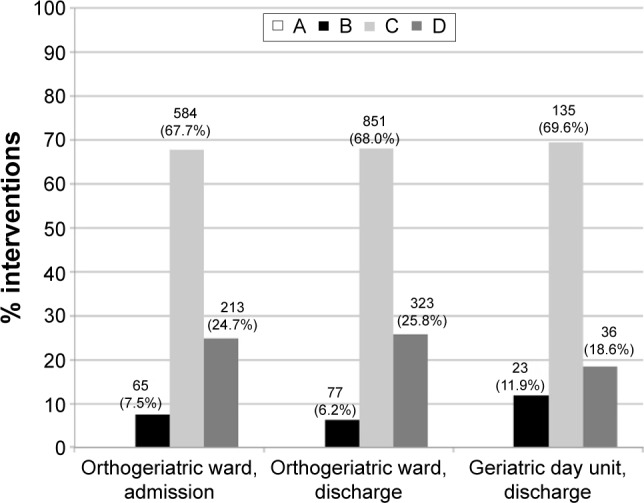
Results: A total of 2,307 interventions associated to a medication error in 15,282 medical orders for 1,859 older patients were recorded. The greater part of the interventions carried out on the orthogeriatric ward at admission and at discharge were due to omission of a drug in the medical order (20.0%) and clinically significant interactions requiring monitoring (30.4%), respectively. The main factor triggering pharmacist's recommendations on the geriatric day unit was clinically significant interactions (21.1%). With regard to the clinical severity of the detected errors, 68.1% were considered significant, 24.8% were of minor significance, and 7.2% were clinically serious.
Conclusion: Our findings show the importance of clinical pharmacist involvement in the optimization of pharmacotherapy in older adults, ensuring that they receive effective, safe, and efficient drug therapy.
Keywords: medication errors; older adults; pharmacist interventions.
Figures
Comment in
-
Pharmaceutical interventions by collaboration between staff pharmacists and clinical pharmacists and implementation of Joint Commission International Accreditation Standards on medication use may optimize pharmacotherapy in geriatric patients.Clin Interv Aging. 2016 Nov 9;11:1575-1577. doi: 10.2147/CIA.S123900. eCollection 2016. Clin Interv Aging. 2016. PMID: 27877026 Free PMC article. No abstract available.
References
-
- Suggested definitions and relationships among medication misadventures, medication errors, adverse drug events, and adverse drug reactions. Am J Health Syst Pharm. 1998;55(2):165–166. - PubMed
-
- Junius-Walker U, Theile G, Hummers-Pradier E. Prevalence and predictors of polypharmacy among older primary care patients in Germany. Fam Pract. 2007;24(1):14–19. - PubMed
-
- Reeve E, To J, Hendrix I, Shakib S, Roberts MS, Wiese MD. Patient barriers to and enablers of deprescribing: a systematic review. Drugs Aging. 2013;30(10):793–807. - PubMed
-
- Garfinkel D, Mangin D. Feasibility study of a systematic approach for discontinuation of multiple medications in older adults: addressing polypharmacy. Arch Intern Med. 2010;170(18):1648–1654. - PubMed
MeSH terms
LinkOut - more resources
Full Text Sources
Other Literature Sources
Medical
