. 2016 Sep 22:7:1490.
doi: 10.3389/fmicb.2016.01490. eCollection 2016.

The Highly Conserved Escherichia coli Transcription Factor YhaJ Regulates Aromatic Compound Degradation

Affiliations

The Highly Conserved Escherichia coli Transcription Factor YhaJ Regulates Aromatic Compound Degradation

Noa Palevsky et al. Front Microbiol. .

Abstract

The aromatic compound 2,4-dinitrotoluene (DNT), a common impurity in 2,4,6-trinitrotoluene (TNT) production, has been suggested as a tracer for the presence of TNT-based landmines due to its stability and high volatility. We have previously described an Escherichia coli bioreporter capable of detecting the presence of DNT vapors, harboring a fusion of the yqjF gene promoter to a reporter element. However, the DNT metabolite which is the direct inducer of yqjF, has not yet been identified, nor has the regulatory mechanism of the induction been clarified. We demonstrate here that the YhaJ protein, a member of the LysR type family, acts as a transcriptional regulator of yqjF activation, as well as of a panel of additional E. coli genes. This group of genes share a common sequence motif in their promoters, which is suggested here as a putative YhaJ-box. In addition, we have linked YhaJ to the regulation of quinol-like compound degradation in the cell, and identified yhaK as playing a role in the degradation of DNT.

Keywords: Escherichia coli; YhaJ; bioreporters; dinitrotoluene; transcriptional regulation; trinitrotoluene; yqjF.


Figures
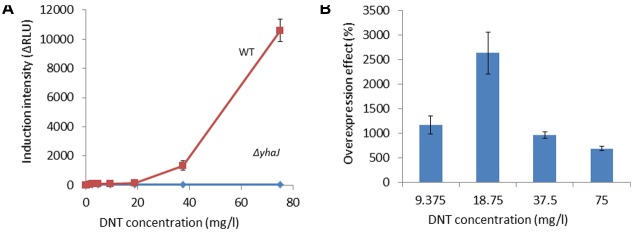
FIGURE 1
FIGURE 1
Induction of yqjF by DNT is abolished in a yhaJ mutant and enhanced when YhaJ is overexpressed. (A) Induction intensity (maximal luminescence recorded within 300 min of exposure) of yqjF as a function of DNT concentration in a ΔyhaJ mutant and the WT. (B) Effect of overexpressed YhaJ on yqjF induction by several DNT concentrations. Calculation of the overexpression effect is as detailed in Section “Materials and Methods.” Error bars represent the standard deviation of at least three independent duplicate experiments.
FIGURE 2
FIGURE 2
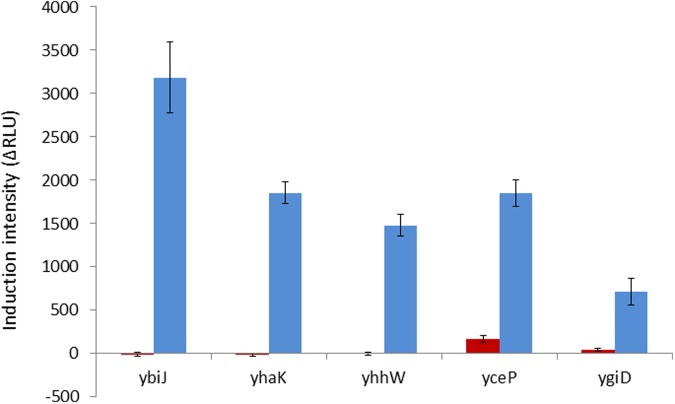
Induction intensity (maximal luminescence recorded within 300 min of exposure) by hydroquinone (75 mg/l) of the five gene promoters found to be affected by the lack of YhaJ. Red bars, plasmids harboring the promoter:gfp fusion in a ΔyhaJ background; blue bars, same plasmids in the WT host. Error bars represent the standard deviation of at least three independent duplicate experiments.
FIGURE 3
FIGURE 3
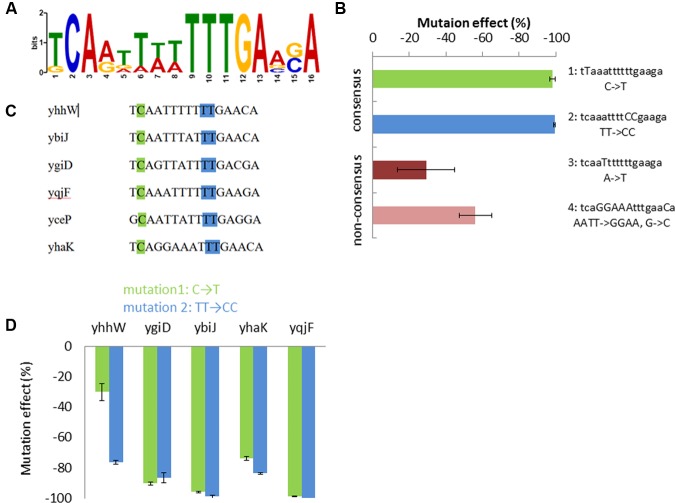
Proposed YhaJ binding motif. (A) The significant common motif found by MEME; (B) effect of the four mutated sequences of the yqjF promoter on its induction by DNT (35 mg/l); (C) the motif sequence in the different YhaJ-regulated promoters; mutation sites 1 (green) and 2 (blue) are marked; (D) the effect of mutations sets 1 and 2, when introduced into YhaJ-regulated gene promoters, on their induction by hydroquinone (75 mg/l). Error bars represent the standard deviation of at least three independent duplicate experiments.
FIGURE 4
FIGURE 4
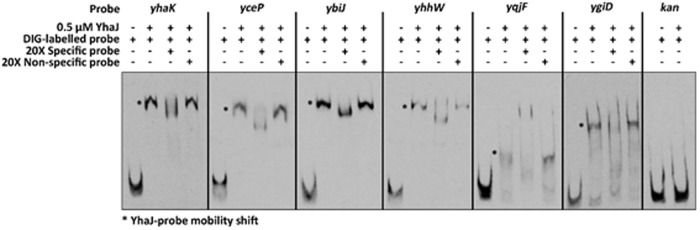
Electrophoretic mobility shift assay (EMSA) analysis of gene promoter regions induced by exposure to DNT. DIG-labeled DNA probes corresponding to the promoter regions of yhaK, yceP, ybiJ, yhhW, yqjF, and ygiD were incubated with 0.5 uM of purified YhaJ per reaction. The presence of YhaJ resulted in an observable mobility shift () when compared to the probe only controls. A fragment of the kan gene was used a non-specific control to indicate no binding. Competition assays were also performed with a 20-fold excess of unlabeled specific or non-specific probe. The specific competitors were able to reduce the intensity of band shift observed for YhaJ whereas addition of the kan probe had no effect on the band shift observed. The probe names and composition of each reaction is indicated at the top of the figure with a – or + indicating absence or presence of that component respectively.
FIGURE 5
FIGURE 5
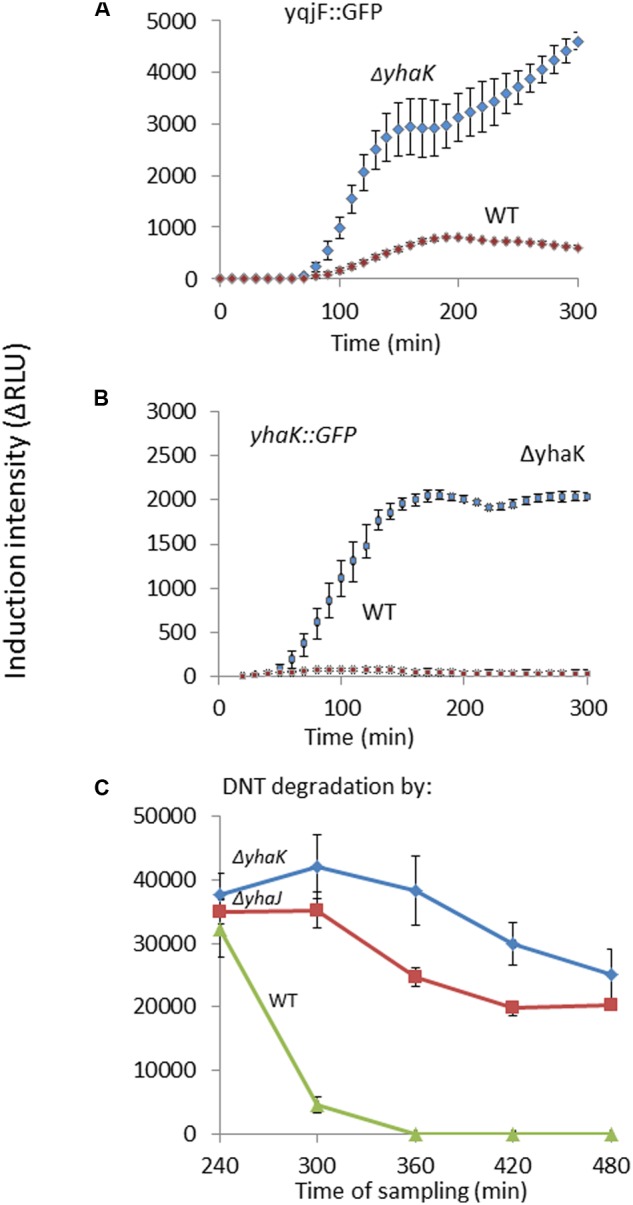
Role of yhaK in DNT degradation and yqjF induction. Effect of a ΔyhaK mutation on (A) yqjF and (B) yhaK induction by DNT (75 mg/l) as a function of time. (C) Accumulation of the yqjF inducing molecule in ΔyhaK and ΔyhaJ mutants. Error bars represent the standard deviation of at least three independent duplicate experiments.

References

    1. Adams M., Jia Z. (2005). Structural and biochemical analysis reveal pirins to possess quercetinase activity. J. Biol. Chem. 280 28675–28682. 10.1074/jbc.M501034200 - DOI - PubMed
    1. Baba T., Ara T., Hasegawa M., Takai Y., Okumura Y., Baba M., et al. (2006). Construction of Escherichia coli K-12 in-frame, single-gene knockout mutants: the Keio collection. Mol. Syst. Biol 2 2006.0008 10.1038/msb4100050 - DOI - PMC - PubMed
    1. Bailey T. L., Williams N., Misleh C., Li W. W. (2006). MEME: discovering and analyzing DNA and protein sequence motifs. Nucleic Acids Res. 3 W369–W373. 10.1093/nar/gkl198 - DOI - PMC - PubMed
    1. Blattner F. R., Plunkett G., Bloch C. A., Perna N. T., Burland V., Riley M., et al. (1997). The complete genome sequence of Escherichia coli K-12. Science 277 1453–1462. 10.1126/science.277.5331.1453 - DOI - PubMed
    1. Cherepanov P. P., Wackernagel W. (1995). Gene disruption in Escherichia coli: TcR and KmR cassettes with the option of Flp-catalyzed excision of the antibiotic-resistance determinant. Gene 158 9–14. 10.1016/0378-1119(95)00193-A - DOI - PubMed

LinkOut - more resources