. 2016 Oct 4;17(1):776.
doi: 10.1186/s12864-016-3114-3.

Novel microRNA discovery using small RNA sequencing in post-mortem human brain

Affiliations

Novel microRNA discovery using small RNA sequencing in post-mortem human brain

Christian Wake et al. BMC Genomics. .

Abstract

Background: MicroRNAs (miRNAs) are short, non-coding RNAs that regulate gene expression mainly through translational repression of target mRNA molecules. More than 2700 human miRNAs have been identified and some are known to be associated with disease phenotypes and to display tissue-specific patterns of expression.

Methods: We used high-throughput small RNA sequencing to discover novel miRNAs in 93 human post-mortem prefrontal cortex samples from individuals with Huntington's disease (n = 28) or Parkinson's disease (n = 29) and controls without neurological impairment (n = 36). A custom miRNA identification analysis pipeline was built, which utilizes miRDeep* miRNA identification and result filtering based on false positive rate estimates.

Results: Ninety-nine novel miRNA candidates with a false positive rate of less than 5 % were identified. Thirty-four of the candidate miRNAs show sequence similarity with known mature miRNA sequences and may be novel members of known miRNA families, while the remaining 65 may constitute previously undiscovered families of miRNAs. Nineteen of the 99 candidate miRNAs were replicated using independent, publicly-available human brain RNA-sequencing samples, and seven were experimentally validated using qPCR.

Conclusions: We have used small RNA sequencing to identify 99 putative novel miRNAs that are present in human brain samples.

Keywords: MicroRNA; Neurodegenerative disease; Novel miRNA discovery; Prefrontal cortex; miRNA sequencing.


Figures

Fig. 1
Fig. 1
Flowchart depiction of the novel miRNA discovery pipeline. This flowchart shows our novel miRNA discovery pipeline beginning with the small RNA sequencing of tissue samples, quality control (cutadapt v. 1.2.1, FASTX-Toolkit v. 0.0.14) and alignment of sequencing reads in fastq file format, and preparation of alignment (bam) files for miRDeep*. The miRNA predictions made by miRDeep* were classified as false positives (gencode v19 exons/sRNA), true positives (miRBase v20 miRNA), or potential novel miRNAs, which were filtered further. In the flowchart, the yellow box represents miRDeep* results that occurred on both exon and miRNA annotations, which were excluded from the analysis. The false positives were used to determine a miRDeep* score threshold with a false positive rate close to 0.05, which was used to filter the miRDeep* results that are neither false positives nor true positives. The result of this filtering step was a final set of putative novel miRNAs. This set was annotated with differential expression analysis (HD/C and PD/C), alignment (SSEARCH) of mature miRNA sequences to known human mature miRNA sequences in miRBase v20, and proximity to human genes
Fig. 2
Fig. 2
miRDeep* putative miRNAs and miRBase miRNAs. This Venn diagram depicts the overlap between two sets of hairpin miRNAs. The first is the set of miRDeep* results after score-filtering (86.13) and filtering to remove exons and sRNAs, using annotation files from gencode v19 and matching by genomic locations with the intersect function from bedtools v2.22.1. This set of 454 miRDeep* results overlaps the set of miRBase v20 hairpin miRNAs, also filtered for exons and sRNAs with the same method. As seen in the Venn diagram, the majority of the score and exon/sRNA filtered miRDeep* results exist within the miRBase database. The 99 that do not are the final putative novel miRNAs of this study. (*) The total number of filtered miRBase hairpin miRNAs is not the sum of the intersection and the remaining miRBase set because the miRBase and miRDeep* hairpin miRNAs do not have a one-to-one relationship. Twenty-two of the miRDeep* set overlap two members of the miRBase set, and eight of the miRBase set overlap two members of the miRDeep* set. In this Venn diagram we have displayed that 355 of the 454 filtered miRDeep* hairpin miRNA predictions overlap at least one filtered miRBase v20 hairpin miRNA, and 1138 of 1507 filtered miRBase v20 hairpin miRNAs overlap zero filtered miRDeep* hairpin miRNA predictions
Fig. 3
Fig. 3
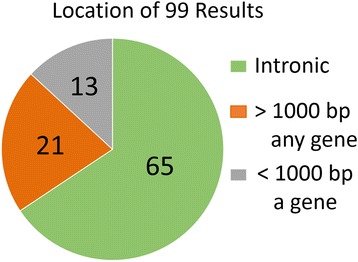
Genomic locations of the putative novel miRNAs. The locations of the 99 novel miRNAs relative to human genes are depicted as a pie chart. It shows the proportion of the 99 novel miRNAs that are within, near (<= 1000 basepairs), or distant (>1000 basepairs) from one or more genes from gencode v19. The 65 novel miRNA results that are within genes are intronic, as cases of miRDeep* results overlapping gencode v19 exon annotations were classified as false positives and excluded
Fig. 4
Fig. 4
Putative novel miRNAs, replication data miRNAs and Londin et al. miRNAs. This Venn diagram depicts the overlap of three sets of mature miRNAs: the novel mature miRNAs discovered using the HD and PD small RNA sequencing data set, the novel mature miRNAs discovered using the publicly available replication data set, and the Londin et al. mature miRNAs. The intersection of sets was obtained using the intersect function from bedtools v2.22.1 with gene transfer format (gtf) annotations files created by the novel miRNA discovery pipeline and from the supplemental data set of Londin et al. Though the sets vary in size, each has unique miRNA entries and overlap with each other set

References

    1. Bryan K, Terrile M, Bray IM, Domingo-Fernandez R, Watters KM, Koster J, et al. Discovery and visualization of miRNA-mRNA functional modules within integrated data using bicluster analysis. Nucleic Acids Res. 2014;42:e17. doi: 10.1093/nar/gkt1318. - DOI - PMC - PubMed
    1. Kim VN, Han J, Siomi MC. Biogenesis of small RNAs in animals. Nat Rev Mol Cell Biol. 2009;10:126–139. doi: 10.1038/nrm2632. - DOI - PubMed
    1. Londin E, Loher P, Telonis AG, Quann K, Clark P, Jing Y, et al. Analysis of 13 cell types reveals evidence for the expression of numerous novel primate- and tissue-specific microRNAs. Proc Natl Acad Sci U S A. 2015;112:E1106–E1115. doi: 10.1073/pnas.1420955112. - DOI - PMC - PubMed
    1. Liang T, Guo L, Liu C. Genome-wide analysis of mir-548 gene family reveals evolutionary and functional implications. J Biomed Biotechnol. 2012;2012:679563. doi: 10.1155/2012/679563. - DOI - PMC - PubMed
    1. Friedman RC, Farh KK, Burge CB, Bartel DP. Most mammalian mRNAs are conserved targets of microRNAs. Genome Res. 2009;19:92–105. doi: 10.1101/gr.082701.108. - DOI - PMC - PubMed

Publication types