


Human-biting activities of Anopheles species in south-central Ethiopia
- PMID: 27716416
- PMCID: PMC5045578
- DOI: 10.1186/s13071-016-1813-x
Human-biting activities of Anopheles species in south-central Ethiopia
Abstract
Background: Indoor residual spraying (IRS) and long-lasting insecticidal nets (LLINs) are the key malaria vector control interventions in Ethiopia. The success of these interventions rely on their efficacy to repel or kill indoor feeding and resting mosquitoes. This study was undertaken to monitor human-biting patterns of Anopheles species in south-central Ethiopia.
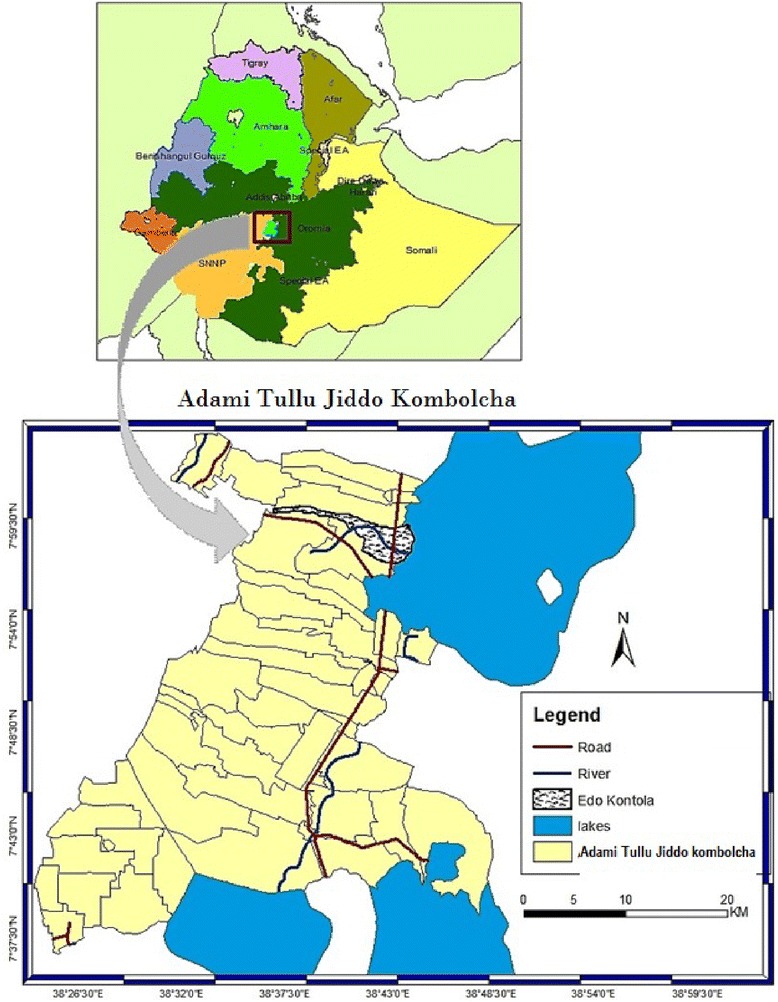
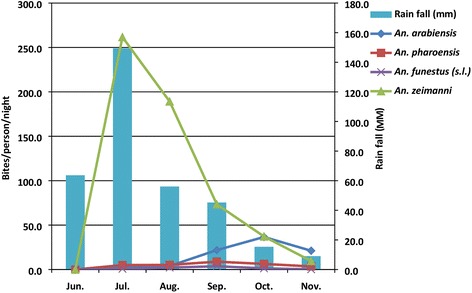
Methods: Human-biting patterns of anophelines were monitored for 40 nights in three houses using human landing catches (HLC) both indoors and outdoors between July and November 2014, in Edo Kontola village, south-central Ethiopia. This time coincides with the major malaria transmission season in Ethiopia, which is usually between September and November. Adult mosquitoes were collected from 19:00 to 06:00 h and identified to species. Comparisons of HLC data were done using incidence rate ratio (IRR) calculated by negative binomial regression. The nocturnal biting activities of each Anopheles species was expressed as mean number of mosquitoes landing per person per hour. To assess malaria infections in Anopheles mosquitoes the presence of Plasmodium falciparum and P. vivax circumsporozoite proteins (CSP) were determined by enzyme-linked immunosorbent assay (ELISA).
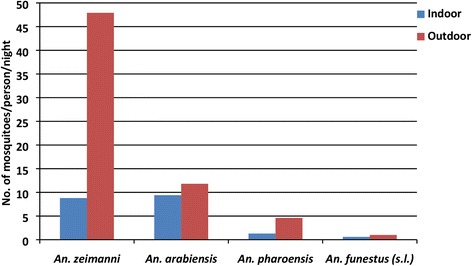
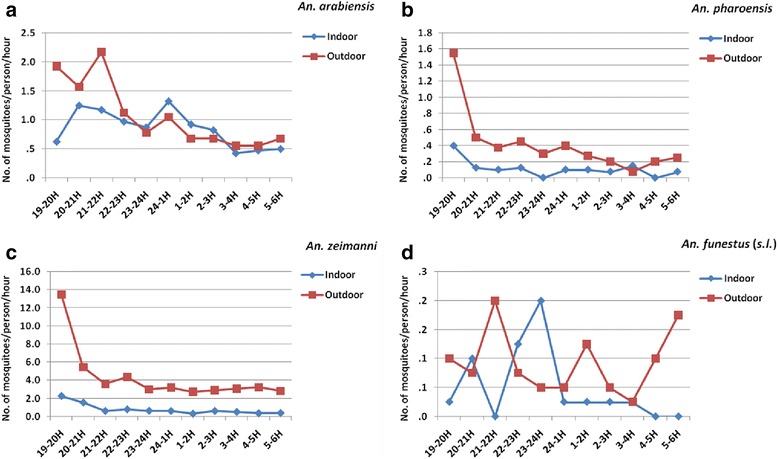
Results: Altogether 3,408 adult female anophelines were collected, 2,610 (76.6 %) outdoors and 798 (23.4 %) indoors. Anopheles zeimanni was the predominant species (66.5 %) followed by An. arabiensis (24.8 %), An. pharoensis (6.8 %) and An. funestus (s.l.) (1.8 %). The overall mean anopheline density was 3.3 times higher outdoors than indoors (65.3 vs 19.9/person/night, IRR: 3.3, 95 % CI: 1.1-5.1, P = 0.001). The mean density of An. zeimanni, An. pharoensis and An. funestus (s.l.) collected outdoors was significantly higher than indoors for each species (P < 0.05). However, the mean An. arabiensis density outdoors was similar to that indoors (11.8 vs 9.4/person/night, IRR: 1.3, 95 % CI: 0.8-1.9, P = 0.335). The mean hourly human-biting density of An. arabiensis was greater outdoors than indoors and peaked between 21:00 and 22:00 h. However, An. arabiensis parous population showed high indoor man biting activities during bedtimes (22:00 to 05:00 h) when the local people were indoor and potentially protected by IRS and LLINs. All mosquito samples tested for CSP antigen were found negative to malaria parasites.
Conclusions: Results show much greater mosquito human-biting activities occurring outdoors than indoors and during early parts of the night, implying higher outdoor malaria transmission potential in the area. However, high bedtime (22:00 to 05:00 h) indoor biting activities of parous An. arabiensis suggest high potential intervention impact of IRS and LLINs on indoor malaria transmission.
Keywords: Anopheles arabiensis; Endophagy; Ethiopia; Exophagy; Malaria.
Figures
References
-
- WHO . Control of residual malaria parasite transmission: Guidance note. Geneva: World Health Organization; 2014.
Publication types
MeSH terms
Substances
Associated data
LinkOut - more resources
Full Text Sources
Other Literature Sources
