


Lessons on malaria control in the ethnic minority regions in Northern Myanmar along the China border, 2007-2014
- PMID: 27716435
- PMCID: PMC5053039
- DOI: 10.1186/s40249-016-0191-0
Lessons on malaria control in the ethnic minority regions in Northern Myanmar along the China border, 2007-2014
Abstract
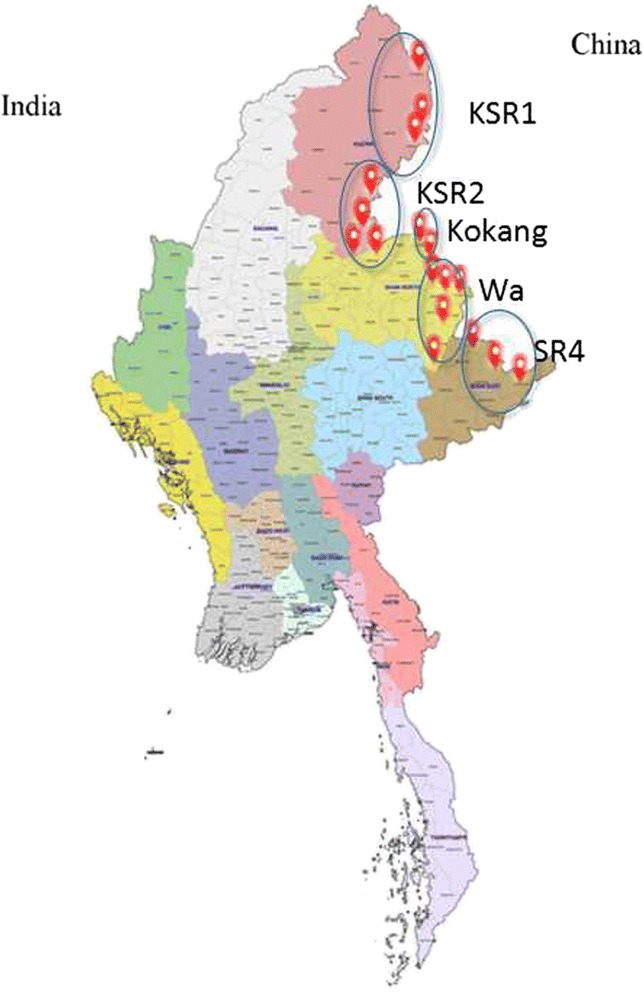
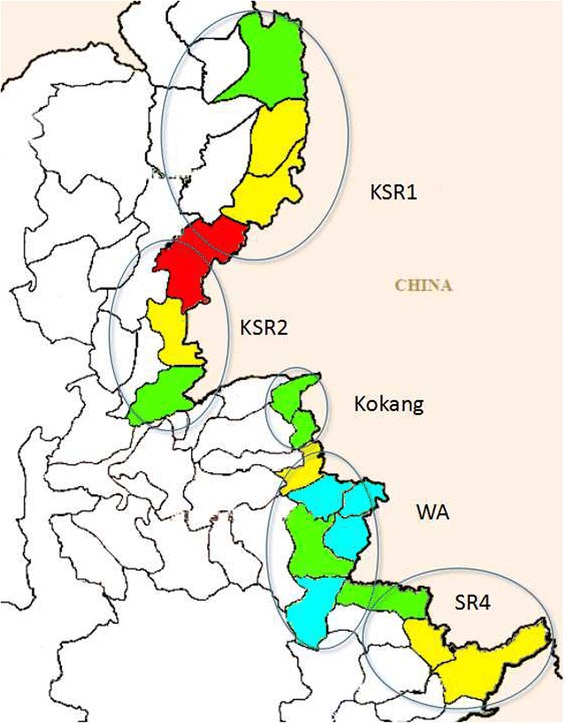
Background: For many countries where malaria is endemic, the burden of malaria is high in border regions. In ethnic minority areas along the Myanmar-China border, residents have poor access to medical care for diagnosis and treatment, and there have been many malaria outbreaks in such areas. Since 2007, with the support of the Global Fund to Fight AIDS, Tuberculosis and Malaria (GFATM), a malaria control project was introduced to reduce the malaria burden in several ethnic minority regions.
Methods: A malaria control network was established during the period from 2007 to 2014. Multiple malaria interventions, including diagnosis, treatment, distribution of LLINs and health education, were conducted to improve the accessibility and quality of malaria control services for local residents. Annual cross-sectional surveys were conducted to evaluate intervention coverage and indicators of malaria transmission.
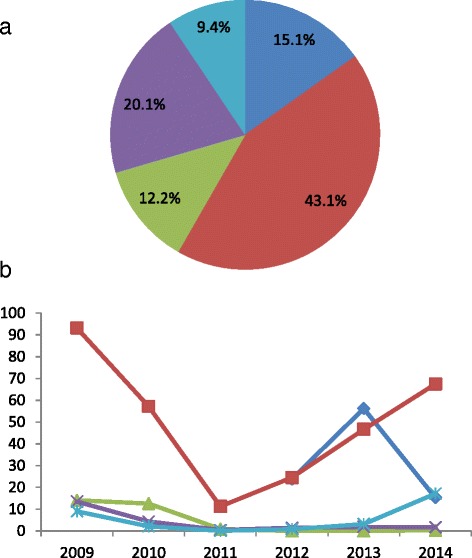
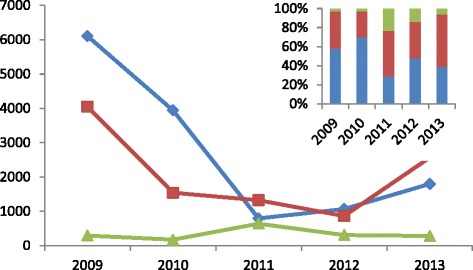
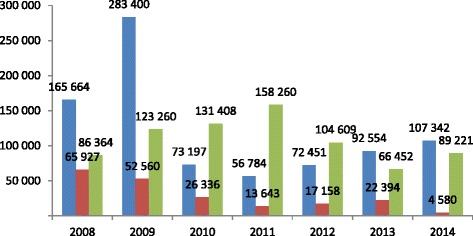
Results: In ethnic minority regions where a malaria control network was established, both the annual malaria incidence (19.1 per thousand per year, in 2009; 8.7, in 2014) and malaria prevalence (13.6 % in 2008; 0.43 % in 2014) decreased dramatically during the past 5-6 years. A total of 851 393 febrile patients were detected, 202 598 malaria cases (including confirmed cases and suspected cases) were treated, and 759 574 LLINs were delivered to populations at risk. Of households in 2012, 73.9 % had at least one ITNs/LLINs (vs. 28.3 %, in 2008), and 50.7 % of children less than 5 years and 50.3 % of pregnant women slept under LLINs the night prior to their visit. Additionally, malaria knowledge was improved in 68.4 % of residents.
Conclusion: There has been great success in improving malaria control in these regions from 2007 to 2014. Malaria burdens have decreased, especially in KOK and WA. The continued maintenance of sustainable malaria control networks in these regions may be a long-term process, due to regional conflicts and the lack of funds, technology, and health workers. Furthermore, information and scientific support from the international community should be offered to these ethnic minority regions to uphold recent achievements.
Keywords: Ethnic minority regions; Malaria control; Northern Myanmar.
Figures
References
-
- World Health Organization . World Malaria Report. 2014.
-
- Cui LW, Yan GY, Sattabongkot J, Cao YM, Chen B, Chen XG, Fan Q, Fang Q, Jongwutiwes S, Parker D, Sirichaisinthop J, Kyaw MP, Su XZ, Yang HL, Yang ZQ, Wang BM, Xu JW, Zheng B, Zhong DB, Zhou GF. Malaria in the Greater Mekong subregion: heterogeneity and complexity. Acta Trop. 2012;121:227–39. doi: 10.1016/j.actatropica.2011.02.016. - DOI - PMC - PubMed
-
- Kumar A, Chery L, Biswas C, Dubhashi N, Dutta P, Dua VK, Kacchap M, Kakati S, Khandeparkar A, Kour D, Mahajan SN, Maji A, Majumder P, Mohanta J, Mohapatra PK, Narayanasamy K, Roy K, Shastri J, Valecha N, Vikash R, Wani R, White J, Rathod PK. Malaria in South Asia: prevalence and control. Acta Trop. 2012;121:246–55. doi: 10.1016/j.actatropica.2012.01.004. - DOI - PMC - PubMed
-
- Li HX, Zhang ZX, Du ZW, Chen GW, Chen ZW. Investigation into an outbreak of malaria in Lincang prefecture on China-Myanmar border and the neighboring area outside China. China Trop Med. 2005;5:55–60.
MeSH terms
LinkOut - more resources
Full Text Sources
Other Literature Sources
Medical
Miscellaneous
