


Pathways through which asthma risk factors contribute to asthma severity in inner-city children
- PMID: 27720018
- PMCID: PMC5381517
- DOI: 10.1016/j.jaci.2016.06.060
Pathways through which asthma risk factors contribute to asthma severity in inner-city children
Abstract
Background: Pathway analyses can be used to determine how host and environmental factors contribute to asthma severity.
Objective: To investigate pathways explaining asthma severity in inner-city children.
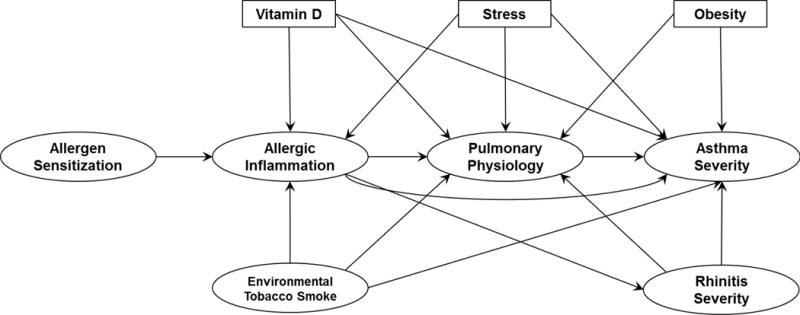
Methods: On the basis of medical evidence in the published literature, we developed a conceptual model to describe how 8 risk-factor domains (allergen sensitization, allergic inflammation, pulmonary physiology, stress, obesity, vitamin D, environmental tobacco smoke [ETS] exposure, and rhinitis severity) are linked to asthma severity. To estimate the relative magnitude and significance of hypothesized relationships among these domains and asthma severity, we applied a causal network analysis to test our model in an Inner-City Asthma Consortium study. Participants comprised 6- to 17-year-old children (n = 561) with asthma and rhinitis from 9 US inner cities who were evaluated every 2 months for 1 year. Asthma severity was measured by a longitudinal composite assessment of day and night symptoms, exacerbations, and controller usage.
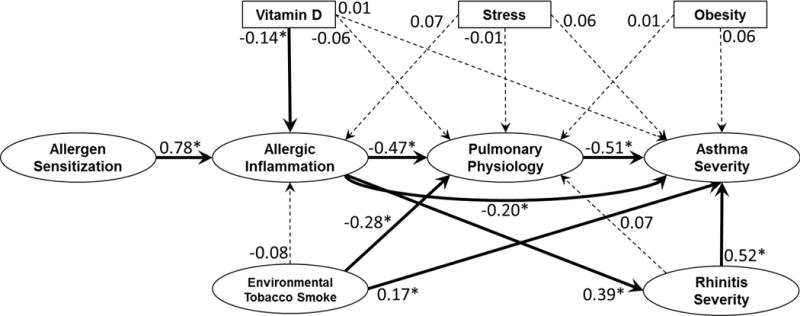
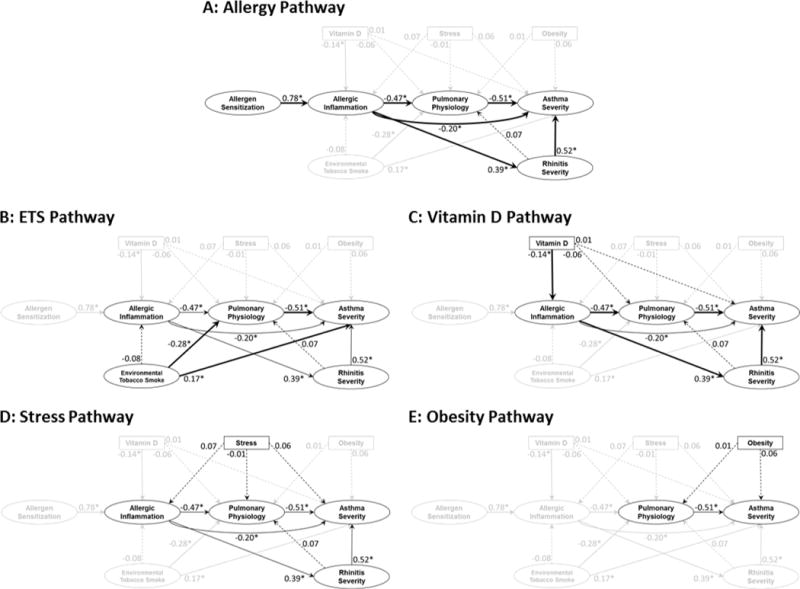
Results: Our conceptual model explained 53.4% of the variance in asthma severity. An allergy pathway (linking allergen sensitization, allergic inflammation, pulmonary physiology, and rhinitis severity domains to asthma severity) and the ETS exposure pathway (linking ETS exposure and pulmonary physiology domains to asthma severity) exerted significant effects on asthma severity. Among the domains, pulmonary physiology and rhinitis severity had the largest significant standardized total effects on asthma severity (-0.51 and 0.48, respectively), followed by ETS exposure (0.30) and allergic inflammation (0.22). Although vitamin D had modest but significant indirect effects on asthma severity, its total effect was insignificant (0.01).
Conclusions: The standardized effect sizes generated by a causal network analysis quantify the relative contributions of different domains and can be used to prioritize interventions to address asthma severity.
Keywords: Asthma; allergy; children; environmental tobacco smoke exposure; inflammation; inner-city; lung function; pulmonary physiology; rhinitis; sensitization.
Copyright © 2016 American Academy of Allergy, Asthma & Immunology. All rights reserved.
Figures
Comment in
-
The multimorbid polysensitized phenotype is associated with the severity of allergic diseases.J Allergy Clin Immunol. 2017 Apr;139(4):1407-1408. doi: 10.1016/j.jaci.2016.12.961. Epub 2017 Feb 22. J Allergy Clin Immunol. 2017. PMID: 28237729 No abstract available.
-
Reply.J Allergy Clin Immunol. 2017 Apr;139(4):1408-1409. doi: 10.1016/j.jaci.2016.12.962. Epub 2017 Feb 22. J Allergy Clin Immunol. 2017. PMID: 28237730 No abstract available.
References
-
- National Asthma Education and Prevention Program. Expert Panel Report 3: Guidelines for the Diagnosis and Management of Asthma. U.S. Department of Health and Human Services; 2007. http://www.nhlbi.nih.gov/guidelines/asthma/
Publication types
MeSH terms
Substances
Grants and funding
- UL1 TR000150/TR/NCATS NIH HHS/United States
- UL1 TR001105/TR/NCATS NIH HHS/United States
- UL1 TR000075/TR/NCATS NIH HHS/United States
- UL1 RR025780/RR/NCRR NIH HHS/United States
- UL1 TR000154/TR/NCATS NIH HHS/United States
- UM2 AI117870/AI/NIAID NIH HHS/United States
- UL1 TR001082/TR/NCATS NIH HHS/United States
- HHSN272200900052C/AI/NIAID NIH HHS/United States
- HHSN272201000052I/AI/NIAID NIH HHS/United States
- UL1 TR000451/TR/NCATS NIH HHS/United States
- UM1 AI114271/AI/NIAID NIH HHS/United States
- UL1 TR000040/TR/NCATS NIH HHS/United States
- UL1 TR000077/TR/NCATS NIH HHS/United States
LinkOut - more resources
Full Text Sources
Other Literature Sources
Medical
