Review
. 2017 Jun 30;429(13):1958-1977.
doi: 10.1016/j.jmb.2016.09.023. Epub 2016 Oct 6.

KATapulting toward Pluripotency and Cancer

Affiliations
Review

KATapulting toward Pluripotency and Cancer

Calley L Hirsch et al. J Mol Biol. .

Abstract

Development is generally regarded as a unidirectional process that results in the acquisition of specialized cell fates. During this process, cellular identity is precisely defined by signaling cues that tailor the chromatin landscape for cell-specific gene expression programs. Once established, these pathways and cell states are typically resistant to disruption. However, loss of cell identity occurs during tumor initiation and upon injury response. Moreover, terminally differentiated cells can be experimentally provoked to become pluripotent. Chromatin reorganization is key to the establishment of new gene expression signatures and thus new cell identity. Here, we explore an emerging concept that lysine acetyltransferase (KAT) enzymes drive cellular plasticity in the context of somatic cell reprogramming and tumorigenesis.

Keywords: acetylation; embryonic stem cells; histone; plasticity; reprogramming.


Figures

Figure 1
Figure 1
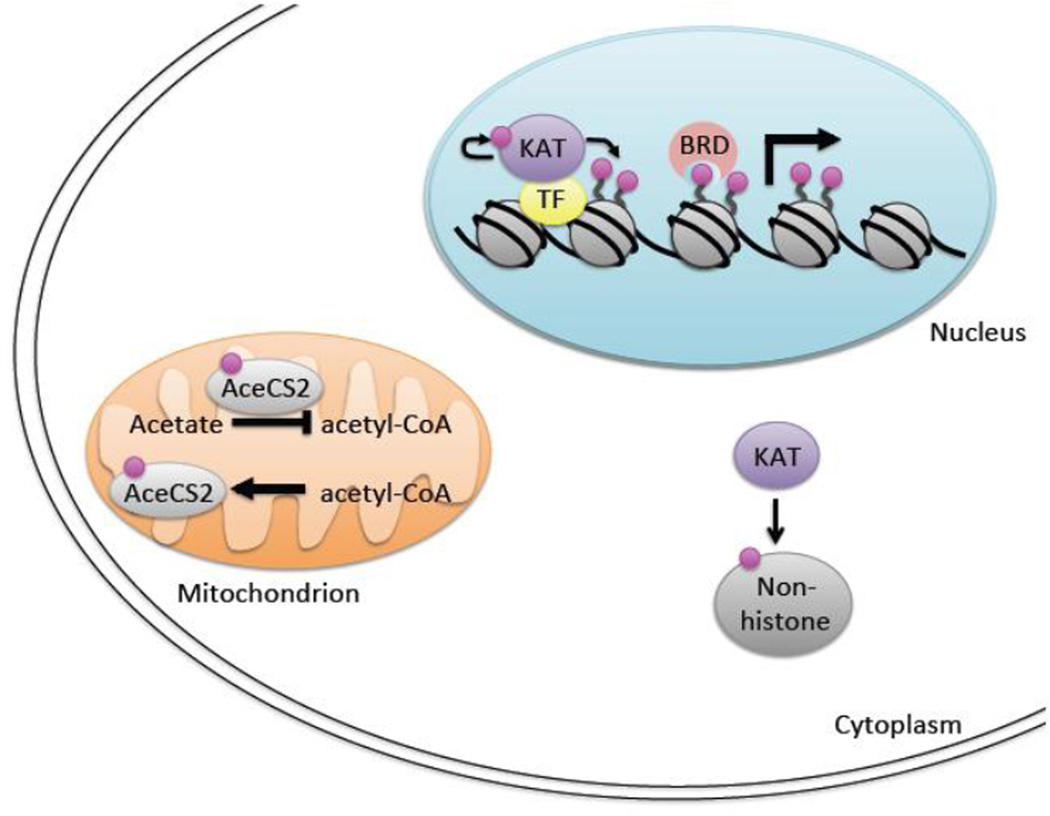
Cellular lysine acetylation. Representative lysine acetylation events are displayed in the nucleus, cytoplasm, and mitochondria. Within the nucleus, KATs are recruited by transcription factors (TFs) to chromatin, where they acetylate surrounding histones and function to reduce chromatin compaction. Following acetylation, bromodomain-containing proteins (BRD) may interact with acetylated histones to further promote gene activation. In the cytoplasm, it is shown that KATs acetylate non-histone proteins. KAT-mediated non-histone acetylation further occurs in the nucleus and mitochondria. As an example, lysine acetylation of the Acetyl-CoA synthetase 2 enzyme (AceCS2) blocks acetyl-CoA production in mitochondria. Pink circle: acetylation.
Figure 2
Figure 2
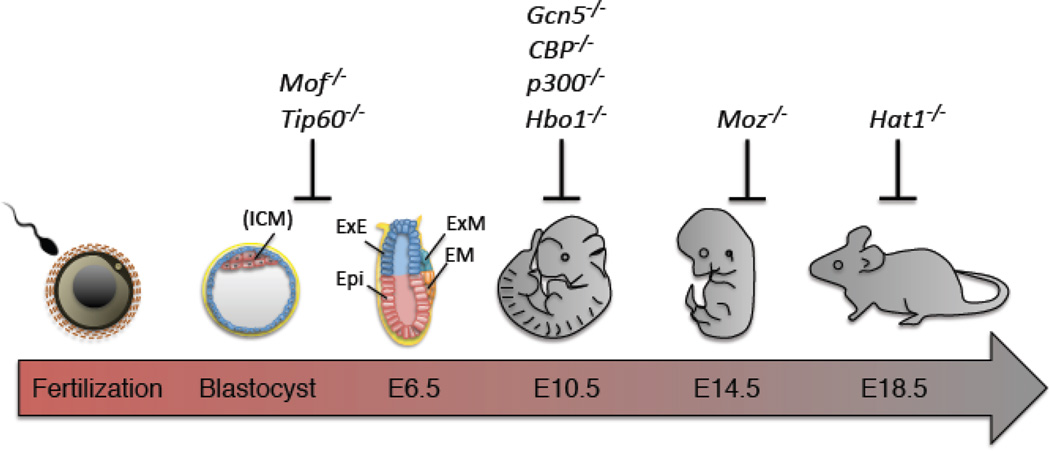
The involvement of KATs in development. A timeline of mouse development is shown highlighting the points of embryonic lethality in different KAT null mouse lines. ICM: inner cell mass, Epi: Epiblast, ExE: extra-embryonic ectoderm, EM: embryonic mesoderm, ExM: extra-embryonic mesoderm.
Figure 3
Figure 3
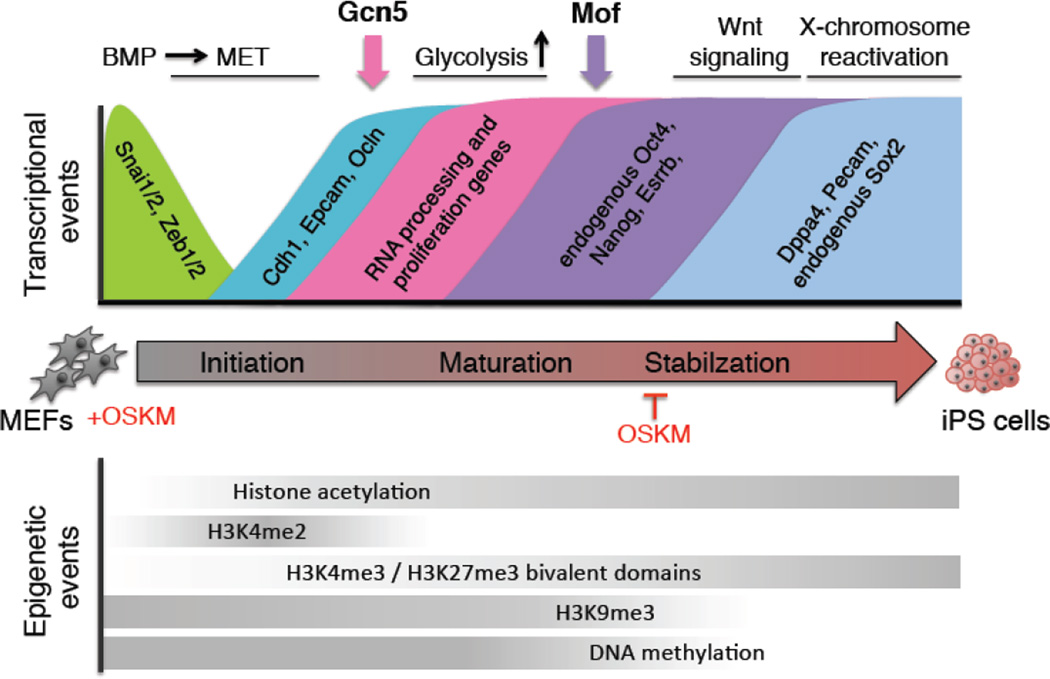
Somatic cell reprogramming. The key transcriptional (top) and epigenetic events (bottom) are detailed across the initiation, maturation and stabilization phases of reprogramming. The involvement of Gcn5 and Mof is highlighted. MEF: mouse embryonic fibroblast, iPS: induced pluripotent stem cells, MET: mesenchymal-to-epithelial transition, OSKM: Oct4, Sox2, Klf4, Myc.
Figure 4
Figure 4
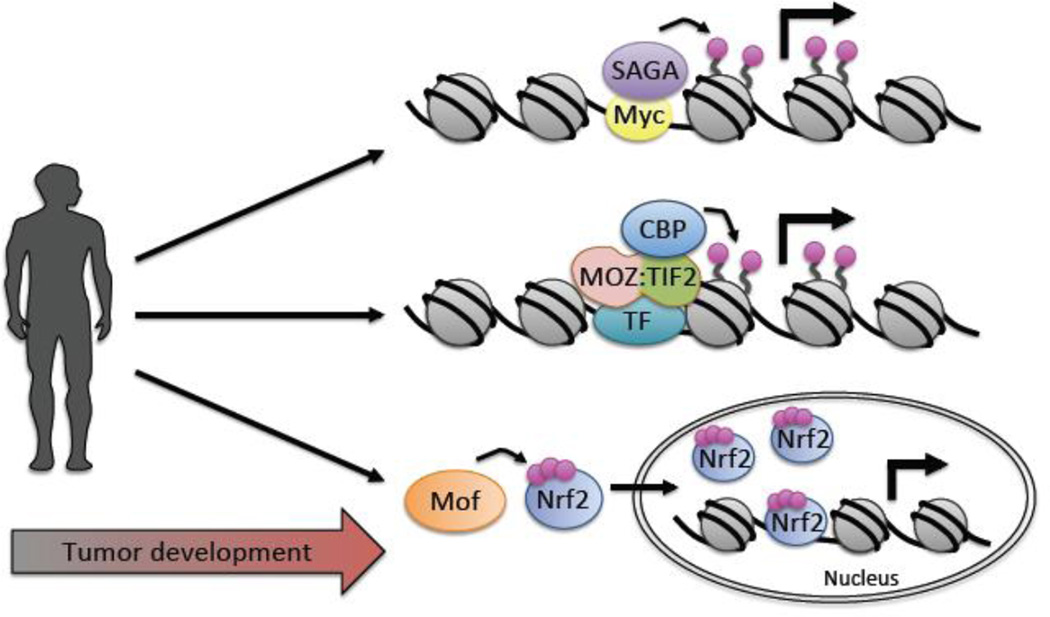
The impact of KATs on tumorigenesis. Representative themes and examples of KAT involvement in tumor development are highlighted. Top. Functioning as co-activators, KATs promote transcriptional up-regulation of oncogene targets. Here, Myc recruits KAT co-activator complexes including SAGA (shown) and TIP60 (not shown) that drive histone acetylation and subsequent gene activation. Middle. KAT fusion proteins result in mistargeting of KAT activity. Here, the MOZ:TIF2 fusion protein triggers CBP recruitment and gene activation of Moz target genes. Bottom. KATs mediate non-histone acetylation. Here, Mof acetylates Nrf2 resulting in nuclear retention and activation of Nrf2 gene targets. Pink circle: acetylation.

References

    1. Khoury GA, Baliban RC, Floudas CA. Proteome-wide post-translational modification statistics: frequency analysis and curation of the swiss-prot database. Sci Rep. 2011:1. - PMC - PubMed
    1. Luger K, Mader AW, Richmond RK, Sargent DF, Richmond TJ. Crystal structure of the nucleosome core particle at 2.8 A resolution. Nature. 1997;389:251–260. - PubMed
    1. Rothbart SB, Strahl BD. Interpreting the language of histone and DNA modifications. Biochim Biophys Acta. 2014;1839:627–643. - PMC - PubMed
    1. Tan M, Luo H, Lee S, Jin F, Yang JS, Montellier E, Buchou T, Cheng Z, Rousseaux S, Rajagopal N, Lu Z, Ye Z, Zhu Q, Wysocka J, Ye Y, Khochbin S, Ren B, Zhao Y. Identification of 67 histone marks and histone lysine crotonylation as a new type of histone modification. Cell. 2011;146:1016–1028. - PMC - PubMed
    1. Chen Y, Sprung R, Tang Y, Ball H, Sangras B, Kim SC, Falck JR, Peng J, Gu W, Zhao Y. Lysine propionylation and butyrylation are novel post-translational modifications in histones. Mol Cell Proteomics. 2007;6:812–819. - PMC - PubMed

Publication types