Long-Term Results after Surgical Treatment of Ebstein's Anomaly: a 30-year Experience
- PMID: 27721863
- PMCID: PMC5054184
- DOI: 10.4070/kcj.2016.46.5.706
Long-Term Results after Surgical Treatment of Ebstein's Anomaly: a 30-year Experience
Abstract
Background and objectives: The aim of the study is to evaluate the long-term results after a surgical repair of Ebstein's anomaly.
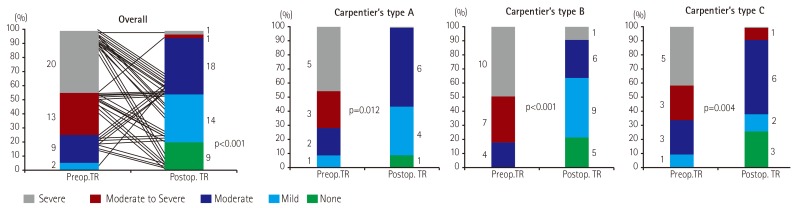
Subjects and methods: Forty-eight patients with Ebstein's anomaly who underwent open heart surgery between 1982 and 2013 were included. Median age at operation was 5.6 years (1 day-42.1 years). Forty-five patients (93.7%) demonstrated tricuspid valve (TV) regurgitation of less than moderate degree. When the patients were divided according to Carpentier's classification, types A, B, C, and D were 11, 21, 12, and 4 patients, respectively. Regarding the type of surgical treatment, bi-ventricular repair (n=38), one-and-a half ventricular repair (n=5), and single ventricle palliation (n=5) were performed. Of 38 patients who underwent a bi-ventricular repair, TV repairs were performed by Danielson's technique (n=20), Carpentier's technique (n=11), Cone repair (n=4), and TV annuloplasty (n=1). Two patients underwent TV replacement. Surgical treatment strategies were different according to Carpentier's types (p<0.001) and patient's age (p=0.022).
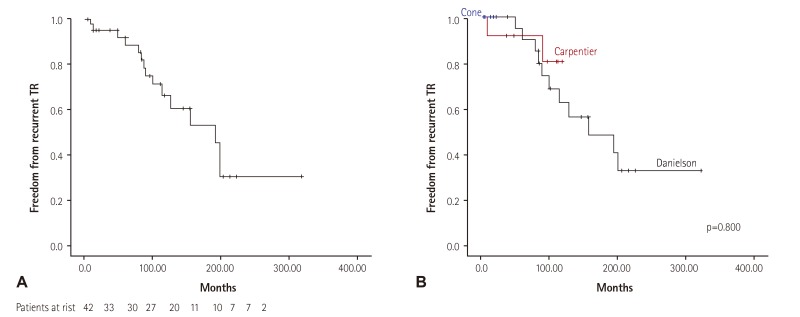
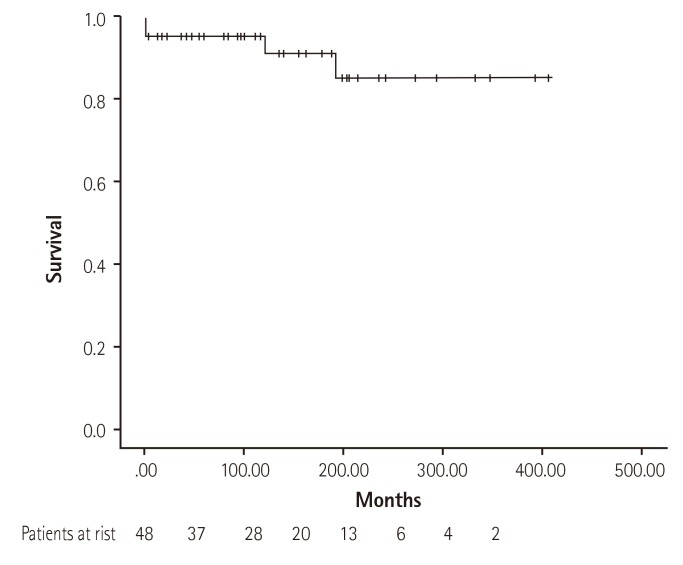
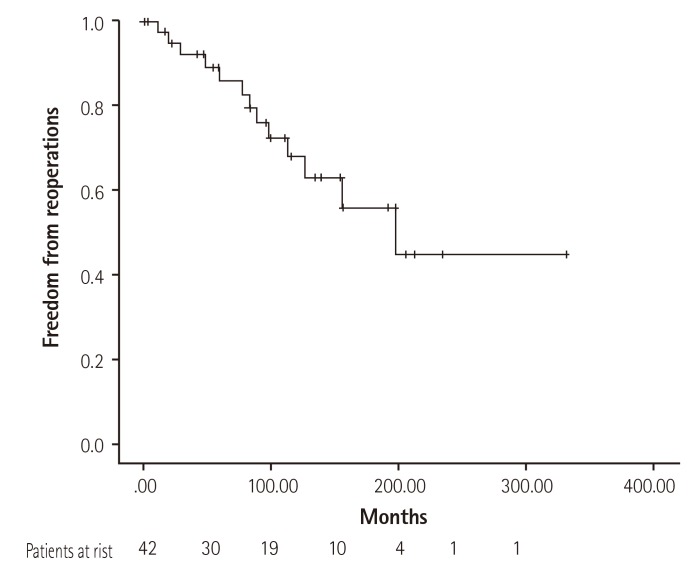
Results: There were 2 in-hospital mortalities (4.2%; 1 neonate and 1 infant) and 2 late mortalities during follow-up. Freedom from recurrent TV regurgitation rates at 5, 10, and 15 years were 88.6%, 66.3%, 52.7%, respectively. TV regurgitation recurrence did not differ according to surgical method (p=0.800). Survival rates at 5, 10, and 20 years were 95.8%, 95.8%, and 85.6%, respectively, and freedom from reoperation rates at 5, 10, and 15 years were 85.9%, 68.0%, and 55.8%, respectively.
Conclusion: Surgical treatment strategies were decided according to Carpentier's type and patient's age. Overall survival and freedom from reoperation rates at 10 years were 95.8% and 68.0%, respectively. Approximately 25% of patients required a second operation for TV during the follow-up.
Keywords: Cyanosis; Heart defects, congenital; Outcomes.
Conflict of interest statement
The authors have no financial conflicts of interest.
Figures
References
-
- Attenhofer Jost CH, Connolly HM, Edwards WD, Hayes D, Warnes CA, Danielson GK. Ebstein's anomaly - review of a multifaceted congenital cardiac condition. Swiss Med Wkly. 2005;135:269–281. - PubMed
-
- Krieger EV, Valente AM. Diagnosis and management of ebstein anomaly of the tricuspid valve. Curr Treat Options Cardiovasc Med. 2012;14:594–607. - PubMed
-
- Attenhofer Jost CH, Connolly HM, Dearani JA, Edwards WD, Danielson GK. Ebstein's anomaly. Circulation. 2007;115:277–285. - PubMed
-
- Huang CJ, Chiu IS, Lin FY, et al. Role of electrophysiological studies and arrhythmia intervention in repairing Ebstein's anomaly. Thorac Cardiovasc Surg. 2000;48:347–350. - PubMed
-
- Iturralde P, Nava S, Sálica G, Medeiros A, et al. Electrocardiographic characteristics of patients with Ebstein's anomaly before and after ablation of an accessory atrioventricular pathway. J Cardiovasc Electrophysiol. 2006;17:1332–1336. - PubMed
LinkOut - more resources
Full Text Sources
Other Literature Sources