Review
. 2016 Nov 21;45(23):6597-6626.
doi: 10.1039/c6cs00271d.

Reactive oxygen species generating systems meeting challenges of photodynamic cancer therapy

Affiliations
Review

Reactive oxygen species generating systems meeting challenges of photodynamic cancer therapy

Zijian Zhou et al. Chem Soc Rev. .

Abstract

The reactive oxygen species (ROS)-mediated mechanism is the major cause underlying the efficacy of photodynamic therapy (PDT). The PDT procedure is based on the cascade of synergistic effects between light, a photosensitizer (PS) and oxygen, which greatly favors the spatiotemporal control of the treatment. This procedure has also evoked several unresolved challenges at different levels including (i) the limited penetration depth of light, which restricts traditional PDT to superficial tumours; (ii) oxygen reliance does not allow PDT treatment of hypoxic tumours; (iii) light can complicate the phototherapeutic outcomes because of the concurrent heat generation; (iv) specific delivery of PSs to sub-cellular organelles for exerting effective toxicity remains an issue; and (v) side effects from undesirable white-light activation and self-catalysation of traditional PSs. Recent advances in nanotechnology and nanomedicine have provided new opportunities to develop ROS-generating systems through photodynamic or non-photodynamic procedures while tackling the challenges of the current PDT approaches. In this review, we summarize the current status and discuss the possible opportunities for ROS generation for cancer therapy. We hope this review will spur pre-clinical research and clinical practice for ROS-mediated tumour treatments.


Figures

Fig. 1
Fig. 1
Schematic illustration of the mechanism of ROS generation through a typical photodynamic procedure. However, traditional photodynamic procedure encounters several challenges at difference levels (in black) blocking the broad applications of PDT. The overall contents are provided to summarize the advanced strategies to solve these problems through photodynamic and/or non-photodynamic procedures while highlighting the generation of ROS for cancer therapy.
Fig. 2
Fig. 2
Light penetration through the tissues. The penetration depth of a typical light is dominated by the rates of absorption, scattering, transmission and reflection by tissue itself, which vary with different wavelengths. Adapted with permission from ref. 31. Copyright 2011, American Cancer Society.
Fig. 3
Fig. 3
(A) NIR light harvesting by UCNP for photosensitizing PS and ROS generation. (B-E) Strategies for integrating UCNP and PS for PDT study including covalent binding (B), physical attachment through hydrophobic-hydrophobic interaction or electron static interaction (C), silica shell embedding (D), and direct PS coating (E).
Fig. 4
Fig. 4
(A) Scheme of two-photon activation of PS for ROS generation. (B) Structures and absorption spectra of conjugated porphyrin dimers 1-5, and the clinically used photosensitizer verteporfin, 6. (C) One-photon absorption spectra of 1, 2, 4 and 6. (D) Two-photon absorption spectra of 1-4. All spectra were recorded in dimethylformamide (DMF) with 1% pyridine. (E) In vitro photodynamic therapy of porphyrin dimers 1-5, compared to verteporfin, 6. Reprinted with permission from ref. 96. Copyright 2008, Nature Publishing Group.
Fig. 5
Fig. 5
Schematic representation of RLuc8-immobilized QDs-655 for BRET-based PDT. Reprinted with permission from ref. 114. Copyright 2012, Elsevier Ltd.
Fig. 6
Fig. 6
(A) Scintillating nanoparticles (ScNPs) act as an X-ray transducer to generate 1O2 through the electron transfer process. (B) Diagram of the PDT mechanism that occurs when energy is transferred from ScNPs to activate the PS. (C-F) Scanning transmission electron microscope (STEM) image and corresponding element mapping (for Y, Ce, Si, and Zn) of ScNPs. (G, H) In vivo ionizing-radiation-induced ScNPs-mediated synchronous radiotherapy and PDT. Reprinted with permission from ref. 62. Copyright 2016, American Chemical Society. Reprinted with permission from ref. 134. Copyright 2015, John Wiley & Sons, Inc.
Fig. 7
Fig. 7
(A) Schematic of the CR-mediated excitation of TiO2 nanoparticles to generate cytotoxic hydroxyl and superoxide radicals from water and dissolved oxygen, respectively, through electron-hole pair generation. CR is generated by PET radionuclides (not to scale). (B, C) Cell-viability and DNA damage by TiO2 treatment. (D-F) In vivo CRIT through a one-time intra-tumoural administration shows significant shrinkage of tumour, and extensive necrotic centres and destruction of the tumour architecture from haematoxylin and eosin (H&E) slices. Reprinted with permission from ref. 141. Copyright 2015, Nature Publishing Group.
Fig. 8
Fig. 8
Scheme shows several situations of oxygen in PDT, indicating great importance for introducing oxygen self-supplied systems to confer efficient PDT outcomes.
Fig. 9
Fig. 9
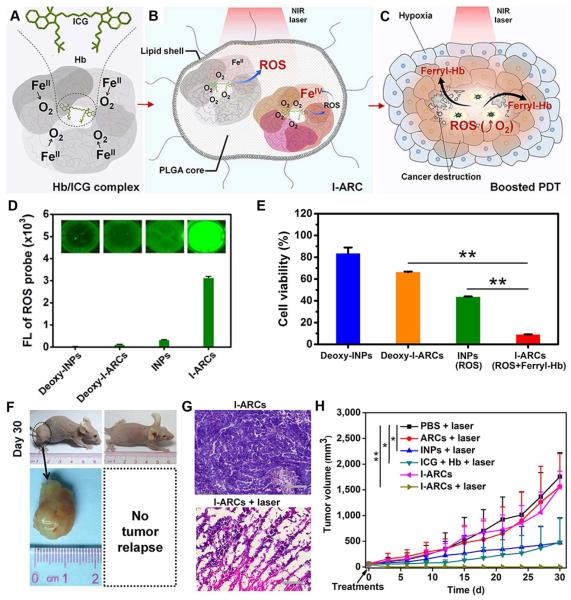
(A-C) Schematic illustration of cancer-boosted PDT based on ICG-loaded artificial red cells (I-ARCs) (D, E) ROS generation and ROS-mediated cell viability assay using I-ARCs. (F-G) In vivo anti-tumour evaluation of I-ARC-based PDT shows complete remission of MCF-7 tumours. Reprinted with permission from ref. 163. Copyright 2016, Nature Publishing Group.
Fig. 10
Fig. 10
(A) Structure and design of the Oxy-PDT agent. (B) Structure of PS IR780. (C, D) Cell viability assay in CT-26 cells shows enhanced cytotoxicity by Oxy-PDT agents. (E-G) In vivo photodynamic therapy of Oxy-PDT by intra-tumoural injection in a subcutaneous tumour model, showing prominent 1O2 generation and tumor growth inhibition. Reprinted with permission from ref. 178. Copyright 2015, Nature Publishing Group.
Fig. 11
Fig. 11
(A) Schematic illustration of mechanism of H2O2-controllable release of PS and O2 to implement PDT and (B) HAOP NP for selective and efficient PDT against hypoxic tumor cell. (C) Change of relative tumor volume (V/V0) and tumor slides by H&E staining upon different treatments. Scale bars: 100 µm. Reprinted with permission from ref. 184. Copyright 2015, American Chemical Society.
Fig. 12
Fig. 12
Scheme shows the ROS generation through diverse stimulations other than light activation of photosensitization, which could provide spatiotemporal control for ROS-based cancer therapy.
Fig. 13
Fig. 13
(A) Synthesis of the targeted anthracene endoperoxide derivative (EPT1) for gold nanorod functionalization. (B) PDT concept of photo-triggered thermal conversion and 1O2 generation. (C) Absorbance at one of the anthracene peaks (404 nm) after heating EPT1 for 30 min at the indicated temperatures. (D) Viability assays of HeLa cells incubated with 10 pm of GNR-PEG or EPT1-GNR for 24 h, washed with DPBS, and irradiated with 808 nm laser (2.0 Wcm−2, 10 min). Reprinted with permission from ref. 198. Copyright 2016, John Wiley & Sons, Inc.
Fig. 14
Fig. 14
(A) Schematic illustration of sonodynamic therapy (SDT) using HTiO2 NPs. (B, C) TEM EDS mapping and images of HTiO2 NPs. Scale bar is 500 and 90 nm for B and C, respectively. (D) Treatment regimen of SDT. Red arrow represents injection time-points of HTiO2 NPs. (F) Antitumour efficacy of HTiO2 NPs in SCC7 tumour-bearing mice. (G) Bright-field images of tumour vasculature after SDT with US. Scale bar, 1000 µm. Reprinted with permission from ref. 206. Copyright 2016, Nature Publishing Group.
Fig. 15
Fig. 15
(A) Concept of 1O2 quenching/scavenging and activation by an enzymatic cleavage of a caspase-3 substrate. (B) Structure of caspase-3 activatable Pyro-peptide-CAR (PPC) beacon. (C-F) HPLC chromatograms monitoring caspase-3 cleavage by (C,D) Pyro fluorescence and (E,F) CAR absorption: (C,E) PPC alone and (D,F) PPC + caspase-3. Reprinted with permission from ref. 213. Copyright 2004, American Chemical Society.
Fig. 16
Fig. 16
(A) Structures and pH-activatable generation of fluorescence and 1O2 by cRGD-NEt2Br2BDP NP. (B) NIR fluorescence spectra of cRGD-NEt2Br2BDP NP at different pH. (C) Subcellular localization of 1O2 generated during cRGD-NEt2Br2BDP NP-mediated PDT with singlet oxygen sensor green (SOSG), LysoTracker Red and Hoechst 33342 staining. Scale bars: 25 µm. Reprinted with permission from ref. 236. Copyright 2015, The Royal Society of Chemistry.
Fig. 17
Fig. 17
(A) Proposed mechanism for autocatalytic 1O2 amplification. Following photoexcitation of Br2B-PMHC, its singlet excited state rapidly deactivates via intra-molecular photo-induced electron transfer (PeT). The improbable occurrence of a chemical quenching pathway of 1O2 by Br2B−PMHC will yield an oxidized, active form, Br2B−PMHCox that will sensitize additional 1O2. (B) 1O2 phosphorescence emission intensities (λem = 1270 nm) as a function of irradiation time for different PSs in air-equilibrated acetonitrile solutions. (C) Antibacterial photodynamic inactivation in E. coli ATCC 25922. E. coli dark controls (from left to right): control, incubated with 500 nM hydrogen peroxide. Reprinted with permission from ref. 243. Copyright 2016, American Chemical Society.
Fig. 18
Fig. 18
(A) Mechanism of ROS generation by FAP-TAPs. IC, internal conversion by molecule’s free rotation; ISC, intersystem crossing. (B) Images of cells that were labeled with 400 nM of the indicated dye taken before laser illumination (top) by differential interference contrast (DIC) and fluorogen-FAP (red). Live cell (cyan) and dead cell (yellow) were assayed 30 min after illumination (bottom). Scale bar, 10 µm. (C) Merge of DIC and mCer3 fluorescence (cyan) showing phenotype development from 0 h p. i. to 96 h p. i. of larval zebrafish (n = 20 for each group). Scale bar: 1000 µm. Reprinted with permission from ref. 284. Copyright 2016, Nature Publishing Group.
Fig. 19
Fig. 19
(A) Preparation of amorphous Fe0 nanoparticles (AFeNPs). (B) Electron spin resonance (ESR) spectra of different reaction systems with 5, 5-Dimethyl-1-Pyrroline-N-Oxide (DMPO) as the spin trap. (C) Growth inhibitory effects of the AFeNPs on MCF-7 cells at pH 7.4 and 6.5 at various H2O2 concentrations (n = 6, mean ± s. d., **P<0.01, and ***P<0.001). Reprinted with permission from ref. 313. Copyright 2016, John Wiley & Sons, Inc.
Fig. 20
Fig. 20
An overview of major biochemical reactions that are able to generate 1O2. R indicates alkyl groups, enzymes include catalase and peroxidases. (i) H2O2 and hypochlorite (ClO) during phagocytosis; (ii) energy transfer reaction from excited carbonyl species; (iii) superoxide anion reactions with organic or inorganic substances; (iv) ozone reaction involving hydrotrioxide intermediates; (v) peroxynitrite reactions with hydroperoxides or hydrogen peroxides; (vi) decomposition of lipid hydroperoxides by reduction through Russell mechanism; (vii) enzymes (e.g., catalase, peroxidases)-involved metabolism.

References

    1. Dickinson BC, Chang CJ. Nat. Chem. Biol. 2011;7:504–511. - PMC - PubMed
    1. Apel K, Hirt H. Annu. Rev. Plant Biol. 2004;55:373–399. - PubMed
    1. Tripathy BC, Oelmüller R. Plant Signal. Behav. 2012;7:1621–1633. - PMC - PubMed
    1. Turrens JF. J. Physiol. 2003;552:335–344. - PMC - PubMed
    1. Murphy Michael P. Biochem. J. 2009;417:1–13. - PMC - PubMed

Publication types

LinkOut - more resources