. 2016 Nov;48(11):1396-1406.
doi: 10.1038/ng.3695. Epub 2016 Oct 10.

Genome-wide association analysis identifies variation in vitamin D receptor and other host factors influencing the gut microbiota

Affiliations

Genome-wide association analysis identifies variation in vitamin D receptor and other host factors influencing the gut microbiota

Jun Wang et al. Nat Genet. 2016 Nov.

Abstract

Human gut microbiota is an important determinant for health and disease, and recent studies emphasize the numerous factors shaping its diversity. Here we performed a genome-wide association study (GWAS) of the gut microbiota using two cohorts from northern Germany totaling 1,812 individuals. Comprehensively controlling for diet and non-genetic parameters, we identify genome-wide significant associations for overall microbial variation and individual taxa at multiple genetic loci, including the VDR gene (encoding vitamin D receptor). We observe significant shifts in the microbiota of Vdr-/- mice relative to control mice and correlations between the microbiota and serum measurements of selected bile and fatty acids in humans, including known ligands and downstream metabolites of VDR. Genome-wide significant (P < 5 × 10⁻⁸) associations at multiple additional loci identify other important points of host-microbe intersection, notably several disease susceptibility genes and sterol metabolism pathway components. Non-genetic and genetic factors each account for approximately 10% of the variation in gut microbiota, whereby individual effects are relatively small.


Figures
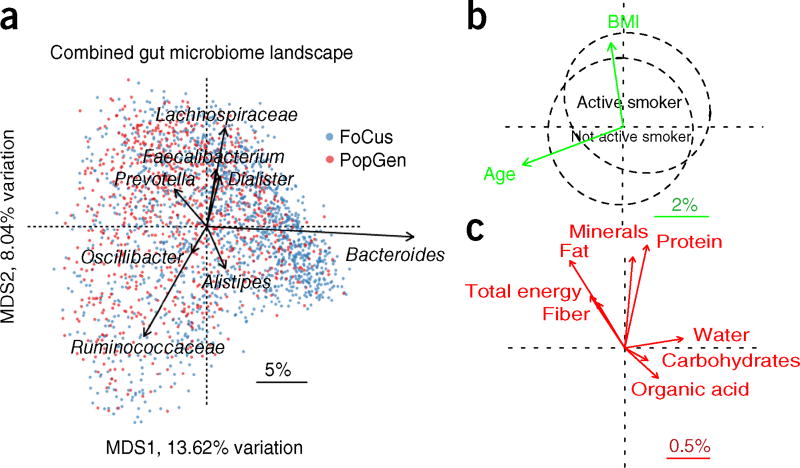
Figure 1
Figure 1. Overview of variation in the gut microbiota and significantly associated non-genetic parameters
(a) PCoA of the combined cohort using BC. Arrows represent increases in the eight most abundant genera (arrow length is proportional to mean abundance; scale bar); n= 1,812. Samples are colored according to cohort. MDS1 and MDS2 are the two major axes from PCoA. (b) Correlation of age, BMI and smoking status with microbiota. For age and BMI, green arrows denote effect size (variation in β diversity explained; scale bar). Differences in smoking status are depicted as two circles with different centroids, with the dashed lines containing 50% of the samples for each group (for visualization). (c) Correlation of major nutrients with microbiota, with red arrows denoting effect size (variation in β diversity explained; scale bar). As most individual nutrients are co-linear with total energy, all arrows, save for the one for total energy, show the increase in standardized nutrient values (calculated by nutrient/total energy).
Figure 2
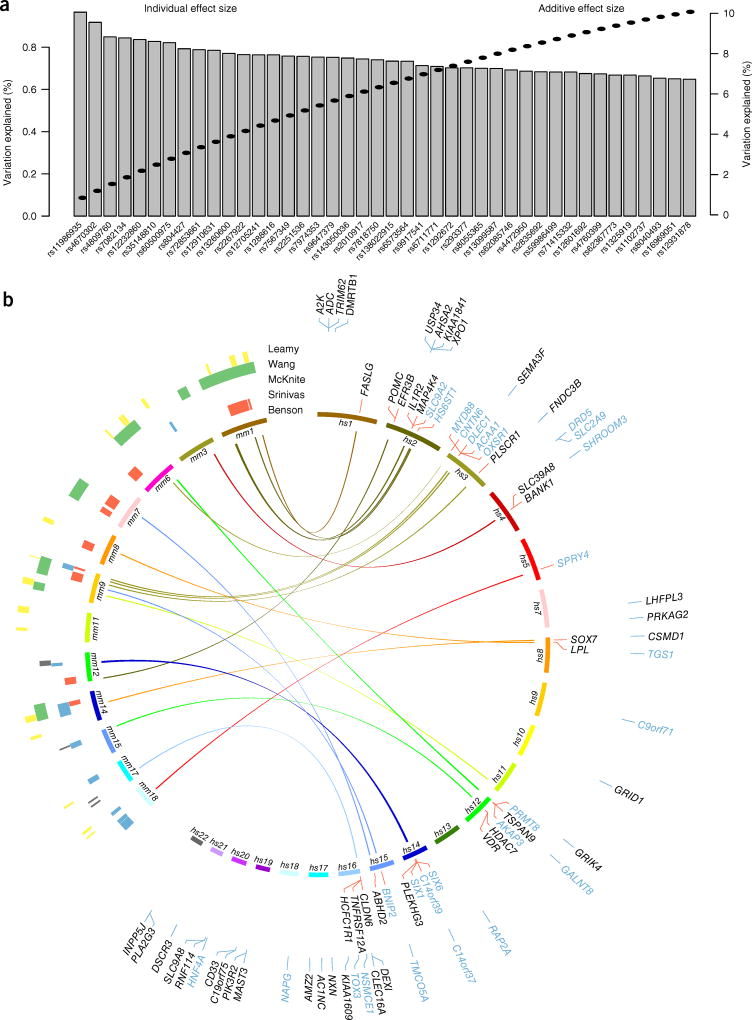
Figure 2. Individual and combined effects of significant loci and overview of all significant loci identified in this study
(a) Effect sizes (variation in β diversity explained) for the 42 significant loci (lead SNPs) are shown in decreasing order (left axis), and additive effects (Online Methods) are shown by the dashed line (right axis). (b) Chromosomes on the right side of the plot show the chromosomal position of genes significantly associated with β diversity (black) or an individual taxon (blue). The inner circle includes genes whose mouse homologs were implicated in one or more previously published mouse QTL studies,–(supplementary tables 6 and 7), denoted by a link to the corresponding mouse chromosome and appearing in the same color as the human chromosome on which the gene is located. For genes located in the outer circle, either there is no mouse homolog or the mouse homolog does not fall within a QTL.
Figure 3
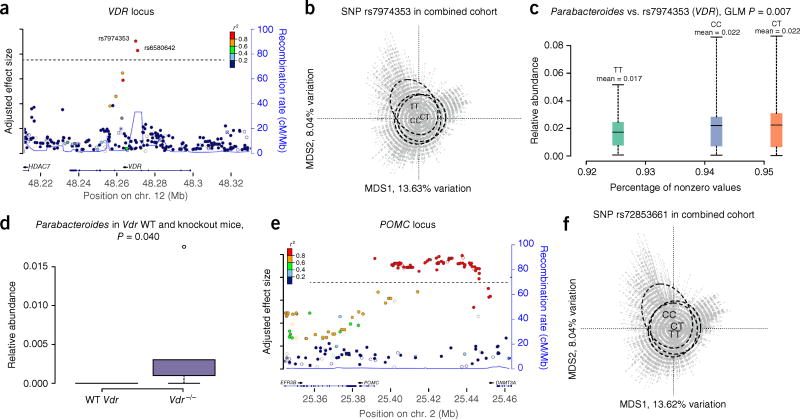
Figure 3. VDR and POMC as examples of genes associated with β diversity
(a) LocusZoom plot of adjusted effect size (for each SNP, the actual effect size is divided by the significance threshold adjusted according to MAF category, represented by the dashed line; Online Methods) at the VDR locus, where two SNPs passed the significance threshold for association with β diversity (P < 5 × 10⁻⁸ for association with overall microbiome variation, measured by BC). (b) Association between genotypes at the lead SNP (rs7974353) and β diversity (BC). Microbiome data are shown in a PCoA plot; the dashed lines contain 50% of the samples for each group (for visualization) and show differences in the centroids for each genotype group; n = 1,812. (c) Meta-analysis in humans shows Parabacteroides to be the most significant taxon correlated with VDR using a GLM (Online Methods). The x axis shows the percentage of nonzero values for each genotype at rs7974353, and boxes and bars summarize 50% and 95% confidence intervals, respectively, for nonzero values; n = 1,812. (d) Knockout of Vdr in mice also leads to changes in Parabacteroides abundance. Error bars, 5–95% confidence intervals (n = 3 wild-type (WT) mice and n = 5 knockout mice; supplementary Fig. 6 and supplementary Note). (e) LocusZoom plot for adjusted effect size in the region upstream of POMC, where 78 SNPs passed the significance threshold. (f) Association between the genotypes of the lead SNP at POMC (rs72853661) and β diversity (BC). Microbiome data are shown in a PCoA plot; the dashed lines contain 50% of the samples for each group (for visualization) and show differences in the centroids for each genotype group; n = 1,812.

References

    1. Ley RE, Peterson DA, Gordon JI. Ecological and evolutionary forces shaping microbial diversity in the human intestine. Cell. 2006;124:837–848. - PubMed
    1. Fraune S, Bosch TC. Why bacteria matter in animal development and evolution. BioEssays. 2010;32:571–580. - PubMed
    1. Sekirov I, Russell SL, Antunes LCBB, Finlay BB. Gut microbiota in health and disease. Physiol. Rev. 2010;90:859–904. - PubMed
    1. Chow J, Mazmanian SK. A pathobiont of the microbiota balances host colonization and intestinal infammation. Cell Host Microbe. 2010;7:265–276. - PMC - PubMed
    1. Costello EK, Stagaman K, Dethlefsen L, Bohannan BJ, Relman DA. The application of ecological theory toward an understanding of the human microbiome. Science. 2012;336:1255–1262. - PMC - PubMed

Publication types