. 2016 Oct 10;11(10):e0164463.
doi: 10.1371/journal.pone.0164463. eCollection 2016.

A Tale of Tails: Dissecting the Enhancing Effect of Tailed Primers in Real-Time PCR

Affiliations

A Tale of Tails: Dissecting the Enhancing Effect of Tailed Primers in Real-Time PCR

Frank Vandenbussche et al. PLoS One. .

Abstract

Non-specific tail sequences are often added to the 5'-terminus of primers to improve the robustness and overall performance of diagnostic assays. Despite the widespread use of tailed primers, the underlying working mechanism is not well understood. To address this problem, we conducted a detailed in vitro and in silico analysis of the enhancing effect of primer tailing on 2 well-established foot-and-mouth disease virus (FMDV) RT-qPCR assays using an FMDV reference panel. Tailing of the panFMDV-5UTR primers mainly affected the shape of the amplification curves. Modelling of the raw fluorescence data suggested a reduction of the amplification efficiency due to the accumulation of inhibitors. In depth analysis of PCR products indeed revealed the rapid accumulation of forward-primer derived artefacts. More importantly, tailing of the forward primer delayed artefacts formation and concomitantly restored the sigmoidal shape of the amplification curves. Our analysis also showed that primer tailing can alter utilisation patterns of degenerate primers and increase the number of primer variants that are able to participate in the reaction. The impact of tailed primers was less pronounced in the panFMDV-3D assay with only 5 out of 50 isolates showing a clear shift in Cq values. Sequence analysis of the target region of these 5 isolates revealed several mutations in the inter-primer region that extend an existing hairpin structure immediately downstream of the forward primer binding site. Stabilisation of the forward primer with either a tail sequence or cationic spermine units restored the sensitivity of the assay, which suggests that the enhancing effect in the panFMDV-3D assay is due to a more efficient extension of the forward primer. ur results show that primer tailing can alter amplification through various mechanisms that are determined by both the assay and target region. These findings expand our understanding of primer tailing and should enable a more targeted and efficient use of tailed primers.


Conflict of interest statement

The authors have declared that no competing interests exist.

Figures
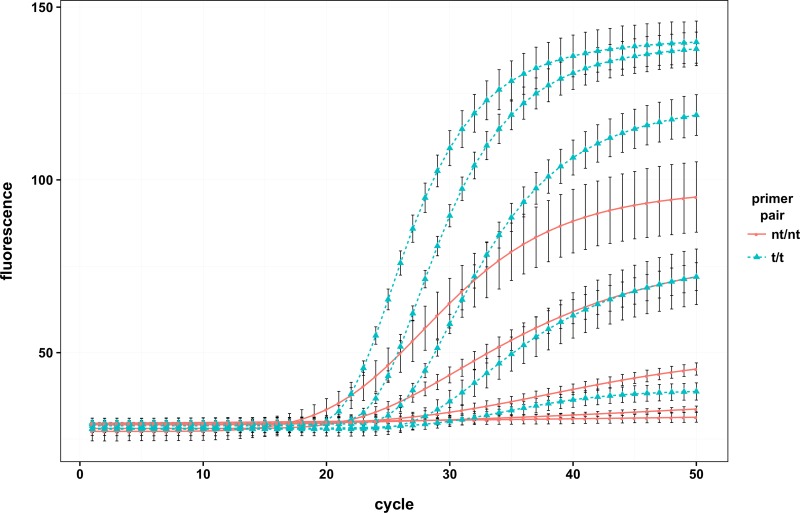
Fig 1
Fig 1. Impact of primer tailing on the panFMDV-5UTR RT-qPCR assay.
A 5-fold dilution series of viral genomic RNA of isolate SAT2/ZIM/3/97 was tested in triplicate with the panFMDV-5UTR RT-qPCR assay using either non-tailed or tailed primers. Non-linear regression models were fitted to the raw fluorescence data of each replicate and the resulting models were amalgamated into a single replicate model using the replist function from the qpcR package [38] (S4 File). The figure shows the replicate model of 5 dilutions with error bars representing 1 standard deviation (nt: non-tailed, t: tailed).
Fig 2
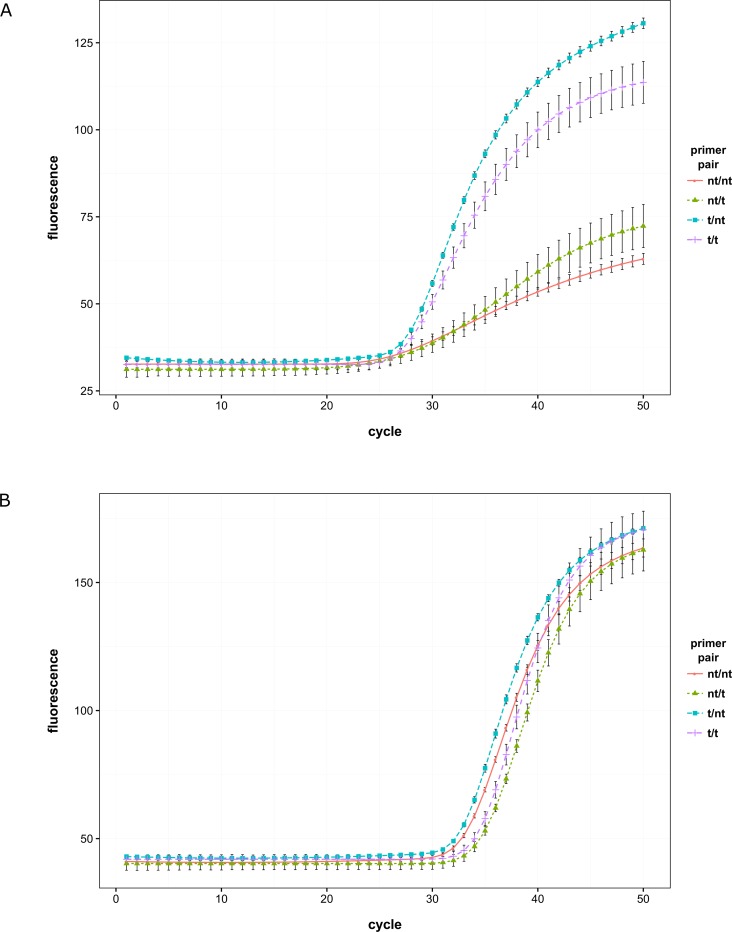
Fig 2. Impact of primer tailing on the panFMDV-5UTR RT-qPCR assay using normal or hot-start dNTPs.
Viral genomic RNA of FMDV isolate SAT3/MAL/3/76 was tested with the panFMDV-5UTR RT-qPCR assay using different primer combinations in the presence of either normal dNTPs (panel A) or hot-start dNTPs (panel B). Non-linear regression models were fitted to the raw fluorescence data of each replicate and the resulting models were amalgamated into a single replicate model using the replist function from the qpcR package [38] (S4 File). The figures show the replicate model of each primer combination with error bars representing 1 standard deviation (nt: non-tailed, t: tailed).
Fig 3
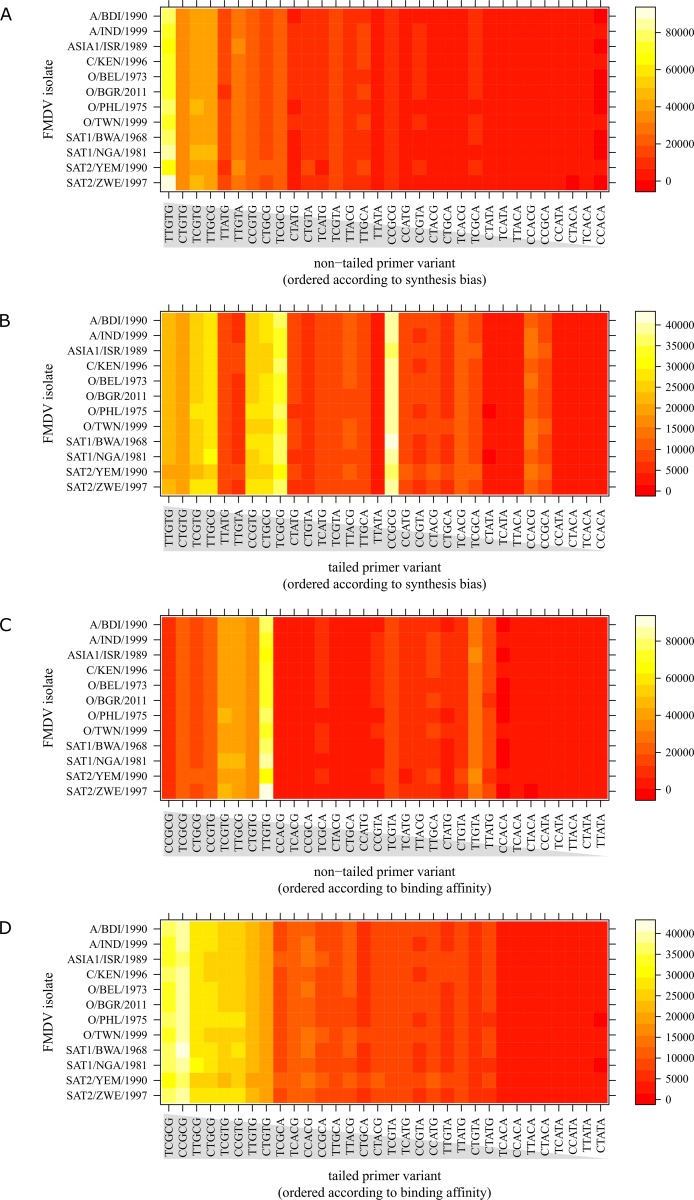
Fig 3. Primer utilisation patterns of the FMDV-5UTR forward primer using hot-start dNTPs.
Heat map of forward primer utilisation patterns using non-tailed (A and C) or tailed (B and D) primers. The heat map indicates the abundance of each primer variant for each FMDV isolate, with primers ordered by decreasing synthesis bias (A and B) or decreasing binding affinity (C and D). Primer variants are named according to the nucleotide bases present at the degenerate positions (e.g. primer variant TTGTG corresponds to the primer 5’- CACTTTAAGGTGACATTGGTACTGGTAC -3’).
Fig 4
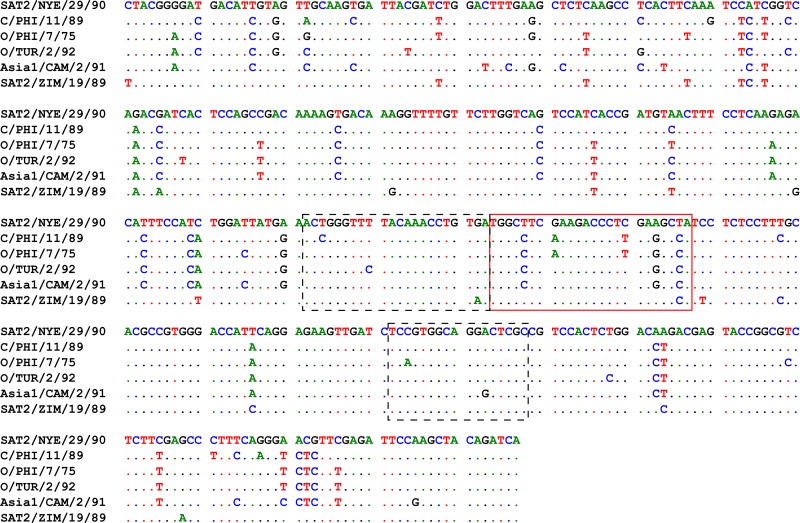
Fig 4. Sequence alignment of a 367 bp fragment of the 3D gene from the control isolate (row 1) and the 5 aberrant isolates (rows 2–6).
The region contains the entire panFMDV-3D target region as well as part of the upstream and downstream regions. Primer binding sites are shown in black, dashed boxes whereas the region involved in the hairpin formation is shown in the red box.
Fig 5
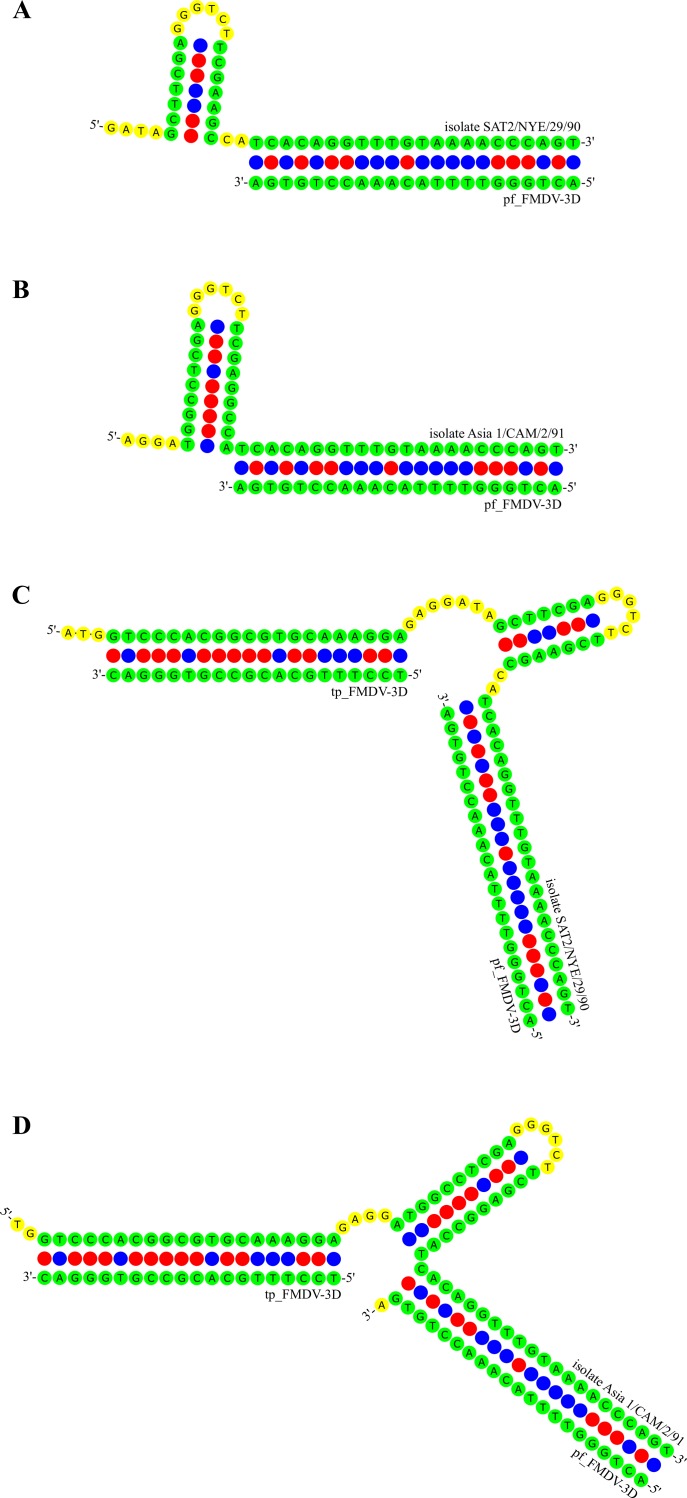
Fig 5. Primer/target and primer/probe/target interactions as predicted by Visual OMP.
Interactions between the panFMDV-3D forward primer/probe and target regions from FMDV isolates SAT2/NYE/29/90 (A, C) and Asia 1/CAM/2/91 (B, D). Figures A and B show the predicted interactions between the primer pf_FMDV-3D and the target DNA. Figures C and D show the same interactions in the presence of the probe tp_FMDV-3D.
Fig 6
Fig 6. Effect of stabilisation of the forward primer on the performance of the panFMDV-3D RT-qPCR assay.
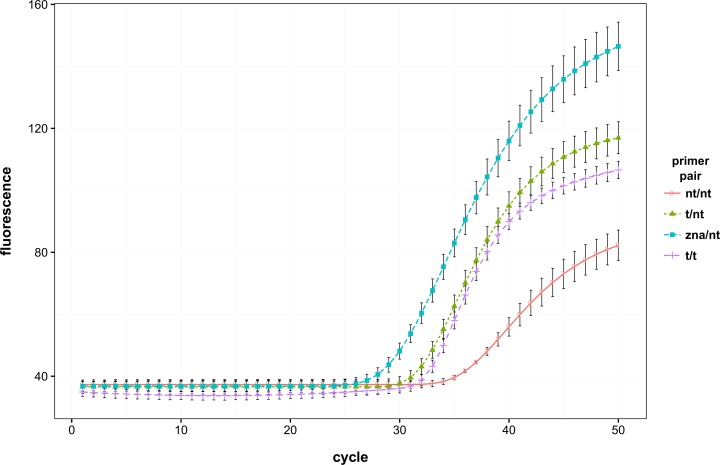
FMDV isolate O/TUR/2/92 was tested with the panFMDV-3D RT-qPCR assay using different primer combinations. Non-linear regression models were fitted to the raw fluorescence data of each replicate and the resulting models were amalgamated into a single replicate model using the replist function from the qpcR package [38] (S4 File). The figure shows the replicate model of each primer combination with error bars representing 1 standard deviation. (nt: non-tailed, t: tailed, zna: zipped nucleic acid).

References

    1. Saiki RK, Gelfand DH, Stoffel S, Scharf SJ, Higuchi R, Horn GT, et al. Primer-directed enzymatic amplification of DNA with a thermostable DNA polymerase. Science. 1988; 239(4839): 487–491. 10.1126/science.2448875 - DOI - PubMed
    1. Saiki RK, Scharf S, Faloona F, Mullis KB, Horn GT, Erlich HA, et al. Enzymatic amplification of beta-globin genomic sequences and restriction site analysis for diagnosis of sickle cell anemia. Science. 1985; 230(4732): 1350–1354. 10.1126/science.2999980 - DOI - PubMed
    1. Scharf SJ, Horn GT, Erlich HA. Direct cloning and sequence analysis of enzymatically amplified genomic sequences. Science. 1986; 233(4768): 1076–1078. 10.1126/science.3461561 - DOI - PubMed
    1. Kaufman DL, Evans GA. Restriction endonuclease cleavage at the termini of PCR products. Biotechniques. 1990; 9(3): 304, 306. - PubMed
    1. Daigle D, Simen BB, Pochart P. High-throughput sequencing of PCR products tagged with universal primers using 454 life sciences systems. Curr Protoc Mol Biol. 2011; Chapter 7: Unit7.5. 10.1002/0471142727.mb0705s96 - DOI - PubMed