


School-based sexual health education interventions to prevent STI/HIV in sub-Saharan Africa: a systematic review and meta-analysis
- PMID: 27724886
- PMCID: PMC5057258
- DOI: 10.1186/s12889-016-3715-4
School-based sexual health education interventions to prevent STI/HIV in sub-Saharan Africa: a systematic review and meta-analysis
Abstract
Background: School-based sexual health education has the potential to provide an inclusive and comprehensive approach to promoting sexual health among young people. We reviewed evaluations of school-based sexual health education interventions in sub-Saharan Africa to assess effectiveness in reducing sexually transmitted infections and promoting condom use.
Methods: We searched ten electronic databases, hand-searched key journals, and reference lists of included articles for potential studies. Data were extracted on outcomes, intervention characteristics, methods and study characteristics indicative of methodological quality. Where possible, data were synthesized using random effect meta-analysis. Intervention features found predominantly in effective interventions were noted.
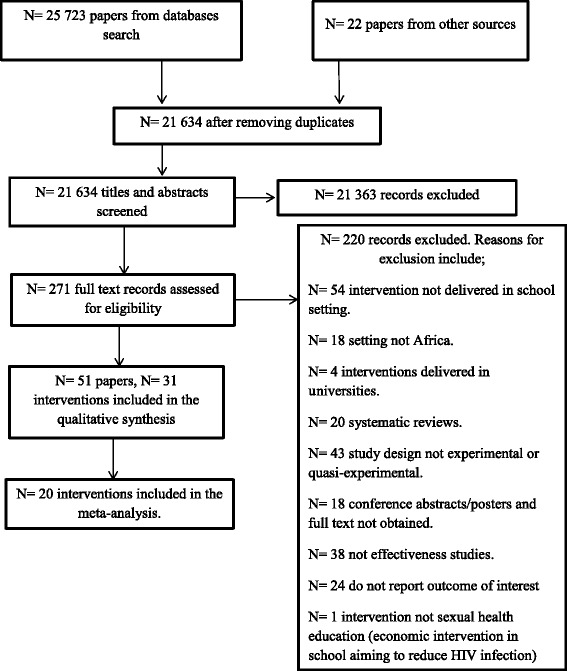
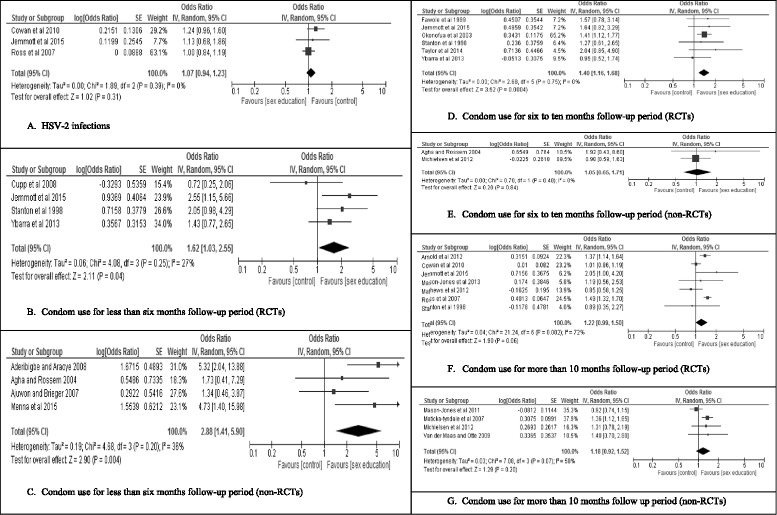
Results: The initial search retrieved 21634 potentially relevant citations. Of these, 51 papers reporting on 31 interventions were included. No evaluation reported statistically significant effects on the incidence or prevalence of Human Immunodeficiency Virus and Herpes Simplex Virus 2 infections. However, intervention participants reported statistically significant greater condom use in both randomised controlled trials and non-randomised trials for short (less than 6 months) follow-up periods (OR = 1.62, 95 % CI = 1.03-2.55 and OR = 2.88, 95 % CI = 1.41-5.90 respectively). For intermediate (6-10 months) and long-term (more than 10 months) follow-up periods, the effect was statistically significant (OR = 1.40, 95 % CI = 1.16-1.68) and marginally significant (OR = 1.22, 95 % CI = 0.99-1.50) among the randomised trials respectively. Only 12 of the 31 interventions reported implementation details, out of which seven reported on fidelity.
Conclusion: School-based sexual health education has the potential to promote condom use among young people in sub-Saharan Africa. However, further work is needed to develop and evaluate interventions that have measurable effects on sexually transmitted infections.
Keywords: HIV/STI prevention; School-based sexual health education; Sub-Saharan Africa; Systematic review.
Figures
References
-
- World Health Organization . Global incidence and prevalence of selected curable sexually transmitted infections-2008. Geneva: World Health Organization; 2012.
-
- UNAIDS . The Gap Report’. Geneva: UNAIDS; 2014.
-
- World Health Organization. Mortality, morbidity and disability in Adolescent. What we can learn from mortality data? Maternal, newborn, child and adolescent health, Data, statistics and epidemiology. Geneva: WHO; 2015. Available at: http://apps.who.int/adolescent/second-decade/section3/page2/mortality.html. Accessed 12 Nov 2015.
Publication types
MeSH terms
LinkOut - more resources
Full Text Sources
Other Literature Sources
Medical
