


Positive impact of a clinical goal-directed protocol on reducing cardiac arrests during potential brain-dead donor maintenance
- PMID: 27724931
- PMCID: PMC5057215
- DOI: 10.1186/s13054-016-1484-1
Positive impact of a clinical goal-directed protocol on reducing cardiac arrests during potential brain-dead donor maintenance
Abstract
Background: The disproportion between the large organ demand and the low number of transplantations performed represents a serious public health problem worldwide. Reducing the loss of transplantable organs from deceased potential donors as a function of cardiac arrest (CA) may contribute to an increase in organ donations. Our purpose was to test the hypothesis that a goal-directed protocol to guide the management of deceased donors may reduce the losses of potential brain-dead donors (PBDDs) due to CA.
Methods: The quality improvement project included 27 hospitals that reported deceased donors prospectively to the Transplant Center of the State of Santa Catarina, Brazil. All deceased donors reported prospectively between May 2012 and April 2014 were analyzed. Hospitals were encouraged to use the VIP approach checklist during the management of PBDDs. The checklist was composed of the following goals: protocol duration 12-24 hours, temperature > 35 °C, mean arterial pressure ≥ 65 mmHg, diuresis 1-4 ml/kg/h, corticosteroids, vasopressin, tidal volume 6-8 ml/kg, positive end-expiratory pressure 8-10 cmH2O, sodium < 150 mEq/L, and glycemia < 180 mg/dl. A logistic regression model was used to identify predictors of CA.
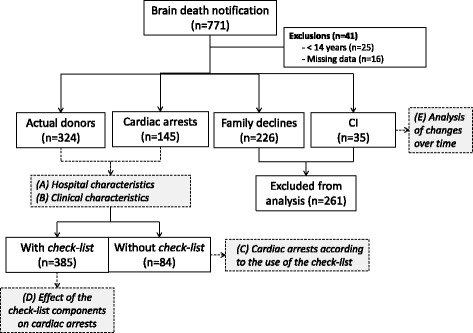
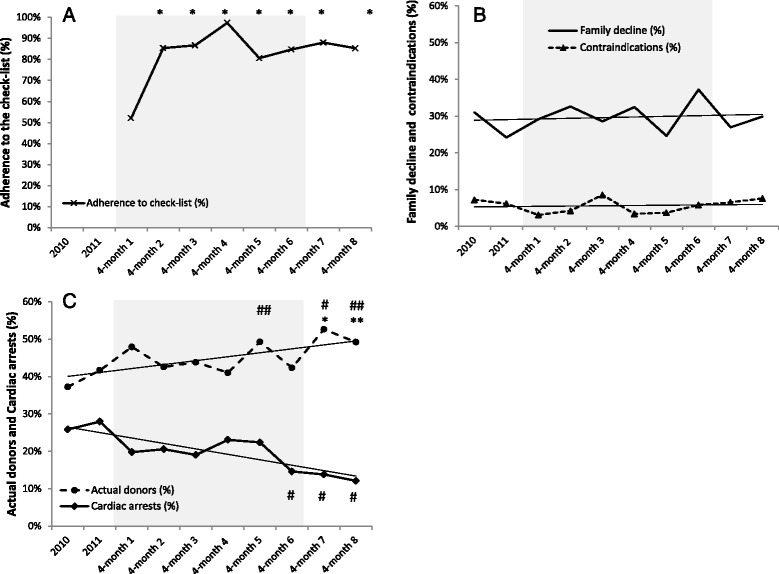
Results: There were 726 PBDD notifications, of which 324 (44.6) were actual donors, 141 (19.4 %) CAs, 226 (31.1 %) family refusals, and 35 (4.8 %) contraindications. Factors associated with CA reduction included use of the checklist (odds ratio (OR) 0.43, p < 0.001), maintenance performed inside the ICU (OR 0.49, p = 0.013), and vasopressin administration (OR 0.56, p = 0.04). More than three interventions had association with less CAs (OR 0.19, p < 0.001). After 24 months, CAs decreased from 27.3 % to 14.6 % (p = 0.002), reaching 12.1 % in the following two 4-month periods (p < 0.001). Simultaneous increases in organ recovered per donor and in actual donors were observed.
Conclusions: A quality improvement program based on education and the use of a goal checklist for the management of potential donors inside the ICU is strongly associated with a decrease in donor losses and an increase in organs recovered per donor.
Keywords: Checklist; Donor management; Donor management goals; Organ donor; Organ transplantation.
Figures
References
-
- España. Ministerio de Sanidad, Política Social e Igualdad. Organización Nacional de Trasplantes. Guía de buenas prácticas en el proceso de ladonación de órganos. España: Organización Nacional de Trasplantes; 2011. http://www.ont.es/publicaciones/Documents/GUIA_BUENAS_PRACTICAS_DONACION.... Accessed 5 Aug 2015.
-
- Westphal GA, Caldeira Filho M, Vieira KD, et al. Guidelines for potential multiple organ donors (adult). Part I. Rev Bras Ter Intensiva. 2011;23(3):255–68. - PubMed
MeSH terms
LinkOut - more resources
Full Text Sources
Other Literature Sources
Medical
Miscellaneous
