


Production of α1,3-galactosyltransferase and cytidine monophosphate-N-acetylneuraminic acid hydroxylase gene double-deficient pigs by CRISPR/Cas9 and handmade cloning
- PMID: 27725344
- PMCID: PMC5320426
- DOI: 10.1262/jrd.2016-079
Production of α1,3-galactosyltransferase and cytidine monophosphate-N-acetylneuraminic acid hydroxylase gene double-deficient pigs by CRISPR/Cas9 and handmade cloning
Abstract
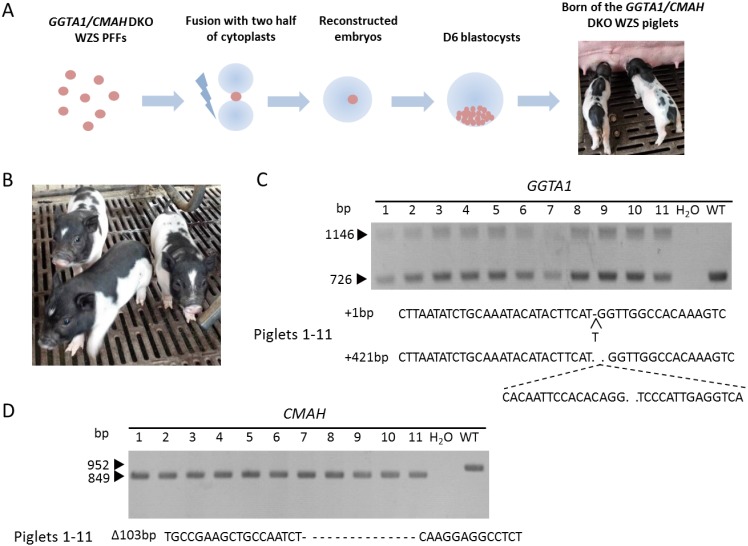
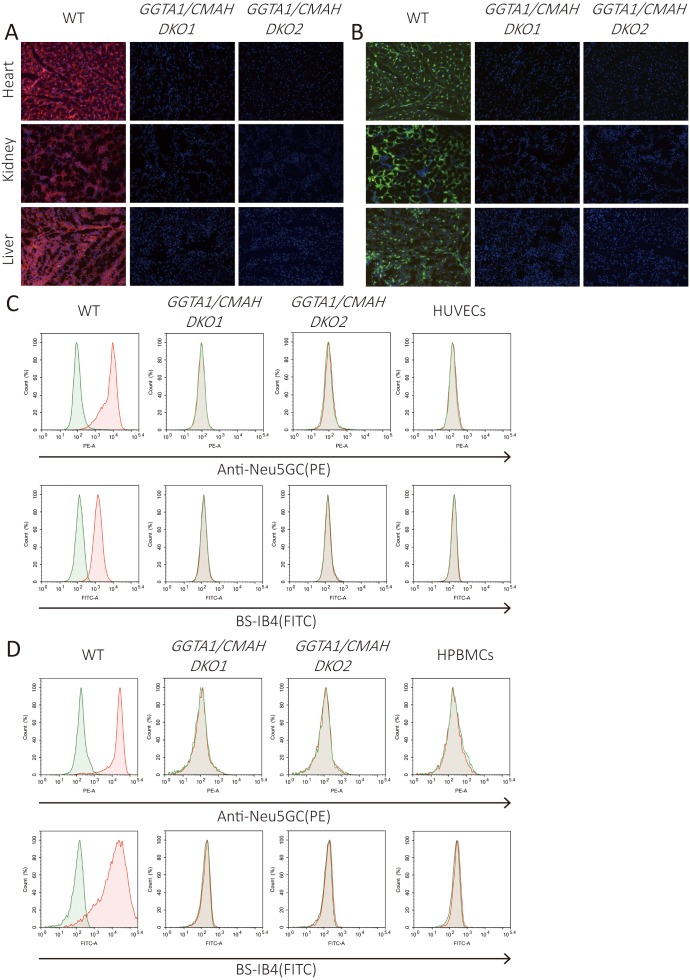
Gene-knockout pigs hold great promise as a solution to the shortage of organs from donor animals for xenotransplantation. Several groups have generated gene-knockout pigs via clustered regularly interspaced short palindromic repeats (CRISPR)/CRISPR-associated 9 (Cas9) and somatic cell nuclear transfer (SCNT). Herein, we adopted a simple and micromanipulator-free method, handmade cloning (HMC) instead of SCNT, to generate double gene-knockout pigs. First, we applied the CRISPR/Cas9 system to target α1,3-galactosyltransferase (GGTA1) and cytidine monophosphate-N-acetylneuraminic acid hydroxylase (CMAH) genes simultaneously in porcine fetal fibroblast cells (PFFs), which were derived from wild-type Chinese domestic miniature Wuzhishan pigs. Cell colonies were obtained by screening and were identified by Surveyor assay and sequencing. Next, we chose the GGTA1/CMAH double-knockout (DKO) cells for HMC to produce piglets. As a result, we obtained 11 live bi-allelic GGTA1/CMAH DKO piglets with the identical phenotype. Compared to cells from GGTA1-knockout pigs, human antibody binding and antibody-mediated complement-dependent cytotoxicity were significantly reduced in cells from GGTA1/CMAH DKO pigs, which demonstrated that our pigs would exhibit reduced humoral rejection in xenotransplantation. These data suggested that the combination of CRISPR/Cas9 and HMC technology provided an efficient and new strategy for producing pigs with multiple genetic modifications.
Figures



References
-
- Butler JR, Ladowski JM, Martens GR, Tector M, Tector AJ. Recent advances in genome editing and creation of genetically modified pigs. Int J Surg 2015; 23(Pt B): 217–222. - PubMed
-
- DeMayo FJ, Spencer TE. Editors-in-Chief BoR. CRISPR bacon: a sizzling technique to generate genetically engineered pigs. Biol Reprod2014; 91:79. - PubMed
-
- Lutz AJ, Li P, Estrada JL, Sidner RA, Chihara RK, Downey SM, Burlak C, Wang ZY, Reyes LM, Ivary B, Yin F, Blankenship RL, Paris LL, Tector AJ. Double knockout pigs deficient in N-glycolylneuraminic acid and galactose α-1,3-galactose reduce the humoral barrier to xenotransplantation. Xenotransplantation 2013; 20: 27–35. - PubMed
MeSH terms
Substances
LinkOut - more resources
Full Text Sources
Other Literature Sources
Research Materials
