


Pancreatic exocrine insufficiency after pancreaticoduodenectomy is more prevalent with pancreaticogastrostomy than with pancreaticojejunostomy. A retrospective multicentre observational cohort study
- PMID: 27726974
- PMCID: PMC5144554
- DOI: 10.1016/j.hpb.2016.09.002
Pancreatic exocrine insufficiency after pancreaticoduodenectomy is more prevalent with pancreaticogastrostomy than with pancreaticojejunostomy. A retrospective multicentre observational cohort study
Abstract
Objective: Recently, pancreaticogastrostomy (PG) has attracted renewed interest as a reconstruction technique after pancreaticoduodenectomy (PD), as it may imply a lower risk of clinical pancreatic fistula than reconstruction by pancreaticojejunostomy (PJ). We hypothesise that pancreatic exocrine insufficiency (PEI) is more common during clinical follow-up after PG than it is after PJ.
Research design and methods: This study compares the prevalence of PEI in patients undergoing PD for malignancy with reconstruction by PG versus reconstruction by PJ. PEI during the first year of follow-up was defined as the intake of pancreatic enzyme replacement therapy (PERT) within one year postoperatively and/or an abnormal exocrine function test.
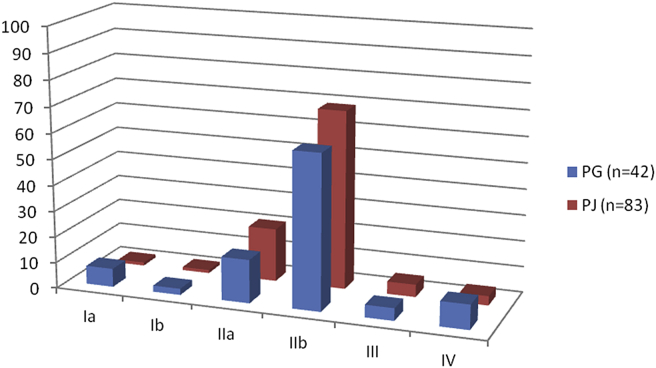
Results: A total of 186 patients, having undergone surgery at two university hospitals, were included in the study. PEI during the first year postoperatively was present in 75.0% of the patients with PG, compared to 45.7% with PJ (p < 0.001). Intake of PERT within one year after surgery was found to be more prevalent in the PG group, i.e. 75.8% versus 38.5% (p < 0.001). There was a trend towards more disturbed exocrine function tests after PG (p = 0.061).
Conclusions: PEI is more common with PG reconstruction than with PJ reconstruction after pancreaticoduodenectomy for malignancy.
Copyright © 2016 International Hepato-Pancreato-Biliary Association Inc. Published by Elsevier Ltd. All rights reserved.
Figures
References
-
- Topal B., Fieuws S., Aerts R., Weerts J., Feryn T., Roeyen G. Pancreaticojejunostomy versus pancreaticogastrostomy after pancreaticoduodenectomy for pancreatic or periampullary tumours: a multicentre randomized trial. Lancet Oncol. 2013;14:655–662. - PubMed
-
- Bassi C., Dervenis C., Butturini G., Fingerhut A., Yeo C., Izbicki J. Postoperative pancreatic fistula: an international study group (ISGPF) definition. Surgery. 2005;138:8–13. - PubMed
-
- Guerrini G., Soliani P., D'Amico G., Di Benedetto F., Negri M., Piccoli M. Pancreaticojejunostomy versus pancreaticogastrostomy after pancreaticoduodenectomy: an up-to-date meta-analysis. J Invest Surg. 2016;29:175–184. - PubMed
-
- Crippa S., Cirocchi R., Randolph J., Partelli S., Belfiori G., Piccioli A. Pancreaticojejunostomy is comparable to pancreaticogastrostomy after pancreaticoduodenectomy: an updated meta-analysis of randomized controlled trials. Langenbecks Arch Surg. 2016;401(4):427–437. - PubMed
-
- Hänninen J., Takala J., Keinänen-Kikaaniemi S. Quality of life in NIDDM patients assessed with the SF-20 Questionnaire. Diabetes Res Clin Pract. 1998;42:17–27. - PubMed
Publication types
MeSH terms
LinkOut - more resources
Full Text Sources
Other Literature Sources
