Review
. 2017 Mar;33(3):175-184.
doi: 10.1016/j.pt.2016.09.004. Epub 2016 Oct 7.

Mathematical Modelling to Guide Drug Development for Malaria Elimination

Affiliations
Review

Mathematical Modelling to Guide Drug Development for Malaria Elimination

Hannah C Slater et al. Trends Parasitol. 2017 Mar.

Abstract

Mathematical models of the dynamics of a drug within the host are now frequently used to guide drug development. These generally focus on assessing the efficacy and duration of response to guide patient therapy. Increasingly, antimalarial drugs are used at the population level, to clear infections, provide chemoprevention, and to reduce onward transmission of infection. However, there is less clarity on the extent to which different drug properties are important for these different uses. In addition, the emergence of drug resistance poses new threats to longer-term use and highlights the need for rational drug development. Here, we argue that integrating within-host pharmacokinetic and pharmacodynamic (PK/PD) models with mathematical models for the population-level transmission of malaria is key to guiding optimal drug design to aid malaria elimination.

Keywords: Plasmodium falciparum; Plasmodium vivax; drug development; drug-based strategies; malaria; mathematical modelling.


Figures

Figure 1
Figure 1
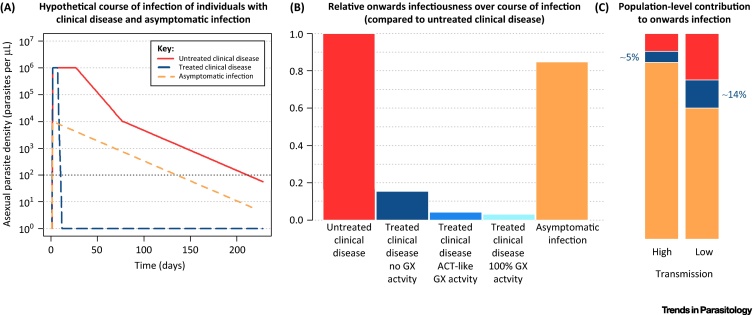
Schematic of the Relationship between an Individual's Course of Infection, Their Contribution to the Population Infectious Reservoir and the Impact of Treatment. Panel (A) shows a hypothetical typical course of infection for untreated and treated clinical disease (i.e., symptomatic infection) and asymptomatic infection. The black horizontal line indicates the limit of detection for microscopy (200 parasites per μL). Panel (B) combines the duration of infection with the infectivity to mosquitoes to produce a relative measure of onwards infectiousness for individuals with different types of infection and treatment based on parameter values presented in . We assume individuals with untreated clinical disease are highly infectious for 25 days, followed by a period of 200 days where they have patent asymptomatic infection, then 100 days where they have subpatent asymptomatic infection. During these periods they are 65% and 9% as infectious as at their peak, respectively. Individuals with clinical disease who are treated with a non-artemisinin combination therapy (ACT) with no gametocytocidal (GX) activity (dark blue) are assumed to remain highly infectious for 25 days after treatment, whereas treatment with an ACT (medium blue) reduces the total duration to 10 days and the infectiousness after treatment to 9% of the pretreatment amount , , . A drug with perfect GX activity (light blue) renders individuals instantly noninfectious after treatment , , . Panel (C) considers the population-level contribution of untreated (red) and treated (dark blue) symptomatic and asymptomatic (orange) individuals based on the individual-level durations of infection presented in (A) and the relative onwards infectiousness presented in (B). We assume that 80% of individuals with clinical disease are treated, and that 30% of new infections are symptomatic in a high transmission setting and 60% in a low transmission setting . Converting individual-level infectiousness to the population level allows us to see that treated individuals only contribute 5% or 14% (high and low transmission settings respectively) to the total infectiousness of a population. This indicates that improving the gametocytocidal activity of an antimalarial drug used for treatment of symptomatic cases can only potentially impact a small proportion of the total infectiousness of the population.
Figure 2
Figure 2
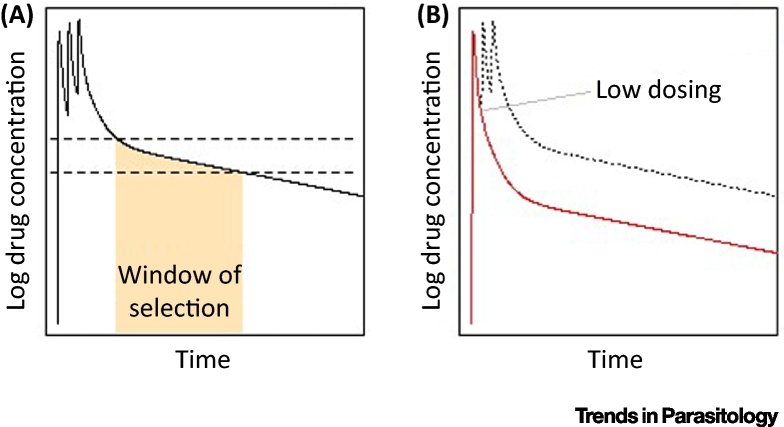
Pharmacokinetics and Vulnerable Time-Points for Selection of Partial Resistance. (A) During drug elimination, the unbroken line shows the drug concentration in the blood of a patient who takes the full course of a three-dose drug regimen, which has a long elimination half-life and so its concentration wanes gradually over time. This schematic is based on the antimalarial piperaquine. The window of selection is the time during which drug concentrations are sufficiently high to allow partially resistant parasites to survive, but kill sensitive parasites (in between the horizontal broken lines). During this period, this selection will usually act on parasites from new infections. Above these concentrations (above the upper broken line), both sensitive and partially resistant parasites are killed by the drug, and below these concentrations (below the lower broken line), both sensitive and partially resistant parasites can survive, so there is no selection. The window of selection would be longer for highly resistant parasites compared with parasites with a low level of partial resistance. (B) The red line shows the drug concentration in the blood of a patient who receives a lower than recommended amount of the drug, in this case because they take only one dose instead of three. Drug concentration therefore does not remain at a high enough level for a sufficient length of time to kill all parasites in the initial infection, potentially selecting for partially resistant parasites.
Figure I
Figure I
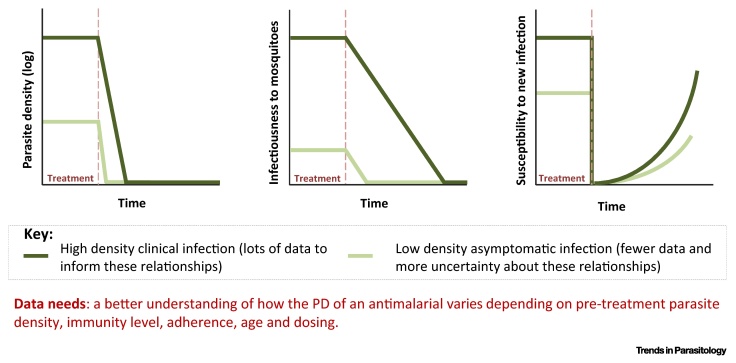
Hypothetical Pharmacodynamics (PD) in Individuals with High- and Low-density Malaria Infections.

References

    1. World Health Organisation . WHO; 2015. World Malaria Report 2015.
    1. Bhatt S. The effect of malaria control on Plasmodium falciparum in Africa between 2000 and 2015. Nature. 2015;526:207–211. - PMC - PubMed
    1. Moonen B. Operational strategies to achieve and maintain malaria elimination. Lancet. 2010;376:1592–1603. - PMC - PubMed
    1. Amaratunga C. Dihydroartemisinin-piperaquine resistance in Plasmodium falciparum malaria in Cambodia: a multisite prospective cohort study. Lancet Infect. Dis. 2016;16:357–365. - PMC - PubMed
    1. Denis M.B. Surveillance of the efficacy of artesunate and mefloquine combination for the treatment of uncomplicated falciparum malaria in Cambodia. Trop. Med. Int. Health. 2006;11:1360–1366. - PubMed

Publication types