


Trends in Dietary Supplement Use Among US Adults From 1999-2012
- PMID: 27727382
- PMCID: PMC5540241
- DOI: 10.1001/jama.2016.14403
Trends in Dietary Supplement Use Among US Adults From 1999-2012
Abstract
Importance: Dietary supplements are commonly used by US adults; yet, little is known about recent trends in supplement use.
Objective: To report trends in dietary supplement use among US adults.
Design, setting, and participants: Serial cross-sectional study using nationally representative data from the National Health and Nutrition Examination Survey (NHANES) collected between 1999 and 2012. Participants include noninstitutionalized adults residing in the United States, surveyed over 7 continuous 2-year cycles (sample size per cycle, 4863 to 6213).
Exposures: Calendar time, as represented by NHANES cycle.
Main outcomes and measures: In an in-home interview, participants were queried on use of supplements in the preceding 30 days to estimate the prevalence of use within each NHANES cycle, and trends were evaluated across cycles. Outcomes included use of any supplements; use of multivitamins/multiminerals (MVMM; defined as a product containing ≥10 vitamins and/or minerals); and use of individual vitamins, minerals, and nonvitamin, nonmineral supplements. Data were analyzed overall and by population subgroup (including age, sex, race/ethnicity, and educational status), and were weighted to be nationally representative.
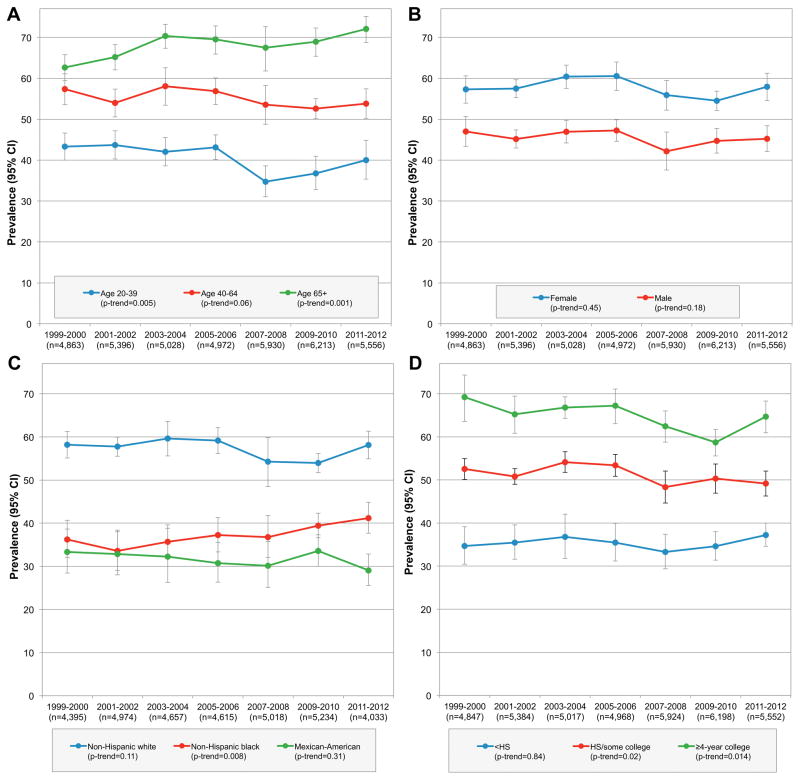
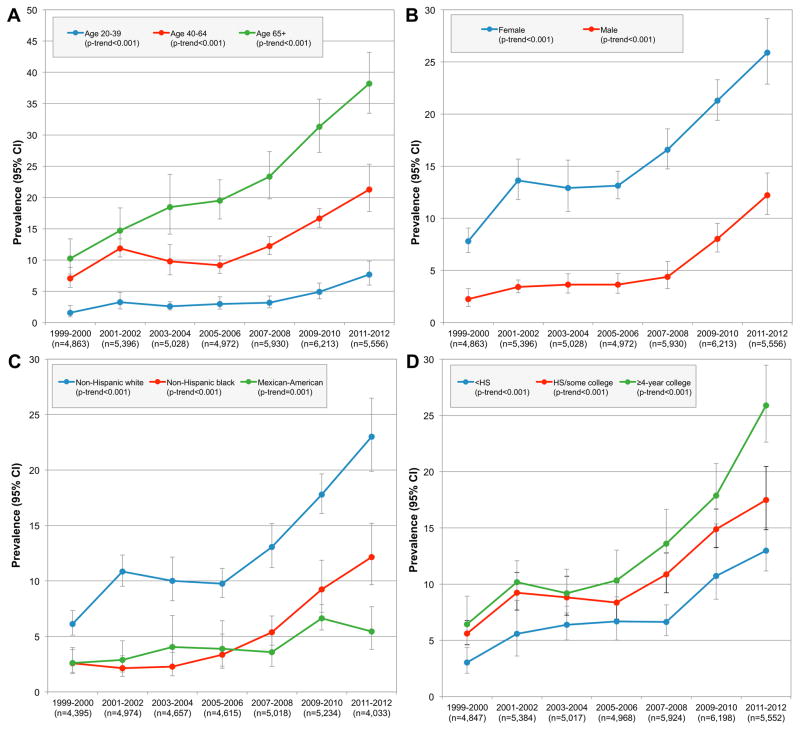
Results: A total of 37 958 adults were included in the study (weighted mean age, 46.4 years; women, 52.0% ), with an overall response rate of 74%. Overall, the use of supplements remained stable between 1999 and 2012, with 52% of US adults reporting use of any supplements in 2011-2012 (P for trend = .19). This trend varied by population subgroup. Use of MVMM decreased, with 37% reporting use of MVMM in 1999-2000 and 31% reporting use in 2011-2012 (difference, -5.7% [95% CI, -8.6% to -2.7%], P for trend < .001). Vitamin D supplementation from sources other than MVMM increased from 5.1% to 19% (difference, 14% [95% CI, 12% to 17%], P for trend < .001) and use of fish oil supplements increased from 1.3% to 12% (difference, 11% [95% CI, 9.1% to 12%], P for trend < .001) over the study period, whereas use of a number of other supplements decreased.
Conclusions and relevance: Among adults in the United States, overall use of dietary supplements remained stable from 1999-2012, use of MVMM decreased, and trends in use of individual supplements varied and were heterogeneous by population subgroups.
Figures
Comment in
-
The Supplement Paradox: Negligible Benefits, Robust Consumption.JAMA. 2016 Oct 11;316(14):1453-1454. doi: 10.1001/jama.2016.14252. JAMA. 2016. PMID: 27727369 No abstract available.
References
-
- Briefel RR, Johnson CL. Secular trends in dietary intake in the United States. Annu Rev Nutr. 2004;24:401–431. - PubMed
-
- Bailey RL, Gahche JJ, Miller PE, Thomas PR, Dwyer JT. Why US adults use dietary supplements. JAMA Intern Med. 2013;173(5):355–361. - PubMed
-
- Giovannucci E, Rimm EB, Liu Y, Stampfer MJ, Willett WC. A prospective study of tomato products, lycopene, and prostate cancer risk. J Natl Cancer Inst. 2002;94(5):391–398. - PubMed
-
- Hu FB, Bronner L, Willett WC, et al. Fish and omega-3 fatty acid intake and risk of coronary heart disease in women. JAMA. 2002;287(14):1815–1821. - PubMed
Publication types
MeSH terms
Substances
Grants and funding
LinkOut - more resources
Full Text Sources
Other Literature Sources
Medical
