Review
. 2016 Oct;204(2):423-434.
doi: 10.1534/genetics.116.194860.

The Evolutionary Origin and Genetic Makeup of Domestic Horses

Affiliations
Review

The Evolutionary Origin and Genetic Makeup of Domestic Horses

Pablo Librado et al. Genetics. 2016 Oct.

Abstract

The horse was domesticated only 5.5 KYA, thousands of years after dogs, cattle, pigs, sheep, and goats. The horse nonetheless represents the domestic animal that most impacted human history; providing us with rapid transportation, which has considerably changed the speed and magnitude of the circulation of goods and people, as well as their cultures and diseases. By revolutionizing warfare and agriculture, horses also deeply influenced the politico-economic trajectory of human societies. Reciprocally, human activities have circled back on the recent evolution of the horse, by creating hundreds of domestic breeds through selective programs, while leading all wild populations to near extinction. Despite being tightly associated with humans, several aspects in the evolution of the domestic horse remain controversial. Here, we review recent advances in comparative genomics and paleogenomics that helped advance our understanding of the genetic foundation of domestic horses.


Figures

Figure 1
Figure 1
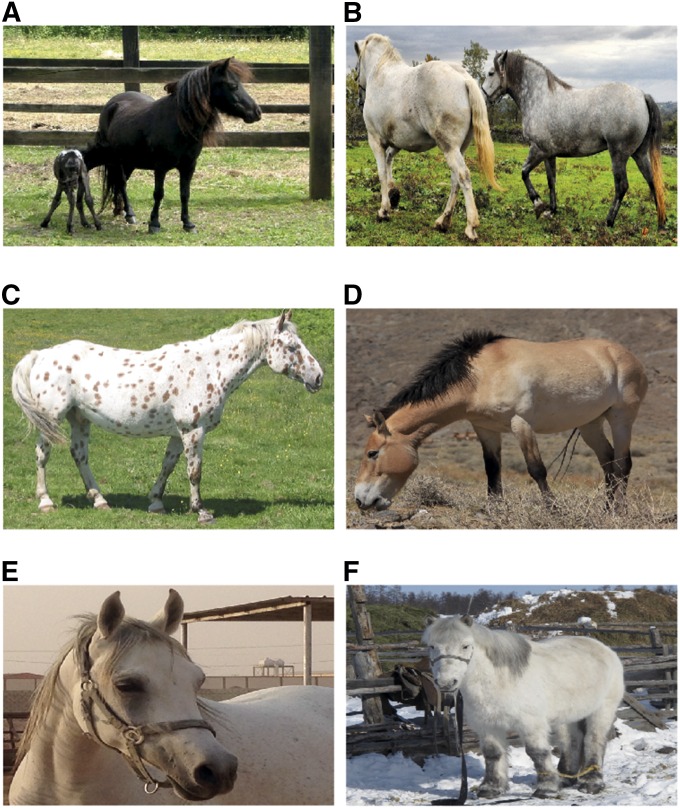
Diversity of breed phenotypes (size, shapes, and coat colors). (A) Falabella (image: E. H. Eckholdt, Wikimedia Commons). (B) Percheron horses (image: Carl Wycoff; Wikimedia Commons). (C) Appaloosa with LP coat (image: Jean-Pol Grandmont and Kersti Nebelsiek; Wikimedia Commons). (D) Przewalski’s horse (image: Ludovic Orlando at Seer, one of the Mongolian reintroduction reserves). (E) The Arabian horse (image: Ludovic Orlando at Riyad, Saudi Arabia). (F) Yakutian horse [image: Morgane Gibert, Centre National de la Recherche Scientifique (CNRS) UMR Anthropobiologie Moléculaire et Imagerie de Synthèse, France. Copyright Morgane Gibert-CNRS-Mountain Areas Farmer Support Organization].
Figure 2
Figure 2
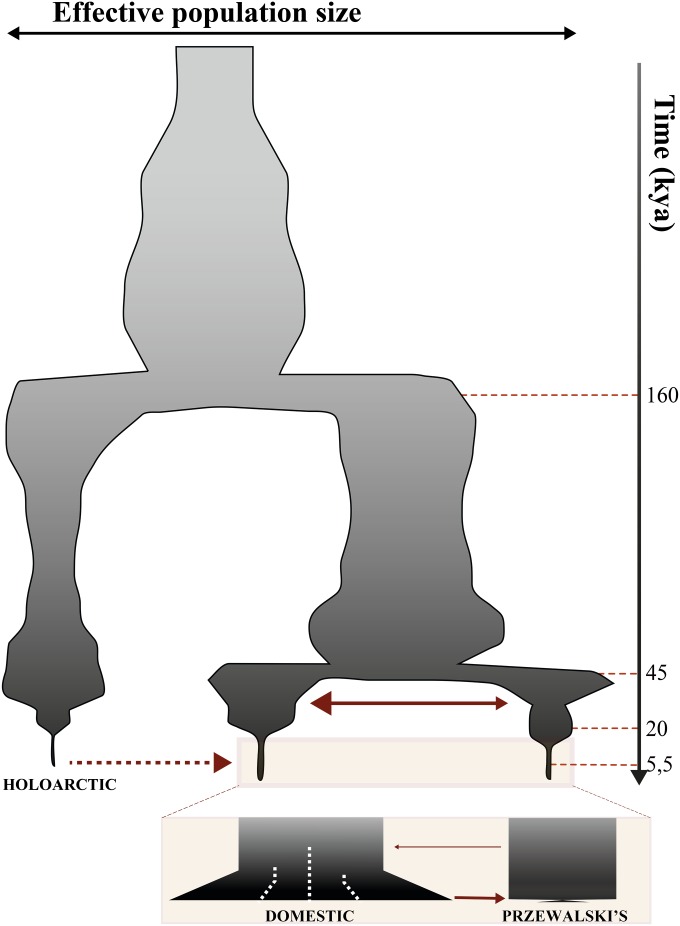
Demographic model summarizing the recent evolution of the horse. Red arrows depict secondary contact events, with their size representing the magnitude of gene flow. The area of the shaded surface is proportional to the effective population size over time, as inferred with the pairwise sequentially Markov coalescent program (Li and Durbin 2011). The dashed arrow from the Holoartic to the domestic population indicates that the date for the gene-flow event represented is currently unknown. The last 18K years are zoomed in to illustrate recent evolutionary processes, such as the bottleneck experienced by the Przewalski’s horses, and the population structure and/or expansion observed since the horse domestication (∼5.5 KYA).
Figure 3
Figure 3
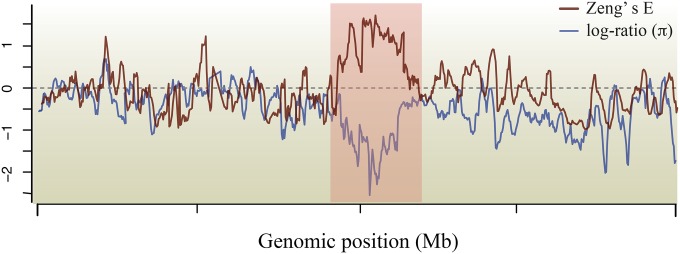
Genome-wide scan of positive selection. The shaded area showcases a genomic region that has potentially undergone a recent episode of positive selection, as the Zeng’s E statistic (Zeng et al. 2006) shows an excess of high-frequency derived variants, and the levels of nucleotide diversity (π) are lower in present-day than in a hypothetical wild ancestor (i.e., the log ratio of their respective π values is below zero and low over a genomic block of significant size).

References

    1. Achilli A., Olivieri A., Soares P., Lancioni H., Hooshiar Kashani B., et al. , 2012. Mitochondrial genomes from modern horses reveal the major haplogroups that underwent domestication. Proc. Natl. Acad. Sci. USA 109: 2449–2454. - PMC - PubMed
    1. Adler C. J., Dobney K., Weyrich L. S., Kaidonis J., Walker A. W., et al. , 2013. Sequencing ancient calcified dental plaque shows changes in oral microbiota with dietary shifts of the Neolithic and Industrial revolutions. Nat. Genet. 45: 450–455. - PMC - PubMed
    1. Alroy J., 2001. A Multispecies Overkill Simulation of the End-Pleistocene Megafaunal Mass Extinction. Science 292: 1893–1896. - PubMed
    1. Andersson L. S., Larhammar M., Memic F., Wootz H., Schwochow D., et al. , 2012. Mutations in DMRT3 affect locomotion in horses and spinal circuit function in mice. Nature 488: 642–646. - PMC - PubMed
    1. Andersson L., Archibald A. L., Bottema C. D., Brauning R., Burgess S. C., et al. , 2015. Coordinated international action to accelerate genome-to-phenome with FAANG, the Functional Annotation of Animal Genomes project. Genome Biol. 16: 57. - PMC - PubMed