Review
. 2016:1478:1-31.
doi: 10.1007/978-1-4939-6371-3_1.

Using FlyBase, a Database of Drosophila Genes and Genomes

Affiliations
Review

Using FlyBase, a Database of Drosophila Genes and Genomes

Steven J Marygold et al. Methods Mol Biol. 2016.

Abstract

For nearly 25 years, FlyBase (flybase.org) has provided a freely available online database of biological information about Drosophila species, focusing on the model organism D. melanogaster. The need for a centralized, integrated view of Drosophila research has never been greater as advances in genomic, proteomic, and high-throughput technologies add to the quantity and diversity of available data and resources.FlyBase has taken several approaches to respond to these changes in the research landscape. Novel report pages have been generated for new reagent types and physical interaction data; Drosophila models of human disease are now represented and showcased in dedicated Human Disease Model Reports; other integrated reports have been established that bring together related genes, datasets, or reagents; Gene Reports have been revised to improve access to new data types and to highlight functional data; links to external sites have been organized and expanded; and new tools have been developed to display and interrogate all these data, including improved batch processing and bulk file availability. In addition, several new community initiatives have served to enhance interactions between researchers and FlyBase, resulting in direct user contributions and improved feedback.This chapter provides an overview of the data content, organization, and available tools within FlyBase, focusing on recent improvements. We hope it serves as a guide for our diverse user base, enabling efficient and effective exploration of the database and thereby accelerating research discoveries.

Keywords: Database; Drosophila; FlyBase; Genetics; Genomics; Translational research.


Figures

Figure 1
Figure 1
The FlyBase homepage.
Figure 2
Figure 2
The Gene Report, using zipper as an example. The ‘Alleles and Phenotypes’ and ‘Stocks and Reagents’ sections have been opened to show the first tier of subsections.
Figure 3
Figure 3
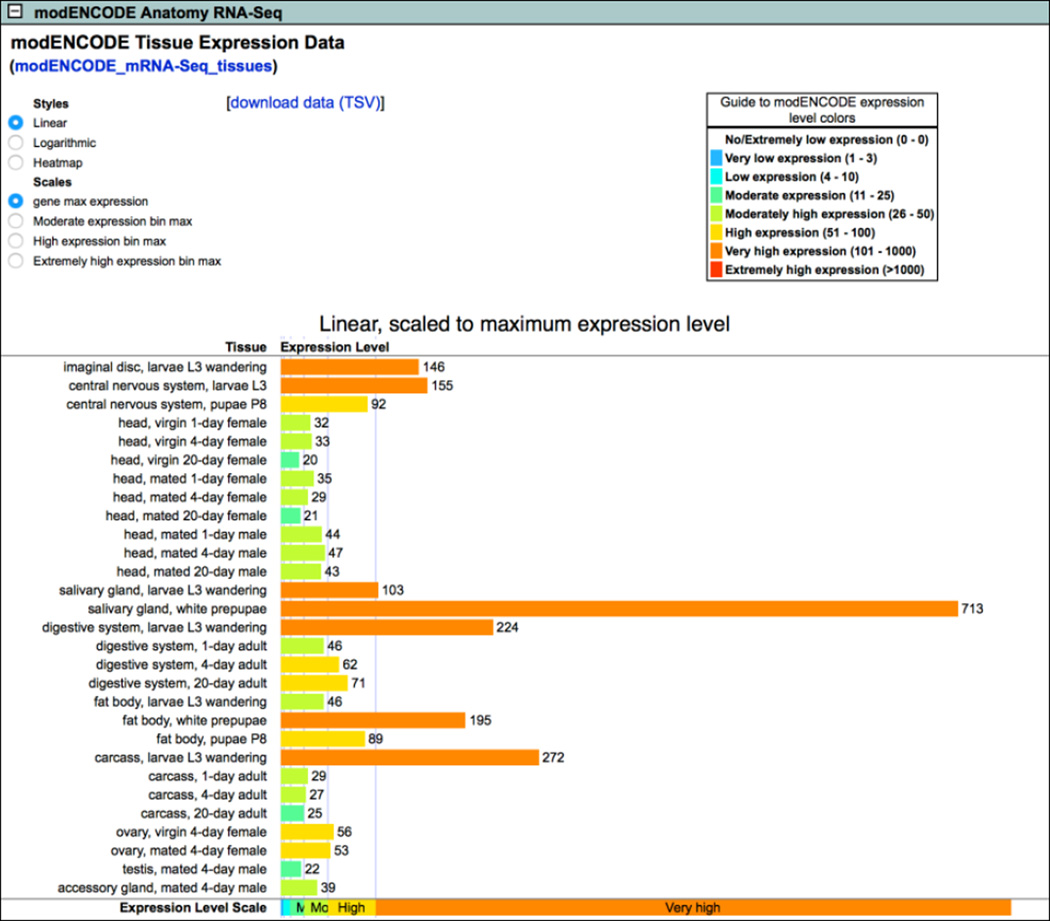
High-throughput expression data. Bar graph of modENCODE RNA-seq tissue expression data for the zipper gene, as shown within the ‘Expression Data’ section of the Gene Report. In this example, the view is configured to be linear and scaled to the gene’s maximum expression level.
Figure 4
Figure 4
GBrowse. This view of sequence features and genomic data in the region of the stmA gene has been customized by: (1) using the ‘Select Tracks’ option at the upper left to turn several default tracks off and new data tracks on; (2) using track-specific options accessed from the wrench/spanner icon in the title bar to select a subset of the RNA-Seq dataset shown; and (3) dragging tracks to preferred positions vertically. (A) Clicking on most objects in GBrowse links to the full FlyBase report for that feature, as shown here for a transcription factor binding site (TFBS) sequence feature. (B) By zooming in, the details of a defined Transcription Start Site (TSS) can be seen, including a bar graph of TSS distribution within the defined region and the total number of reads. (C) Mousing over an individual RNA-Seq junction produces a pop-up that provides read counts; relative read counts of the two selected junctions indicate that the small alternative exon is not present in the majority of stmA transcripts. (D) Mousing over a Transgenic Insertion Site produces a pop-up with additional information, including whether there is a publicly available stock. For other genomic reagents, such as the Point Mutations and RNAi amplicons shown, availability of stocks can be determined by clicking through to the full reports.
Figure 5
Figure 5
FeatureMapper. (i) Query interface. In this example, a single sequence range has been entered and several mapped features have been selected (corresponding to the GBrowse view shown in Fig. 4). The default output is to group features by type in HTML format. (ii) Mapping results. The sequence coordinates, strand and symbol of each sequence feature are presented in a table. Links to hit lists are shown for each group to enable further analyses or downloads. (Note that only a subset of hits of each type is shown in this example.)
Figure 6
Figure 6
Batch upload and download. (i) The Upload/Convert IDs tool is used to type/paste in a mixture of gene identifiers. (ii) The resulting validation report shows that 6 of the 7 entries were validated/updated. Note that in two cases a secondary FBgn ID was entered and updated successfully. The ‘FlyBase HitList’ button (orange box) is then clicked to export the IDs. (iii) The resulting hit list shows the 6 validated genes in a table with columns appropriate to the gene data class. At this stage, two of the genes have been de-selected (first column, red box). The ‘HitList Conversion Tools’ button (orange box) is then clicked and ‘Export to Batch Download’ is selected (not shown). (iv) The Batch Download interface shows the search box pre-populated with the 4 final gene IDs. In this example, transcript sequences in FASTA format have been selected for download with the results being sent to a ‘File’.

References

    1. Drysdale R FlyBase Consortium. FlyBase : a database for the Drosophila research community. Methods Mol Biol. 2008;420:45–59. - PubMed
    1. McQuilton P, St Pierre SE, Thurmond J, et al. FlyBase 101--the basics of navigating FlyBase. Nucleic Acids Res. 2012;40:D706–D714. - PMC - PubMed
    1. Marygold SJ, Leyland PC, Seal RL, et al. FlyBase: improvements to the bibliography. Nucleic Acids Res. 2013;41:D751–D757. - PMC - PubMed
    1. Wilson RJ, Goodman JL, Strelets VB, et al. FlyBase: integration and improvements to query tools. Nucleic Acids Res. 2008;36:D588–D593. - PMC - PubMed
    1. Tweedie S, Ashburner M, Falls K, et al. FlyBase: enhancing Drosophila Gene Ontology annotations. Nucleic Acids Res. 2009;37:D555–D559. - PMC - PubMed

LinkOut - more resources