Review
. 2017 Jan 14:68:459-472.
doi: 10.1146/annurev-med-072115-033220. Epub 2016 Oct 10.

Noninvasive Prenatal DNA Testing: The Vanguard of Genomic Medicine

Affiliations
Review

Noninvasive Prenatal DNA Testing: The Vanguard of Genomic Medicine

Lisa Hui et al. Annu Rev Med. .

Abstract

Noninvasive prenatal DNA testing is the vanguard of genomic medicine. In only four years, this screening test has revolutionized prenatal care globally and opened up new prospects for personalized medicine for the fetus. There are widespread implications for increasing the scope of human genetic variation that can be detected before birth, and for discovering more about maternofetal and placental biology. These include an urgent need to develop pretest education for all pregnant women and consistent post-test management recommendations for those with discordant test results. The reduction in invasive testing has had downstream effects on specialist training and caused many countries to re-examine their national approaches to prenatal screening. Finally, the accumulating datasets of genomic information on pregnant women and their fetuses raise ethical issues regarding consent for future data mining and intellectual property.

Keywords: cell-free DNA analysis; copy-number variants (CNVs); noninvasive prenatal screening; pregnancy; sex chromosome aneuploidy.


Figures
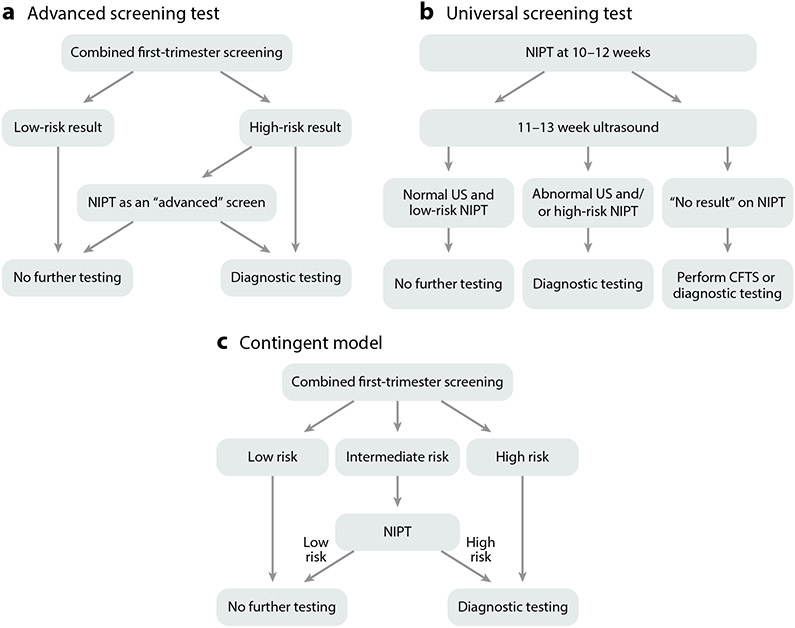
Figure 1
Figure 1
Models of incorporating noninvasive prenatal testing with existing screening methods. (a) “Advanced” or “secondary” screening. Noninvasive prenatal testing (NIPT) is offered to women at “high risk” based on prior conventional screening tests. This method reduces invasive testing rates and has a variable effect on the overall detection rate of trisomy 21. The UK National Screening Committee has recommended evaluating the introduction of this model within the National Health Service (http://legacy.screening.nhs.uk/fetalanomalies). (b) “Universal primary screening” provides NIPT and a 12-week ultrasound (US) examination to all pregnant women. This provides the maximum detection rate of fetal aneuploidy and provides early detection of structural abnormalities but is the most expensive model (23). Abbreviation: CFTS, combined first-trimester screening. (c) The “contingent model”of screening offers NIPT only to women with a locally defined “intermediate risk” of aneuploidy after combined first-trimester screening (e.g., risk between 1:100 and 1:1,000). This model is less costly than the universal model and improves aneuploidy detection over the “advanced screening test” model because a larger group of women is offered NIPT (24).
Figure 2
Figure 2
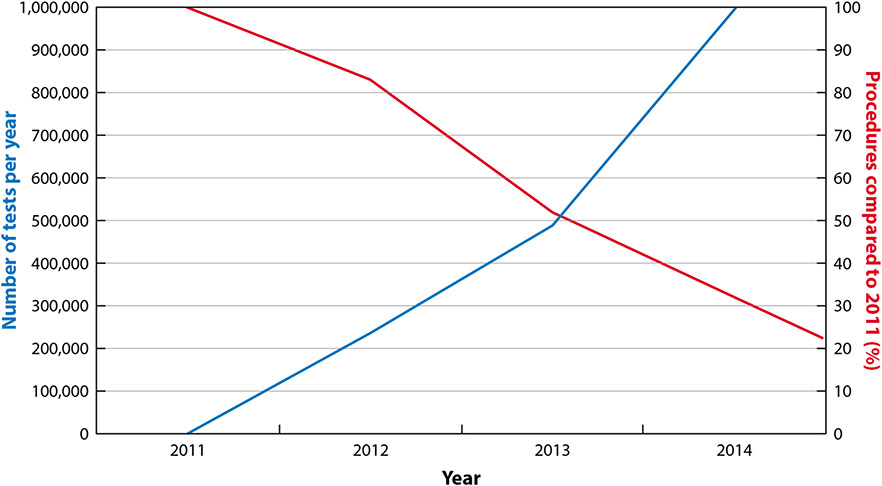
Decline in invasive prenatal diagnosis in association with increased uptake of noninvasive prenatal testing (NIPT). Numbers of NIPTs obtained from publications and/or public presentations as reported by Genome Web from BGI, Berry Genomics, Verinata, Sequenom, and Natera. After 2014, testing was licensed to additional laboratories all over the world. This makes it impossible to calculate the current volume of tests being performed. The decline in the number of procedures was estimated from References -. Figure created by Lillian Zwemer, PhD.

References

    1. Wang L, Wheeler DA. 2014. Genomic sequencing for cancer diagnosis and therapy. Annu. Rev. Med 65:33–48 - PubMed
    1. Weeke P, Roden DM. 2014. Applied pharmacogenomics in cardiovascular medicine. Annu. Rev. Med 65:81–94 - PMC - PubMed
    1. Bianchi DW. 2012. From prenatal genomic diagnosis to fetal personalized medicine: progress and challenges. Nat. Med 18:1041–51 - PMC - PubMed
    1. Wong FC, Lo YM. 2016. Prenatal diagnosis innovation: genome sequencing of maternal plasma. Annu. Rev. Med 67:419–32 - PubMed
    1. ACOG Comm. Pract. Bull. 2007. ACOG Practice Bulletin No. 77: screening for fetal chromosomal abnormalities. Obstet. Gynecol 109:217–27 - PubMed

Substances

LinkOut - more resources