


Understanding Plant Nitrogen Metabolism through Metabolomics and Computational Approaches
- PMID: 27735856
- PMCID: PMC5198099
- DOI: 10.3390/plants5040039
Understanding Plant Nitrogen Metabolism through Metabolomics and Computational Approaches
Abstract
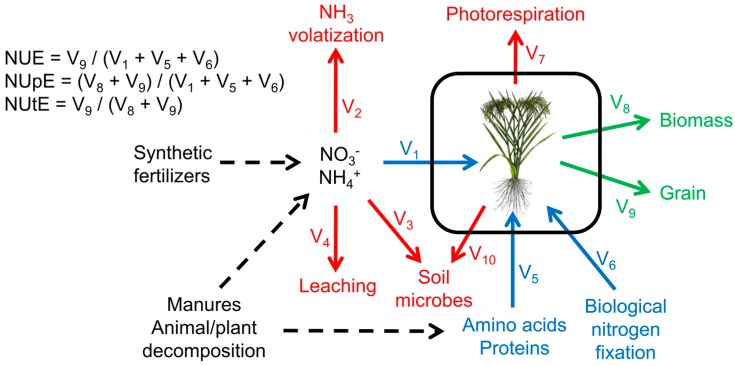
A comprehensive understanding of plant metabolism could provide a direct mechanism for improving nitrogen use efficiency (NUE) in crops. One of the major barriers to achieving this outcome is our poor understanding of the complex metabolic networks, physiological factors, and signaling mechanisms that affect NUE in agricultural settings. However, an exciting collection of computational and experimental approaches has begun to elucidate whole-plant nitrogen usage and provides an avenue for connecting nitrogen-related phenotypes to genes. Herein, we describe how metabolomics, computational models of metabolism, and flux balance analysis have been harnessed to advance our understanding of plant nitrogen metabolism. We introduce a model describing the complex flow of nitrogen through crops in a real-world agricultural setting and describe how experimental metabolomics data, such as isotope labeling rates and analyses of nutrient uptake, can be used to refine these models. In summary, the metabolomics/computational approach offers an exciting mechanism for understanding NUE that may ultimately lead to more effective crop management and engineered plants with higher yields.
Keywords: N boundary; flux balance analysis (FBA); mass spectrometry (MS); metabolomics; nitrogen; nitrogen uptake efficiency (NUpE); nitrogen use efficiency (NUE); nitrogen utilization efficiency (NUtE); nuclear magnetic resonance (NMR); transgenic crops.
Conflict of interest statement
The authors declare no conflict of interest. The founding sponsors had no role in the design of the study; in the collection, analyses, or interpretation of data; in the writing of the manuscript, and in the decision to publish the results.
Figures
References
-
- Hawkesford M.J., Barraclough P. An overview of nutrient use efficiency and strategies for crop improvement. In: Hawkesford M.J., Barraclough P., editors. The Molecular and Physiological Basis of Nutrient Use Efficiency in Crops. 1st ed. John Wiley & Sons, Inc.; New Jersey, NJ, USA: 2011.
Publication types
LinkOut - more resources
Full Text Sources
Other Literature Sources
