. 2016 Nov 21;82(24):7142-7153.
doi: 10.1128/AEM.02221-16. Print 2016 Dec 15.

Genetic Diversity and Origins of the Homoploid-Type Hybrid Phytophthora ×alni

Affiliations

Genetic Diversity and Origins of the Homoploid-Type Hybrid Phytophthora ×alni

Jaime Aguayo et al. Appl Environ Microbiol. .

Abstract

Assessing the process that gives rise to hybrid pathogens is central to understanding the evolution of emerging plant diseases. Phytophthora ×alni, a pathogen of alder, results from the homoploid hybridization of two related species, Phytophthora uniformis and Phytophthora ×multiformis Describing the genetic characteristics of P ×alni should help us understand how reproductive mechanisms and historical processes shaped the population structure of this emerging hybrid pathogen. The population genetic structure of P ×alni and the relationship with its parental species were investigated using 12 microsatellites and one mitochondrial DNA (mtDNA) marker on a European collection of 379 isolates. Populations of P ×alni were dominated by one multilocus genotype (MLG). The frequency of this dominant MLG increased after the disease emergence together with a decline in diversity, suggesting that it was favored by a genetic mechanism such as drift or selection. Combined microsatellite and mtDNA results confirmed that P ×alni originated from multiple hybridization events that involved different genotypes of the progenitors. Our detailed analyses point to a geographic structure that mirrors that observed for P. uniformis in Europe. The study provides more insights on the contribution of P. uniformis, an invasive species in Europe, to the emergence of Phytophthora-induced alder decline.

Importance: Our study describes an original approach to assess the population genetics of polyploid organisms using microsatellite markers. By studying the parental subgenomes present in the interspecific hybrid P. ×alni, we were able to assess the geographical and temporal structure of European populations of the hybrid, shedding new light on the evolution of an emerging plant pathogen. In turn, the study of the parental subgenomes permitted us to assess some genetic characteristics of the parental species of P. ×alni, P. uniformis, and P ×multiformis, which are seldom sampled in nature. The subgenomes found in P. ×alni represent a picture of the "fossilized" diversity of the parental species.


Figures

FIG 1
FIG 1
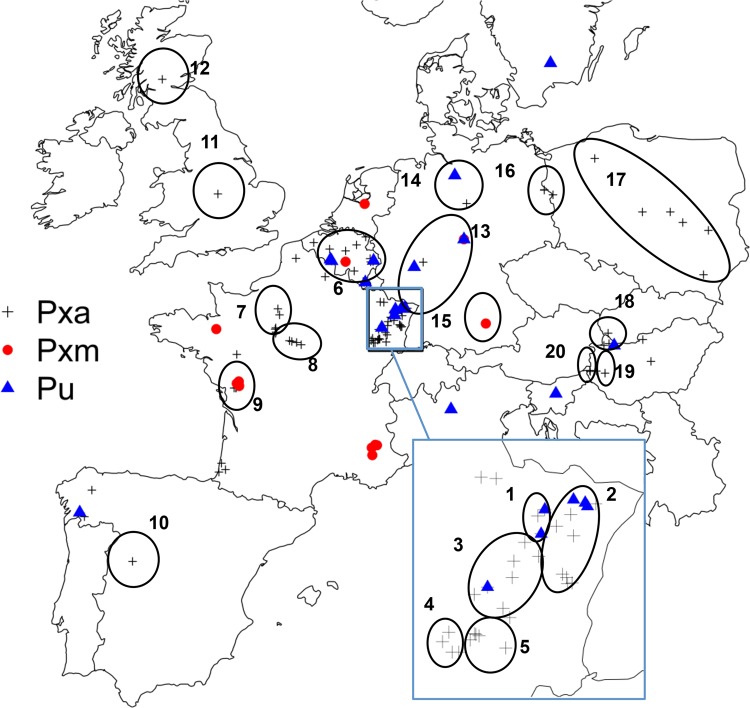
Geographical origins of P. ×alni (Pxa), P. ×multiformis (Pxm), and P. uniformis (Pu) isolates used in this study. 1, Sarre/Nied (France); 2, Rhine (France); 3, Meurthe/Moselle (France); 4, Saône (France); 5, Ognon (France); 6, Meuse (France and Belgium); 7, Loir (France); 8, Loire (France); 9, Sèvre Niortaise (France); 10, Salamanca (Spain); 11, England (United Kingdom); 12, Scotland (United Kingdom); 13, Rhineland (Germany); 14, Braunschweig (Germany); 15, Freising (Germany); 16, Oder (Germany); 17, Poland; 18, Répce (Hungary); 19, Balaton (Hungary); 20, Zala (Hungary).
FIG 2
FIG 2
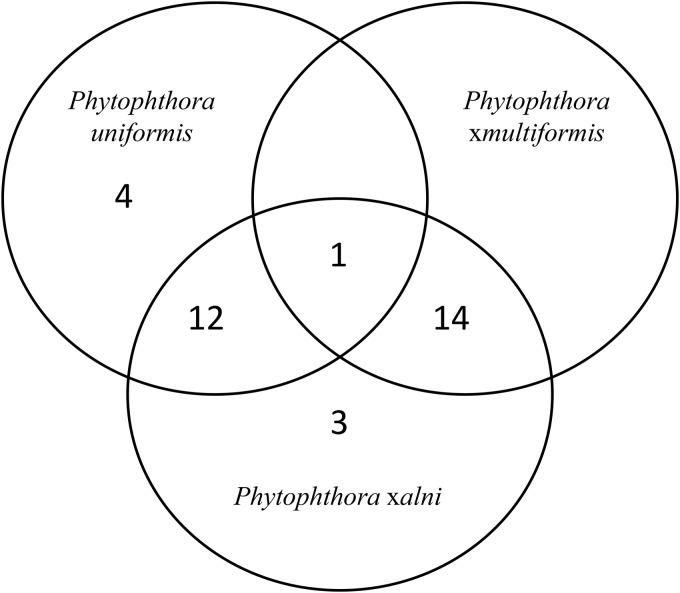
Venn diagram representing the allelic distribution within P. ×alni, P. ×multiformis, and P. uniformis. Numbers in the circles represent the number of alleles found in one specific species or in more than one of the species simultaneously.
FIG 3
FIG 3
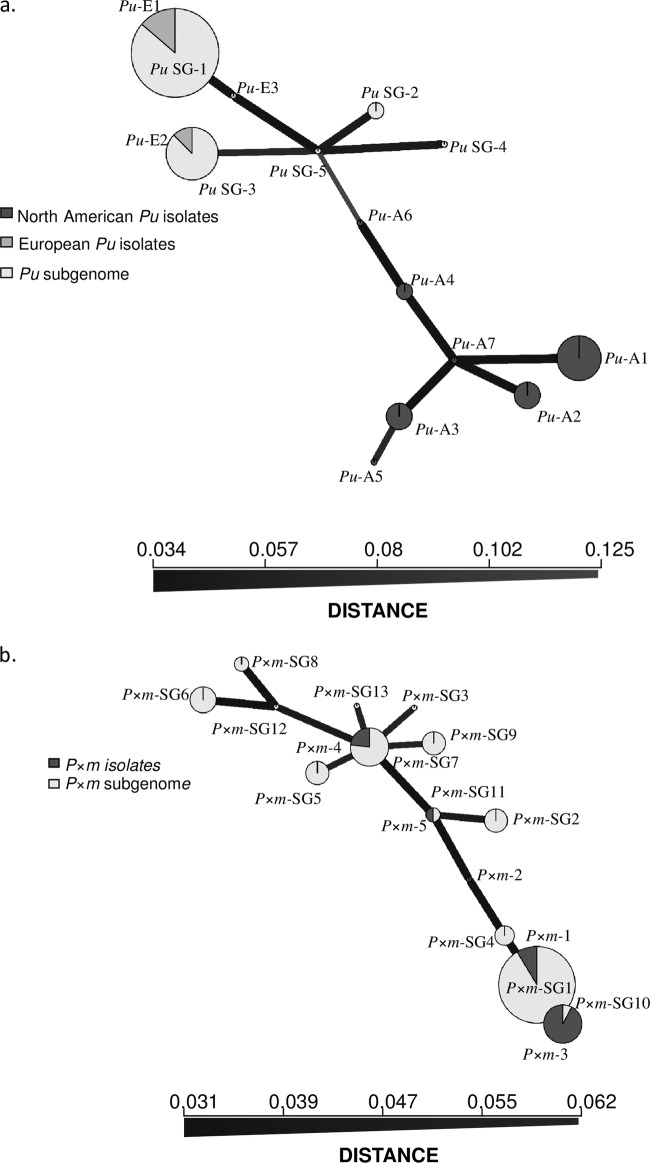
Minimum spanning network (MSN) performed on Bruvo's distances. (a) Phytophthora uniformis isolates (Pu) and P. uniformis subgenome (PuSG) found in P. ×alni isolates. (b) Phytophthora ×multiformis isolates (P×m) and P. ×multiformis subgenome (P×mSG) found in P. × alni isolates.
FIG 4
FIG 4
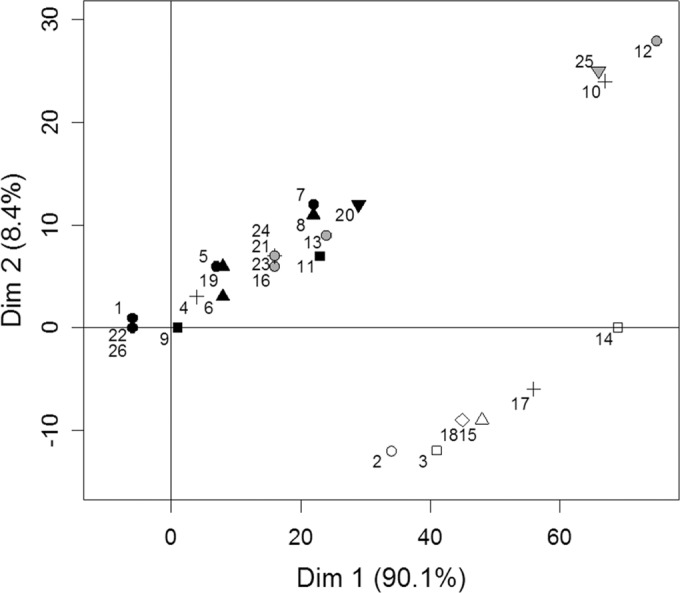
Principal component analysis (PCA) performed on Bruvo's distances on the whole collection of P. ×alni (269 isolates). Symbols indicate P. ×multiformis and P. uniformis putative parents: ○, P×m-1 or P×m-2; □, P×m-2 or P×m-4; △, P×m-1, P×m-2, or P×m-5; ▽, P×m-2; ♢, P×m-4; +, undetermined. Black filled symbols, Pu-E1 or Pu-E3; empty symbols, Pu-E2; gray filled symbols, undetermined P. uniformis putative parents. The numbers indicate the P. ×alni MLGs.
FIG 5
FIG 5
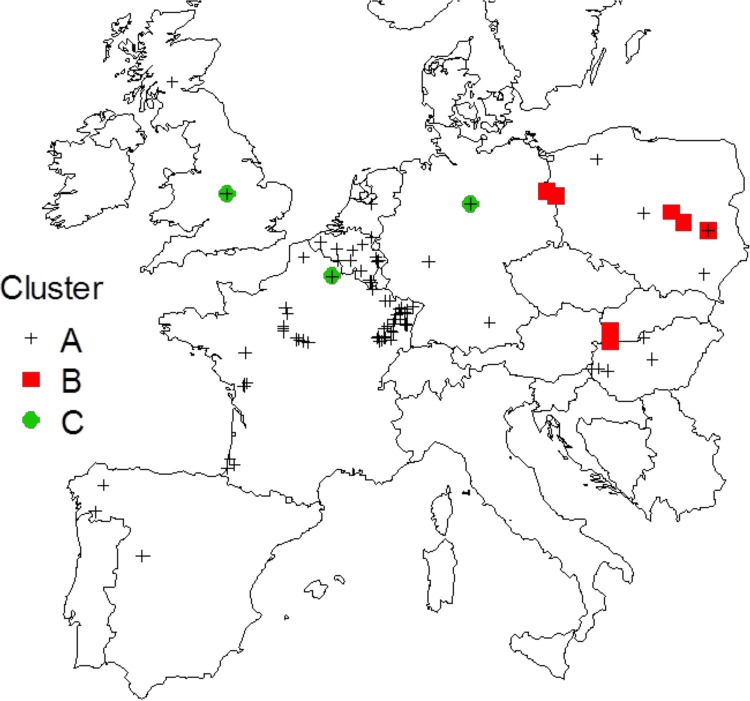
Geographical distribution of P. ×alni clusters determined by principal component analysis (PCA). Isolates from clusters B and C are distributed mostly in the north and the east of Europe, in contrast to isolates from cluster A.
FIG 6
FIG 6
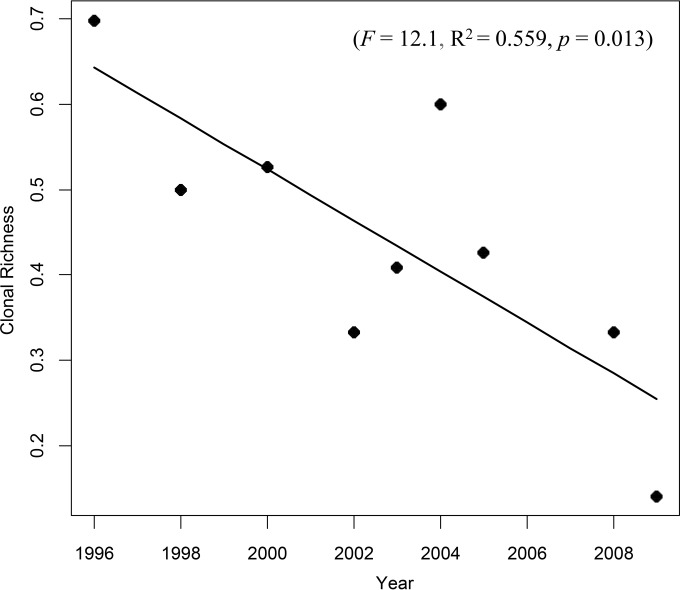
Temporal changes of clonality in P. ×alni. Linear regression shows that clonal richness decreased with time.

References

    1. Giraud T, Refrégier G, Le Gac M, de Vienne DM, Hood ME. 2008. Speciation in fungi. Fungal Genet Biol 45:791–802. doi: 10.1016/j.fgb.2008.02.001. - DOI - PubMed
    1. Schardl CL, Craven KD. 2003. Interspecific hybridization in plant-associated fungi and oomycetes: a review. Mol Ecol 12:2861–2873. doi: 10.1046/j.1365-294X.2003.01965.x. - DOI - PubMed
    1. Stukenbrock EH. 2016. The role of hybridization in the evolution and emergence of new fungal plant pathogens. Phytopathology 106:104–112. doi: 10.1094/PHYTO-08-15-0184-RVW. - DOI - PubMed
    1. Desprez-Loustau M-L, Robin C, Buée M, Courtecuisse R, Garbaye J, Suffert F, Sache I, Rizzo DM. 2007. The fungal dimension of biological invasions. Trends Ecol Evol 22:472–480. doi: 10.1016/j.tree.2007.04.005. - DOI - PubMed
    1. Stukenbrock EH, McDonald BA. 2008. The origins of plant pathogens in agro-ecosystems. Annu Rev Phytopathol 46:75–100. doi: 10.1146/annurev.phyto.010708.154114. - DOI - PubMed

Publication types

Substances

LinkOut - more resources