


Patterns of allergen sensitization and self-reported allergic disease in parents of food allergic children
- PMID: 27742085
- PMCID: PMC5087328
- DOI: 10.1016/j.anai.2016.07.042
Patterns of allergen sensitization and self-reported allergic disease in parents of food allergic children
Abstract
Background: Sensitization in adults has not been extensively studied.
Objective: To investigate patterns of allergen sensitization in parents of food allergic children and to compare self-report of allergic disease with specific IgE (sIgE) measurements.
Methods: A total of 1,252 mothers and 1,225 fathers of food allergic children answered standardized questionnaires about demographics, home environment, history of atopic diseases, and food allergy. Skin prick testing and sIgE serum tests were performed to 9 foods and 5 aeroallergens.
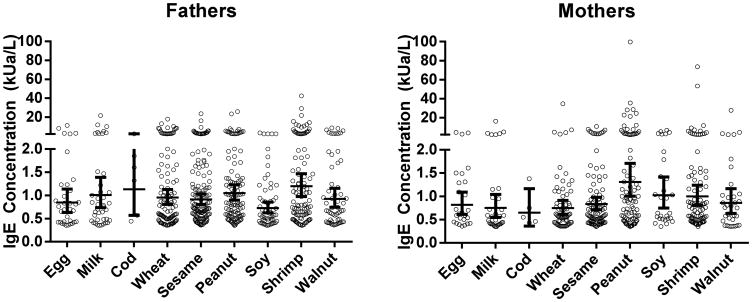
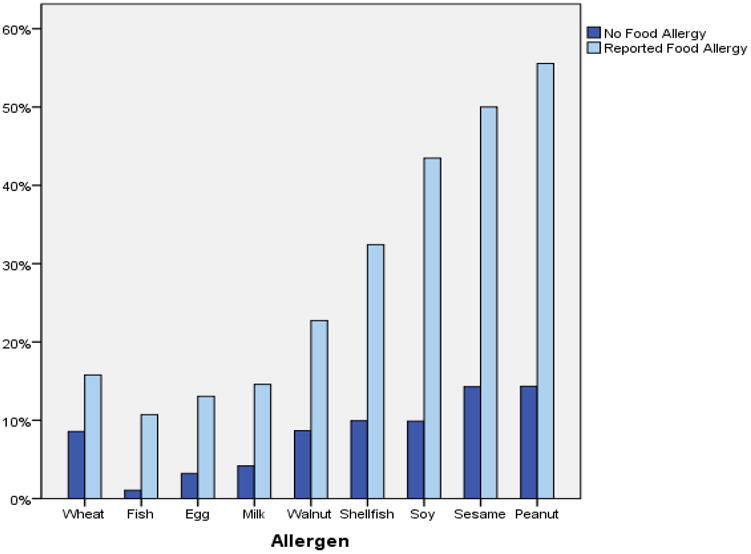
Results: A total of 66.1% of parents were sensitized to either a food or aeroallergen. Mean sIgE levels were low for all foods tested. A total of 14.5% of mothers and 12.7% of fathers reported current food allergy. Only 28.4% had sensitization to their reported allergen. Fathers had significantly higher rates of sensitization to both foods and aeroallergens (P < .01) than mothers. Logistic regression evaluating predictors of self-reported food allergy revealed statistically significant positive associations in fathers with self-reported asthma, environmental allergy, and eczema. For mothers, significant positive associations were found with environmental allergy and having more than 1 food allergic child.
Conclusion: This cohort of parents of food allergic children found higher rates of sensitization to foods and aeroallergens compared with the general population. However, food sIgE levels were low and correlated poorly with self-reported food allergy. Sex differences in sensitization to foods and aeroallergens were seen.
Copyright © 2016 American College of Allergy, Asthma & Immunology. Published by Elsevier Inc. All rights reserved.
Conflict of interest statement
None
Figures
References
-
- Sicherer SH, Munoz-Furlong A, Godbold JH, Sampson HA. US prevalence of self-reported peanut, tree nut, and sesame allergy: 11-year follow-up. The Journal of allergy and clinical immunology. 2010;125:1322–6. - PubMed
-
- Prescott S, Allen KJ. Food allergy: riding the second wave of the allergy epidemic. Pediatric allergy and immunology : official publication of the European Society of Pediatric Allergy and Immunology. 2011;22:155–60. - PubMed
-
- Sicherer SH, Furlong TJ, Maes HH, Desnick RJ, Sampson HA, Gelb BD. Genetics of peanut allergy: a twin study. The Journal of allergy and clinical immunology. 2000;106:53–6. - PubMed
Publication types
MeSH terms
Substances
Grants and funding
LinkOut - more resources
Full Text Sources
Other Literature Sources
Medical
